Aztec Sun Stone: Mexico's Carved Disk of the Five Suns
An Aztec Sun Stone is a massive carved basalt disk from late Mexica Tenochtitlan, better known by its Spanish name, the Piedra del Sol. Tourists and textbooks often call it the Calendar Stone, but scholars treat it as a sculpted solar monument, not a device you could read day to day. The real stone weighs about 25 tons and now stands in the National Museum of Anthropology in Mexico City.
Piedra del Sol, basalt, and a disk that is not a calendar
The Mexica called their capital's great disk by names tied to the sun, but the label that stuck in Spanish is Piedra del Sol, Sun Stone. English guides add Calendar Stone because a ring of twenty day signs circles the face. Those glyphs belong to the 260-day ritual count called the tonalpohualli, yet the carving is not a working calendar in the sense of a hanging almanac or a book of dates. World History Encyclopedia describes it instead as an elaborately carved solar disk that, for Mesoamerican rulers, could stand for legitimate kingship.
The sculptor worked a single block of basalt, the dark volcanic stone common in the Basin of Mexico. The finished disk measures about 3.6 metres across and 98 centimetres thick, roughly twelve feet wide and heavy enough that moving it required pulleys and timber framing when it was dug up in 1790.
From Temple Mayor courtyard to buried monument
The stone belongs to the Late Postclassic Mexica world, the Aztec Empire centred on Tenochtitlan. Most specialists now date the carving to the early 16th century, during the reign of Moctezuma II, from about 1502 to 1520 CE, though earlier scholarship once placed it a generation earlier, around the 1470s. Those two ranges reflect changing readings of its glyphs and workshop style, not doubt that the piece is Mexica court art.
It almost certainly stood near the Templo Mayor, the twin pyramid at the heart of Tenochtitlan where Huitzilopochtli and Tlaloc were honoured. Excavations have tied similar monuments to the temple platform, and colonial witnesses described large carvings in the main plaza. The disk was meant to lie flat, face up, like a stage or altar surface rather than an upright portrait.
Five suns, twenty days, and fifty-two years
Aztec cosmology imagined a sequence of worlds, each ruled by a sun that ended in disaster. The stone maps that story in concentric rings. At the centre is the glyph nahui ollin, "4 Movement", naming both the present fifth sun and the day on which Mexica myth expected it to fall. Around that face lie four squares marking the destroyed earlier suns: 4 Jaguar, 4 Wind, 4 Rain, and 4 Water, each placed at a cardinal point.
Outside them runs the band of twenty day signs of the tonalpohualli, the count that paired days with deities for divination. A further ring of framed squares stands for the fifty-two-year period when the ritual and civil calendars realigned, the cycle that closed with the New Fire ceremony. Twin serpents bite across the outer rim, their bodies framing the disk, while jaguar paws or heads clutch hearts at the sides, linking the heavens to sacrifice on earth.
Tonatiuh at the centre, or earth monster
The round face inside 4 Movement is usually read as Tonatiuh, the sun god who needs tribute to cross the sky. His protruding tongue is often compared to an obsidian knife, a cue that the sun feeds on blood. Britannica identifies Tonatiuh at the centre surrounded by panels for the four previous suns, matching the public name Calendar Stone.
Not every scholar agrees on the identity. Some argue for Yohualtonatiuh, a night sun, or for Tlaltecuhtli, the earth monster whose body must be fed so the world does not collapse. The debate matters because it changes whether the disk celebrates daylight rulership or warns of final destruction when the fifth sun falls.
The Piedra del Sol in Mexico City today
The monument visitors queue to see is catalogued in the Museo Nacional de Antropología as Piedra del Sol. It was uncovered on 17 December 1790 during paving work in Mexico City's central plaza, the Zócalo, about 80 metres west of the Royal Palace, and was raised with block and tackle. Colonial investigators, including Antonio de León y Gama, published drawings within months and helped fix the object's fame.
After excavation the disk spent decades mounted on the cathedral exterior, exposed to weather, before curators moved it to the National Museum on Moneda Street in 1885. It reached the present National Museum of Anthropology in 1964. There it stands upright behind glass, although it was carved to rest horizontally. Dimensions recorded by the museum and repeated in standard references give a diameter of about 358 centimetres, a thickness near 98 centimetres, and a weight commonly cited as 25 tons.
Rediscovery, relocation, and what scholars still dispute
When Spanish clergy and officials ordered Mexica sculptures buried after the conquest, the Sun Stone went face down in the plaza, perhaps to hide an image tied to the old order. That burial preserved the surface well enough that fine detail remains visible today. Even so, questions linger. The 13 Reed date at the top of the stone has been linked to 1427 CE and the accession of Itzcoatl in some interpretations, while inscriptional mentions of Moctezuma support an early 1500s workshop date in others. Sources disagree, and both readings appear in museum scholarship.
Archaeologists also caution against treating every radial band as a neat infographic. The carving compresses mythology, royal propaganda, and calendar mathematics into one face, but it probably served ceremony and spectacle more than daily date keeping. The stone's modern role as Mexico's national emblem, on coins and textbooks, is a story separate from its Aztec use.
In your scene
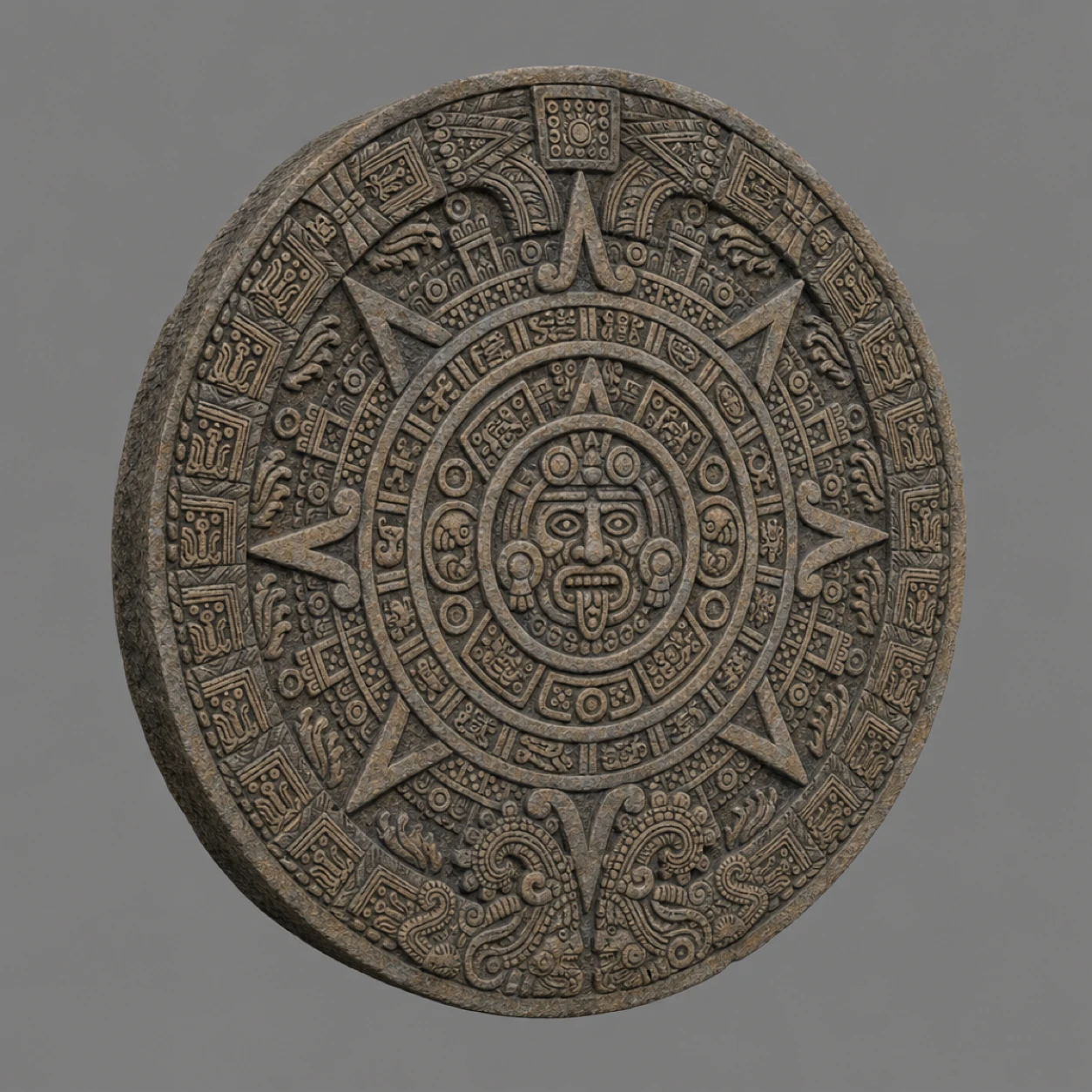
A sun stone reads instantly as Mesoamerican temple architecture when laid flat in a plaza or propped upright as a recovered monument. Scale it generously: the real disk is wider than a room. Our Aztec Temple Relics pack includes a stylised sun stone disk model sized for game courtyards.