Anubis: Jackal God at the Embalming Table
An Anubis statue represents the ancient Egyptian god of embalming, the cemetery, and the passage into the afterlife. Artists showed him as a black jackal, as a recumbent canine, or as a man with a jackal's head. His image stood in tombs, temple deposits, and embalming precincts because Egyptians believed he prepared the dead and guided souls toward judgment.
Jackal head, black coat, many names
Anubis (Egyptian Inpu, also written Anpu) is instantly recognisable: pointed ears, long muzzle, and a coat often painted black. Black did not mean death alone. It echoed the fertile Nile silt and the idea of regeneration in the tomb. Statues range from pocket-sized bronze figures to life-scale limestone jackals more than half a metre long.
Two forms dominate museum collections. The anthropomorphic type shows a standing god in a kilt with a jackal head, sometimes holding a was-sceptre or an ankh. The zoomorphic type shows Anubis purely as a dog, often crouching with alert ears as if watching a burial ground. Priests who worked on mummies sometimes wore jackal masks in his likeness during ritual.
From lord of the dead to Osiris's assistant
In the Early Dynastic period and Old Kingdom, Anubis held a leading role as lord of the dead. Britannica notes epithets such as "He Who Is upon His Mountain" (the necropolis) and "Foremost of the Westerners," the west being the direction of sunset and burial. He was credited with inventing embalming, a craft he first practised on the body of Osiris after Seth dismembered him.
From the Middle Kingdom onward, Osiris rose as king of the underworld and Anubis shifted toward conductor of souls. He still guarded tombs and oversaw mummification, but the weighing of the heart and eternal rule passed to Osiris. In Greco-Roman Egypt, travellers sometimes merged Anubis with Hermes as Hermanubis. The jackal image, however, stayed recognisably Egyptian.
At the tomb, the scales, and the embalmer's tent
Egyptians linked jackals and wild dogs with cemeteries because both scavenged near graves. That observation became theology: a watchful animal at the necropolis became a protective god. Anubis attended the "Weighing of the Heart," where the deceased's heart was measured against the feather of Maat. Tomb paintings often show him adjusting the scales beside Thoth, who recorded the result.
Embalmers invoked him at every stage. Temporary reed pavilions called ibou were erected for royal funeral rites, including the burial of the Apis bull and the Mother of Apis cow. Because Anubis presided over mummification, jackal statues were placed near precincts where bodies were treated. The connection between tent, jackal, and ritual preparation is explicit in excavation reports from North Saqqara.
A recumbent jackal from North Saqqara
The Metropolitan Museum holds a limestone statue of Anubis as a recumbent canid (object 69.105), found in 1966–67 at the Sacred Animal Necropolis at North Saqqara. It measures about 64 cm long, 38 cm tall, and weighs roughly 20 kg. The stone was originally painted black. The piece lay in fill associated with the Northern Enclosure, probably built after 343 BCE, so its exact dedication date is uncertain.
The museum's curators connect the find to a remarkable reed structure nearby: panels of bundled reeds lashed with fibre, apparently part of a temporary four-sided pavilion used during festival or funerary ceremony. Jackal sculptures and embalming tents belonged to the same ritual world. The statue's alert crouch matches how wild canids still stretch out to guard territory in the Egyptian desert today.
Stone, bronze, wood, and what survives
Anubis is among the most commonly represented deities in Egyptian art. Small bronze jackals served as temple offerings. Painted wooden statuettes from the Ptolemaic period show elaborate feather-pattern tunics. Limestone and wood examples come from tomb chapels, animal necropolises, and domestic shrines.
Not every canid-headed figure is Anubis. Duamutef, one of the Four Sons of Horus, has a jackal head on canopic jars and must not be confused with the god himself. Context tells them apart: a lone jackal in a tomb shrine is Anubis; a jackal lid on a jar beside three other animal heads is Duamutef guarding the stomach. Dating also helps, since canopic jars with Sons of Horus lids become standard in the New Kingdom.
In your scene
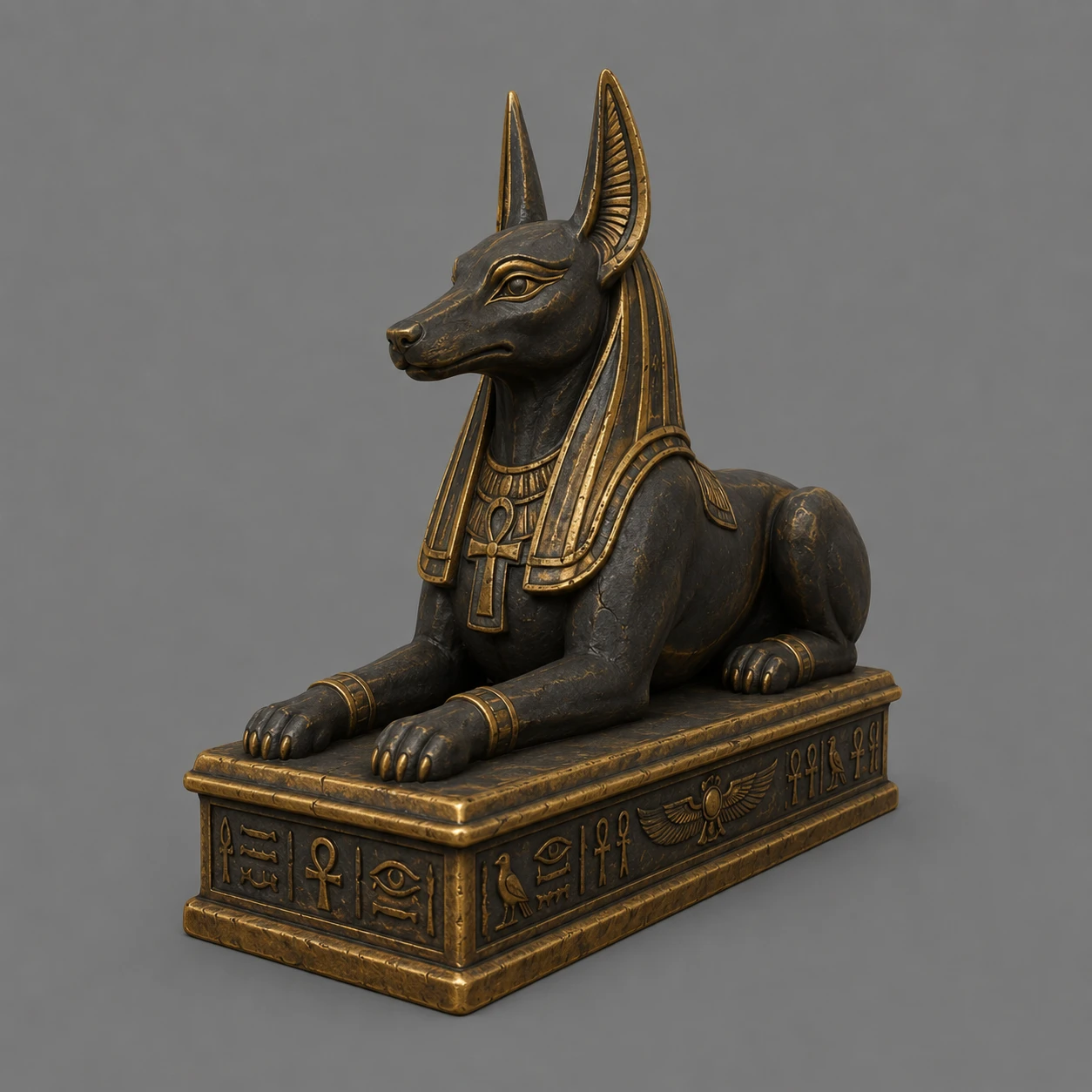
A single Anubis figure at a tomb entrance or beside a canopic niche signals Egyptian burial faster than scattering jackal images at random. Low side light picks up a black-painted stone surface well. Our Egyptian Tomb Relics pack includes a stylised Anubis statue for shrine antechambers and sarcophagus chambers.