Wolf Totem: Odin's Table Wolves and Fenrir's Chain
A carved wolf in a Viking scene usually points to one of several Norse wolves, not to a single ancient object type. Medieval texts name Geri and Freki at Odin's side, Fenrir the bound son of Loki who kills Odin at Ragnarök, and farther off in poetry the wolf-sons Sköll and Hati who chase sun and moon. The English word totem is modern. What archaeology gives us are wolf heads on jewellery, beasts on memorial stones, and paired wolves beside a standing figure on elite metalwork.
Geri, Freki, and Fenrir: three wolf stories
Geri and Freki are Odin's two wolves. Their names appear in Old Norse poetry and are usually glossed as "the ravenous one" and "the greedy one". They belong with Odin's ravens Huginn and Muninn as permanent companions in later illustrated myth, though the poems say less about their appearance than about their place at the god's table.
Fenrir, also called Fenrisúlfr or the Fenris-wolf, is a different creature entirely. Britannica describes him as the monstrous wolf born to Loki and the giantess Angerboda, bound by the gods with the unbreakable fetter Gleipnir after he bites off Tyr's hand. He waits gagged with a sword between his jaws until Ragnarök, when he breaks free, fights Odin, and is killed by Odin's son Víðarr.
Sköll and Hati, Fenrir's sons in some accounts, appear in eschatological poetry as wolves who swallow heavenly bodies. Scholars debate how many distinct wolves the early poets imagined, because names and roles sometimes overlap in the sources we have.
What the Eddas say about wolves at Odin's side
The clearest line on Geri and Freki comes from the poem Grímnismál, quoted in Snorri Sturluson's Prose Edda. Odin, disguised as the wanderer Grímnir, tells the young Agnarr that the god feeds his two wolves while living on wine alone. World History Encyclopedia's account of Valhalla repeats that detail in the hall context: at the evening feast Odin gives his portion of meat to Geri and Freki and drinks only wine, while Valkyries serve the einherjar.
Snorri's Skáldskaparmál also lists Geri and Freki among names for wolves, which shows how the personal names could slide into everyday poetic language for any wolf or carrion beast. That flexibility matters when we look at carved animals on artefacts: a wolf head might evoke Odin's pair, a bound monster, or simply strength.
For Fenrir, both Britannica and World History Encyclopedia follow the Prose Edda binding story. The gods raise the wolf among themselves until his growth and a prophecy frighten them. Only Tyr will put his hand in Fenrir's mouth as a pledge while Gleipnir is tested. When the ribbon holds, Fenrir takes the hand, and the gods fix a sword in his jaws before chaining him to a rock.
From Ironwood whelp to Valhalla hearth
The myths situate wolves at opposite poles of Norse cosmology. Fenrir begins as a pet among the Aesir and ends as the creature whose escape marks the final war. World History Encyclopedia notes that poets in 10th and 11th century Norway and Iceland wrote with dread of the day he would break loose, and that skaldic verse already treats him as a fixed part of the Ragnarök sequence.
Geri and Freki belong to the ordered world of the slain host. Valhalla's warriors fight all day, die, and feast together at night while Odin watches from his throne with ravens on his shoulders and wolves at his feet. The image is aristocratic: wolves share the high table, consuming the meat a king declines.
Voluspa and related poetry place another wolf brood in Ironwood, raised by a giantess, which feeds the apocalyptic mood without giving us a tidy illustrated manual. The texts supply roles and names; they do not describe a standard carved totem every chieftain owned.
At the feast, at the binding, at the end of the world
In life as in myth, wolves sat at the edge of human settlement: dangerous, admired, and useful as symbols. Odin's table wolves turn carrion and sacrifice meat into a divine household. Fenrir turns prophecy into political anxiety among gods who cheat their guest and pay for it at the end of time.
The contrast is deliberate in the literature. One wolf pair eats peacefully beside the All-Father; one bound wolf waits to swallow him. Scene builders borrow both moods: loyal guardian flanking an Odin idol, or a snarling bound beast foreshadowing Ragnarök beside a Mjolnir amulet worn for protection.
Modern heathen groups, games, and fantasy art often collapse the stories into a generic "wolf totem" standing for courage or wildness. That is a new layer. Viking Age makers carved wolves without telling us which myth they meant.
From master-of-beasts to longhouse posts
Zoomorphic wolves appear across early medieval Germanic art long before the word totem entered English. The motif of a standing figure between two beasts, sometimes called the Master of Animals, travels from Scandinavia to Anglo-Saxon England on jewellery and helmet plates.
Wolf heads also served as practical ornament. Viking Age graves in Norway and Denmark have yielded silver and bronze terminals shaped as snarling lupine heads, often thought to belong to chains or belt fittings rather than to freestanding cult posts. Picture stones and rune stones occasionally carry lupine bodies intertwined with serpents in the late Viking art styles scholars label Mammen, Ringerike, and Urnes. Identification as Fenrir rather than a generic beast is argued case by case and often remains open.
A carved wooden wolf post in a reconstructed longhouse is therefore a plausible scene choice, but it extrapolates from metal and stone survivals rather than copying one documented household standard.
The Sutton Hoo purse-lid at the British Museum
The most instructive museum piece for a small carved wolf beside a ruler is not Scandinavian but early Anglo-Saxon. The ship burial at Sutton Hoo, Suffolk, excavated in 1939, held a purse-lid among its grave goods, catalogued as registration numbers 1939,1010.2.a to l in the British Museum collection. The museum dates the burial to the early 600s CE and displays the find in Room 41 with the rest of the Sutton Hoo treasure.
Only the gold frame and fittings survived. The leather pouch rotted in the mound. Seven plaques of gold, garnet cloisonné, and millefiori glass once covered the lid. The lower plaques show birds of prey and, on both sides, a man standing between two beasts in the same composition known from Scandinavian art. Museum guides note that the meaning is now indecipherable but that such images may have stood for strength and courage appropriate to a war leader.
Many scholars read the scene as Woden or Odin with wolf companions, sometimes pointing to a missing gold foil eye on one figure as a one-eyed god marker. The British Museum text stops at the safer description: a man between beasts, paralleled in Europe and Scandinavia. Held next to a wolf-head terminal or a hammer pendant, the lid shows how wolf imagery travelled on portable wealth, not only on standing stones.
Silver heads, worn lines, and modern revival
Wolf images survive unevenly. Organic posts decay. Plain iron fittings rust. Silver and stone pieces dominate museum cases, which can make wolves look rarer or more elite than everyday wood carving ever was.
Even on stone, certainty is limited. A snarling beast in Urnes interlace might be Fenrir, a generic warg, or a decorative great beast with no single myth attached. World History Encyclopedia on Fenrir stresses how much of the wolf lore reaches us through 13th century Christian-era manuscripts, so we cannot assume every Viking viewer read the same story into the same carving.
That gap is worth keeping in mind when placing a wolf prop in a scene. The history supports wolves as powerful symbols at feast, burial, and doom. It does not give us a licensed design for one official totem every hall had to display.
In your scene
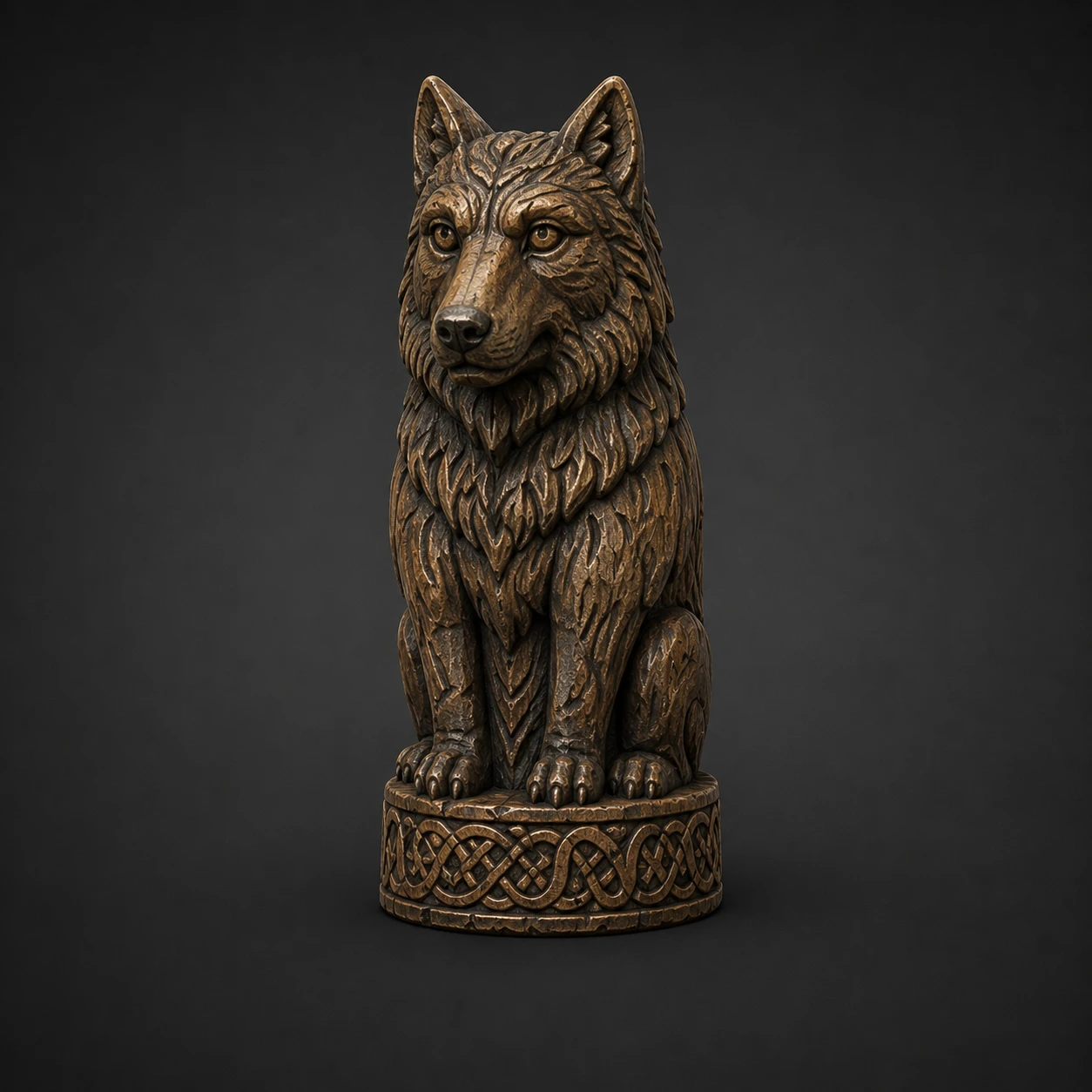
A carved wolf reads well flanking an Odin shrine, mounted on a longhouse post, or set beside grave goods with raven imagery. Pair peaceful table wolves with feasting gear, or a bound, snarling head near stones that foreshadow Ragnarök. Our Viking Ritual Relics pack includes a wolf totem model alongside an Odin idol and Mjolnir amulet for ritual corners and burial sets.