What Is a Teponaztli? Mexico's Sacred Slit Drum
A teponaztli is a Mesoamerican slit drum carved from a single hollow log. Craftsmen cut an H-shaped opening across the top so two wooden tongues remain, each tuned to a different pitch when struck. The name comes from Nahuatl tepontli, meaning log. In the Mexica (Aztec) capital of Tenochtitlan and across central Mexico, the teponaztli was not background noise. It was sacred percussion, played beside the upright skin drum called the huehuetl at festivals, dances, and state rituals that filled the great temple courtyard.
H-shaped slits, hardwood, and two matching tones
The teponaztli belongs to the idiophone family: the wood itself vibrates, with no membrane like a modern drumhead. Britannica describes the classic form as a hollow tree trunk with a carved H-shaped slit that leaves two tongues, each producing a separate tone. Carvers varied tongue length or thickness so the pitches fall roughly a third or fourth apart, enough for rhythmic patterns and call-and-response phrases.
Players strike the tongues with wooden mallets tipped in hard rubber, though colonial sources also mention deer antlers. A performer is called a teponāzoāni in Nahuatl. The drum usually rests horizontally on the ground or a low stand. Some examples were small enough to strap to a player's back so a second musician could strike from behind while the carrier walked in procession. Larger logs could exceed a metre in length; museum pieces more often sit near half a metre.
Decoration ranges from plain polished wood to relief carvings of gods, animals, warriors, and abstract scrollwork. Some drums are shaped like creatures with open mouths that add resonance. Others pierce the underside with a sound hole. Mixtec carvers in particular engraved battle scenes and mythic figures across the body, turning a musical tool into a portable sculpture.
From valley log drums to Mexica temple courts
Slit drums appear across Mesoamerica long before the Mexica rise. The instrument type is ancient; what changes is who owns the finest carved examples and which ceremonies demand them. By the Postclassic period (roughly 1325 to 1521 CE), when Tenochtitlan dominated the Basin of Mexico, teponaztlis were standard equipment in temple music alongside flutes, rattles, and conch trumpets.
Bernardino de Sahagún's Florentine Codex, compiled in the sixteenth century from elder testimony, illustrates musicians playing horizontal slit drums and upright drums at public gatherings. World History Encyclopedia notes that music and dance belonged to Mexica education and civic life, not only to private amusement. A drum in a festival scene signals an official occasion: tribute display, calendar ritual, or victory celebration.
Farther south, Britannica's percussion survey records Zapotec warriors from Ixtepeji marching to battle with an idol and singing to teponaztli accompaniment. That use shows the drum as a signal and morale tool as well as a temple instrument. The Mexica themselves employed percussion in military communication, though most surviving carved drums come from ritual rather than campaign contexts.
Beside the huehuetl at feast and sacrifice
In Mexica ritual, the teponaztli and huehuetl formed a paired set. Britannica's Latin American music overview states that both occupied a special place in Aztec ceremonies and were treated as sacred instruments. The huehuetl is the tall cylindrical drum with an animal-skin head, played with bare hands; the teponaztli supplies the wooden counter-rhythm on the ground beside it.
Colonial-era Nahuatl texts describe drum beats notated alongside sung poetry, as if the percussion were part of the verse itself. Dances in the main plaza of Tenochtitlan combined these drums with flute and rattle lines. Some later accounts, which scholars treat cautiously, claim that on major state occasions sacrificial blood was poured into a drum. Whether every community accepted that practice is unclear, but it points to how seriously central Mexicans treated these objects as ritual participants, not mere furniture.
World History Encyclopedia's survey of Aztec art highlights richly carved teponaztlis and huehuetls, including the Malinalco drum covered in dancing jaguars and eagles read as sacrificial victims marked by war banners and fire symbols. Owls, serpents, and warrior captives appear on other examples. The carving tells you which ceremony or deity the drum served before a single note was struck.
Loot, iron bands, and drums still played in villages
The Spanish conquest scattered many teponaztlis to European collections. Wood that never entered a burial context survives in unusually crisp condition, which curators take as evidence of sixteenth-century loot rather than archaeology. After contact, some drums gained iron hoops around the body to stop the log from splitting as humidity changed, a repair that also marks the colonial afterlife of indigenous instruments.
Not every teponaztli stayed in a museum case. Ethnographers in the twentieth century found pre-Columbian examples still sounded in Nahua villages, guarded as community property. Modern makers continue the tradition for dance and ritual. The form is old; the social contract around who may touch the drum remains active in parts of central Mexico.
The Met's Mexica teponaztli (1979.206.361)
The Metropolitan Museum holds a Mexica teponaztli dated to the fifteenth or sixteenth century (object 1979.206.361). It measures about 46.6 cm long, 15.2 cm wide, and 14.4 cm high. The body is hardwood, possibly rosewood, and an iron band now circles the shell. The museum suggests Spanish priests and organisers of public festivals sometimes folded indigenous percussion into colonial celebrations, and the iron hoop may be evidence of that syncretic reuse rather than pre-contact manufacture.
The piece entered the collection through the Nelson A. Rockefeller bequest. It is smaller than the most spectacular carved monuments but typical of a portable ceremonial drum that could travel between temple platforms and palace courtyards. Compare it with the British Museum's horned-owl teponaztli (tecolotl) at about half a metre. Scholars often link such owl carvings to Mictlantecuhtli, lord of the dead, and read them as possible funerary equipment. Wildform's model keeps the horizontal log silhouette and twin tongue slots without copying a single museum carving.
Carved wood, lost sound, and what curators cannot replay
Hardwood survives better than painted bark paper, yet wood still cracks, splits, and loses surface pigment. Hundreds of teponaztlis exist in museums across Mexico, Europe, and the United States, but the total is a fraction of what once sounded in the Basin of Mexico alone. Sizes, carving programs, and wood species vary by region and century. Acoustic studies on museum pieces show intervals from minor thirds to fifths depending on tongue carving, so reconstructions of Mexica rhythm remain partly speculative.
A teponaztli without provenance is a beautiful log; a teponaztli from a documented temple context or colonial inventory is evidence. Scholars still debate how loudly the tongues were meant to ring in an open courtyard versus an enclosed chamber. What is not in doubt is the pairing with the huehuetl and the place of both in the soundscape Tenochtitlan presented to its subjects and gods.
In your scene
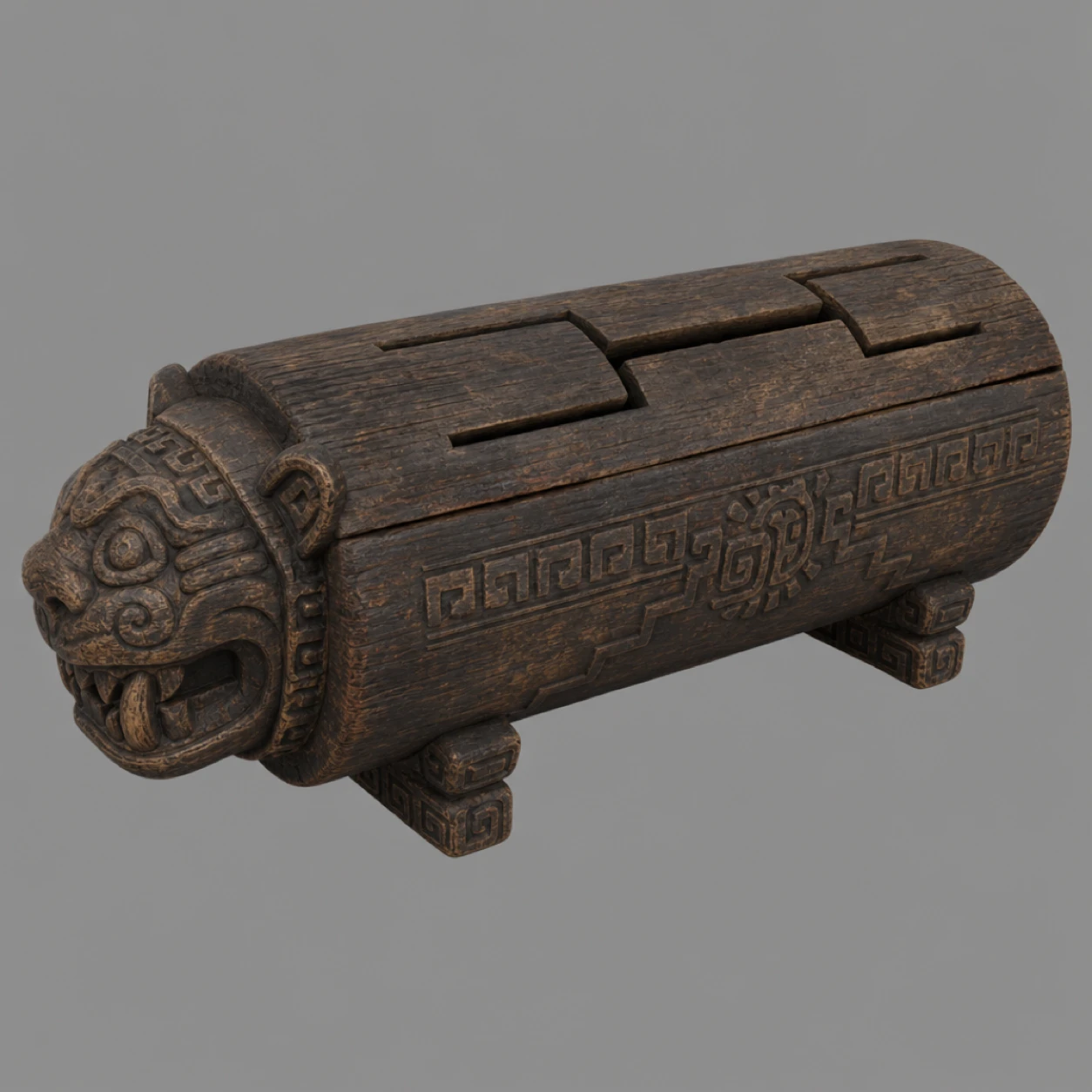
A teponaztli on the temple floor beside a huehuetl tells players this is active ritual space, not an empty ruin. Low torchlight and a circle of dancers read more convincingly with the horizontal drum in frame. Our Aztec Temple Relics pack includes a teponaztli for pyramid courtyards and Mesoamerican festival sets.