Tepetlacalli: Stone Chests for Mexica Temple Offerings
A tepetlacalli is a lidded stone box made by the Mexica (Aztec) people of central Mexico. The name joins Nahuatl tetl (stone) with petlacalli, the woven palm-fiber chest used in households to store fine feathers, jewelry, and cotton garments. In temple and palace contexts, the same idea was carved in basalt or andesite: a permanent container for objects too precious to leave exposed. Despite occasional modern labels that call it a drum, a tepetlacalli is not a musical instrument. The horizontal slit drum is a teponaztli; the tall barrel drum is a huehuetl.
Tetl, petlacalli, and a box meant to last
Everyday petlacalli were rectangular baskets with lids, light enough to move but strong enough to guard heirlooms. Stonemasons translated that form into compact chests, often less than forty centimetres long, with four short feet and a separate lid. Outer walls and inner lid faces received relief carving: calendar glyphs, gods, rulers piercing an ear for bloodletting, feathered serpents, and the earth monster Tlaltecuhtli on undersides. Grey-green volcanic stone was common; surfaces were sometimes painted, though pigment rarely survives on excavated pieces.
Colonial dictionaries already glossed tepetlacalli as a stone box or coffin. Christian Nahuatl texts later applied the word to Christ's tomb, which shows how strongly the form read as a sealed sacred chamber even after the conquest.
From household storage to pyramid deposits
By the late Postclassic period (roughly the 14th to early 16th centuries CE), carved stone boxes belonged to the highest levels of Mexica ritual life. Rulers commissioned them to mark accessions, temple dedications, and cosmic events tied to the 52-year calendar round. Some may have held the ashes of deceased nobles, a theory long attached to named examples, though archaeologists now stress offering deposits at least as often as funerary use.
At the Templo Mayor in Tenochtitlan, the great double shrine to Huitzilopochtli and Tlaloc, excavators have recovered tepetlacalli buried in deliberate layers beneath platforms and stairways. Each new building phase could seal earlier offerings inside the pyramid, turning the temple into a stacked archive of stone, shell, jade, and sculpture.
Offerings, blood tools, and relics from older cultures
Mexica priests and rulers used tepetlacalli as ritual strongboxes. Contents named in excavation reports and colonial accounts include greenstone beads, marine shells carried hundreds of kilometres from the Gulf and Pacific coasts, obsidian blades, small sculptures, and bundles tied for burial. Several caches held Mezcala-style figurines carved centuries earlier in Guerrero, collected and re-consecrated as relics of the deep past.
Bloodletting implements are a recurring possibility. Relief scenes on luxury boxes show rulers piercing an ear or tongue with a bone or obsidian lancet, and some scholars think a commissioned chest stored the very tools used in that act. Whether a given box once held ashes, shells, or a priest's gear is often impossible to prove once the lid is empty, but the container type clearly belonged to sacrifice and offering cycles rather than everyday storage.
How relief programs turned a box into cosmology
Unlike a plain storage jar, a major tepetlacalli was a narrative object. Carvers wrapped gods and date glyphs around all four sides and the lid so that opening the chest re-enacted movement between sky, earth, and underworld. A feathered serpent descending on the lid might pair with Tlaltecuhtli on the base, framing the interior as a microcosm. Calendar dates fixed the commission to a named day in the 260-day ritual count or the 365-day solar year, anchoring political events in sacred time.
Historians disagree on how literally to read each program. Some boxes probably commemorated a single ruler's birth or a temple dedication; others may celebrate infrastructure such as an aqueduct. The stone form itself, however, is widely treated as a metaphor for cave, tomb, and treasure house at once.
The Ahuitzotl fragment in the British Museum
The British Museum holds a celebrated tepetlacalli fragment registered as Am1982,Q.860, associated in scholarship with the ruler Ahuitzotl (reigned 1486 to 1502 CE). The andesite piece measures about 23 cm high, 34 cm wide, and 18 cm deep. One carved face shows Tlaloc, the rain god, pouring water and ears of maize from a jar. The reverse bears an ahuitzotl, the mythical water creature that also served as Ahuitzotl's name sign.
The matching lid, carved with another ahuitzotl and calendar glyphs, is housed in the Ethnologisches Museum in Berlin. Scholars treat the two pieces as one chest: Tlaloc on the exterior paired with ahuitzotl name signs on interior surfaces meant to be seen when the lid was lifted. The London fragment featured in the 2009 Moctezuma exhibition at the British Museum; the Berlin lid remained in Germany. The fragment is displayed in the Mexico gallery.
What survives in excavations and what we still argue about
Dozens of tepetlacalli are known in museums worldwide; almost half carry legible dates. Templo Mayor Project digs continue to add examples, including stone chests packed with figurines, coral, and beads from the reign of Moctezuma I in the mid-15th century CE. Empty boxes in European collections may have lost their contents long before excavation, or never held perishable offerings at all.
Debate persists over funeral use for royal ashes versus purely votive burial. Early 20th-century reports imagined urns for cremated rulers; later work emphasises structured offerings to Tlaloc and fertility symbolism. Provenance gaps for pieces bought before modern archaeology also limit how far we can tie a carved scene to a specific ceremony. A tepetlacalli without a findspot remains a masterpiece of stonework; one lifted from a labelled temple layer is evidence of how the Mexica sealed memory inside stone.
In your scene
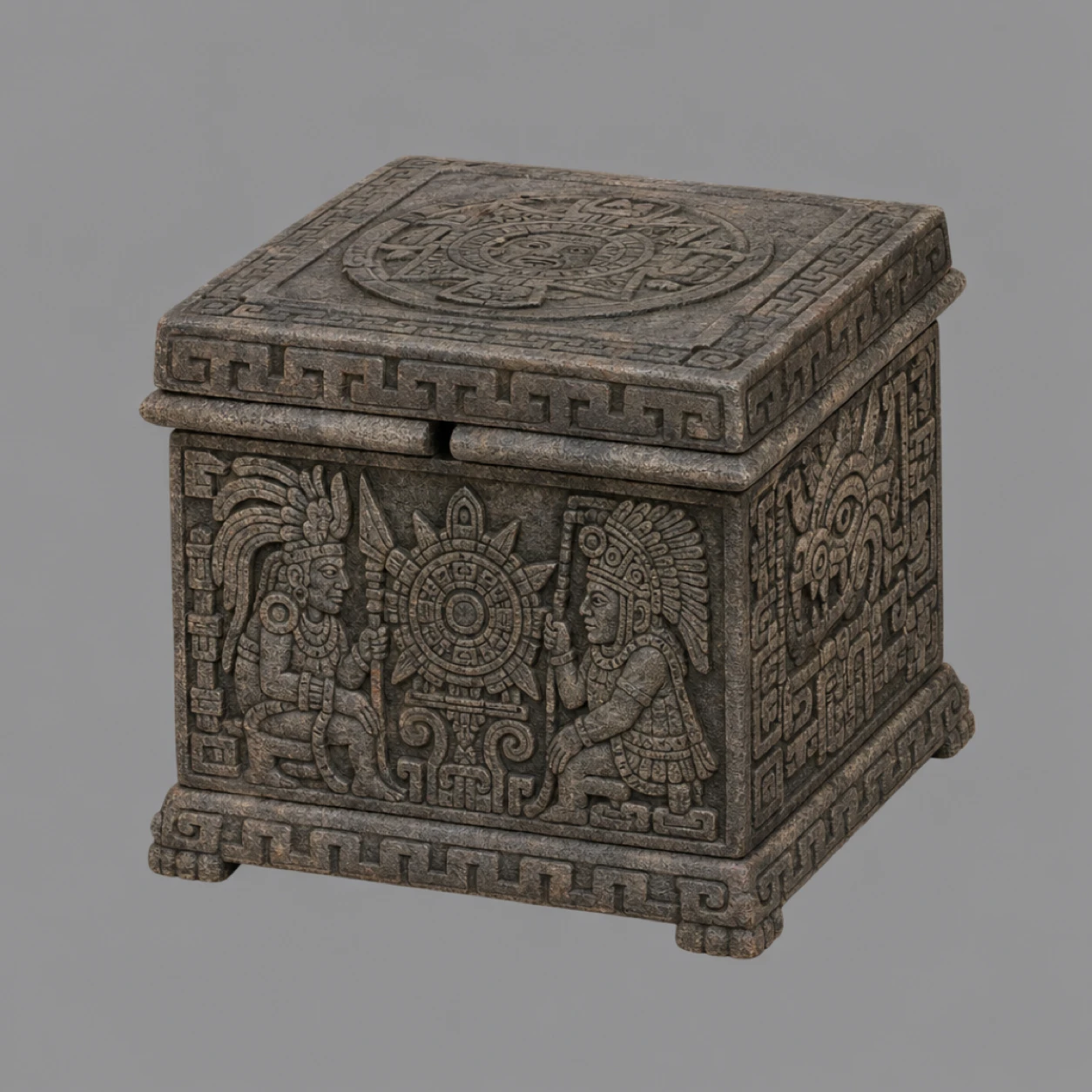
A tepetlacalli on a temple platform or in a priest-king's chamber signals sealed ritual wealth: not clutter, but an object set apart. Place it near braziers, obsidian mirrors, or cached offerings to suggest a deposition rite rather than marketplace trade. Our Aztec Temple Relics pack includes a carved stone chest for pyramid antechambers and offering niches.