Runic Shield Boss: Iron Dome and Early Runes
A shield boss is the iron dome fixed at the centre of a Germanic round shield. Vikings called the part a baugr in poetry, and archaeologists often use the Latin term umbo. The boss protects the hand gripping a wooden bar behind the board and helps turn a blow aside. Most bosses are plain iron, but a few early pieces carry runes cut into the metal, making them rare cousins of the memorial runestones and the hammer pendants discussed in our Mjolnir article.
Iron dome at the centre of the board
The typical Viking shield was a thin wooden disk, often pine or fir, sometimes around 80 cm across. Planks were glued and bound, then covered with leather or rawhide that shrank as it dried and stiffened the face. In the middle sat a hemispherical boss riveted through the wood, with a grip bar on the inside. Arrows and sword cuts that struck the dome could glance off instead of biting deep into the planks.
Bosses vary in profile. Archaeologists date them by shape, using typologies worked out from grave finds across Scandinavia. When only metal survives, the boss often tells you whether you are looking at an Iron Age piece or a Viking Age burial. Diameter commonly falls in the range of roughly 12 to 18 cm for the outer flange, though individual examples differ.
From Iron Age circles to Viking fleets
Round shields with a central boss reach back long before the Viking Age. The form appears across northern Europe in the Roman Iron Age and continues through the 9th to 11th centuries. The National Museum of Denmark notes that Viking shields trace directly to this Iron Age pattern: thin planking, circular outline, iron hand guard in the middle.
Ship finds show how shields worked at sea. The Skuldelev 5 warship preserved a shield rack along one gunwale where boards could hang to catch missiles. Test sails suggest mounting every shield slowed the vessel, so crews probably clipped them on only when battle was near. On land, painted bosses appear on picture stones from Gotland and on small valkyrie figurines that carry decorated round shields.
Burial shields, ship graves, and bog offerings
A shield was personal gear, and it often followed its owner into the ground. Bosses turn up in weapon burials across Denmark, Norway, and Sweden, sometimes the only surviving fragment of a rotted board. They sit beside spears, swords, and axes in the same graves that inspire props such as the ritual axe in the Wildform pack.
Not all shields ended in graves. At war-booty bogs such as Thorsberg in Schleswig and Illerup in Jutland, defeated armies deposited broken weapons as offerings. Swords were bent, spearheads snapped, and shields dismantled. The ritual treatment marks the objects as gifts to the gods or to the land rather than as everyday trash.
From bare bosses to painted fleets at Gokstad
Most bosses are functional iron, without inscription or gilding. Decoration lived on the wooden face. At Gokstad in Norway, a ship burial held dozens of complete round shields painted in bands of yellow and blue. Research on the surviving boards suggests they were light enough to split under hard strikes, which fits the idea that leather facing did much of the real work.
A rare near-complete Viking shield came from waterlogged soil at Trelleborg fortress in Denmark, dated to the late 900s. The pine board, grip, and central hole survived; the boss itself was missing. Together with the Gokstad fleet, the find confirms how large and thin the boards were, and how completely the iron boss could outlast the wood.
The Thorsberg boss and its unread runes
The most famous runic boss does not come from the Viking Age at all. During excavations at Thorsberg moor in the 1850s, Conrad Engelhardt recovered a bronze shield boss among a mass of offered weapons. The piece is catalogued as DR 8 and Sl 12, now in the Archäologisches Landesmuseum at Schloss Gottorf in Schleswig, inventory number 3262.
The University of Copenhagen runic database records the object as a damaged fragment about 16.5 cm across, dated archaeologically to roughly 210 to 260 CE in the Late Roman Iron Age. Runes were cut on the inner rim of the boss, the side that faced the wooden board, reading leftward in the older futhark. The transliteration is given as aisgRh or a(n)sgRh, and the entry classifies the text as untranslated. Scholars have compared the letters to a Latin inscription on another boss from the same bog deposit, but no consensus reading has won the field.
The Thorsberg deposit included other early runic pieces, including the well-studied chape with the name Wulthuthewaz. The shield boss belongs to the same votive horizon: weapons from a defeated force, broken and sunk in the bog. That setting matters. The runes were not a public memorial like a raised stone. They sat on gear meant to die with the fight.
How rare are runes on a boss?
Runic weapon inscriptions are uncommon at every period. Spearheads, bracteates, and amulets carry more examples than bosses. Illerup yielded a rune-spelled name, Swarta, on a shield-handle fitting from about 200 CE, not on the dome itself. Viking Age bosses in graves are counted in the hundreds across Denmark alone, yet only a handful of pre-Viking bosses combine the boss form with runes at all.
That scarcity is why a runic boss reads as a deliberate prop in a ritual scene. You are not showing everyday kit. You are pointing to the moment when literacy, metalwork, and votive violence met in a single object. The Wildform model exaggerates the runes for clarity at game scale, but the historical pattern is real: plain iron bosses everywhere, inscribed ones almost nowhere.
In your scene
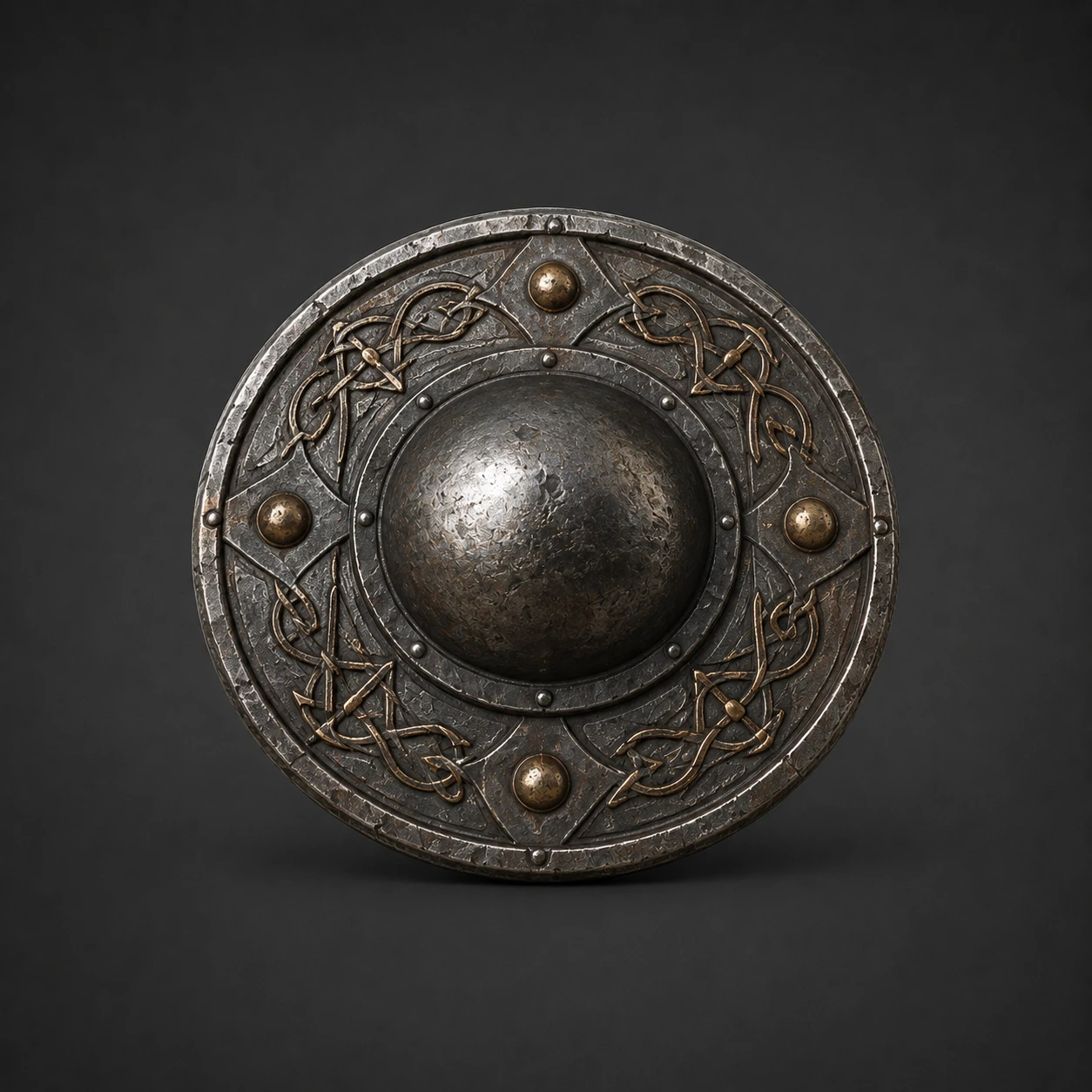
Mount a boss at the centre of a round shield leaning against a grave, a longship rail, or a weapon rack. Keep the wood wide and thin, the iron dome small but proud. A few runes on the inner rim hint at a votive deposit or a warrior's named gear without turning the prop into a readable spell. Our Viking Ritual Relics pack includes a runic shield boss model for burial scenes and ritual weapon piles.