The Jelling Stones: Harald Bluetooth's Runic Memorial
A runestone is a standing stone, boulder, or rock face carved with runes, the letters of the Germanic scripts used in Scandinavia from roughly the early centuries CE into the Middle Ages. Most surviving examples are Viking Age memorials: they name a dead person, say who raised the stone, and often add a prayer or boast about travel, status, or faith.
Carved letters on granite and limestone
Runestones are not casual graffiti. They were commissioned pieces, usually cut by travelling specialists called runemasters and placed where passers-by would see them. The inscription typically follows a set pattern: "in memory of" a named man or woman, "raised by" a son, widow, or lord, sometimes with kinship spelled out and a line about how the person died at home or abroad.
The stones were meant to be read and noticed. Many were originally painted in bright colours so the runes stood out against the rock. That paint is gone today, but microscopic traces on a few stones helped scholars reconstruct red, black, and white schemes.
Sweden holds the largest share of known stones, with dense clusters in Uppland, though Denmark and Norway contributed vital early examples. Norse travellers also left runic marks from Dublin to the Byzantine east, but the classic raised memorial slab belongs to the Scandinavian landscape.
From early markers to Viking Age monuments
The habit of carving runes on stone begins centuries before the Viking Age. Memorial stones in the older futhark alphabet appear from the 4th century onward. The great expansion of raised runestones, however, belongs to the late Viking period, from the 10th century into the 11th, as wealth, literacy, and Christian influence spread.
By then most inscriptions use the reduced 16-character younger futhark. Texts grow longer and more formulaic. A stone might record an expedition to England, a gift to God and Saint Michael, or a local land claim. The tradition fades as churchyard gravestones take over, but the last runestones are carved well into the 12th century.
Memorial, status, and a message to the living
A runestone was expensive. It advertised that a family could afford a skilled carver and a visible plot of ground. The text is public history written by the survivors: who mattered, who paid, and how they wanted the dead remembered.
Many stones mention men who died on Viking expeditions, sometimes far from home. Others stay local, marking a farmer or chieftain buried in a mound nearby. Christianity appears gradually. Early pagan stones invoke Thor or use purely memorial wording; later examples add crosses and prayers to Christ, Saint Michael, or Mary.
The stones also preserve names, place-names, and snippets of poetry. They are among the few Viking Age sources actually commissioned by the people who lived in that world, not written down by monks abroad.
From pagan mounds to crosses on royal granite
The shift from pagan burial mounds to Christian churchyards is visible on the most famous pair of stones in Denmark. At Jelling in central Jutland, two royal monuments stand beside the turf mounds of King Gorm the Old and Queen Thyra and in front of a small whitewashed church.
Gorm's stone is the earlier. Britannica describes it as a memorial commissioned by Gorm, the last pagan king of Denmark, for Queen Thyre. Harald Bluetooth, their son, raised the larger three-sided stone for both parents and used it to proclaim his own reign.
That second stone marks a turning point. One face carries an interlaced animal and a serpent; another bears the earliest known depiction of Christ in Scandinavia, a crucified figure on a plant-like tree. The runic panel boasts that Harald won all of Denmark and Norway and made the Danes Christian. The National Museum of Denmark dates Harald's stone to around 965 and notes that the site is often called Denmark's birth certificate because the country is named in the inscriptions and the stone documents the official change of faith.
Metal-detected finds now suggest some Danes were already Christian before Harald's proclamation, but the Jelling monument is still the clearest public statement of the shift carved in stone.
The Jelling pair you can still see
Visitors today find both originals at Jelling, protected in glass cases beside the church. The smaller Gorm stone reads, in runic Danish, that King Gorm made the monument to Thyra, Denmark's ornament. It is the first time the name Denmark appears on a monument within the country's borders, dated by museum guides to about 950.
Harald's larger block stands nearby. Its inscription, as translated on the National Museum site, runs: "King Harald ordered these kumbls made in memory of Gorm, his father, and in memory of Thyra, his mother; that Harald who won for himself all of Denmark and Norway and made the Danes Christian." The monument complex, including the mounds and church, was inscribed as UNESCO World Heritage in 1994.
Copies painted in reconstructed colours stand at the National Museum in Copenhagen and outside the site museum, giving a sense of how vivid the carving once looked when fresh paint filled the grooves.
Thousands of formulas, one tradition
Roughly six thousand runestones are known across Scandinavia, most sharing the same memorial grammar with local variation. Specialist carvers such as Öpir in Uppland signed dozens of stones in a recognisable style. Others remain anonymous.
Not every inscription is reliable history. Carvers flattered patrons, and boasts could outrun facts. Still, the stones give real names, family ties, and dates that anchor Viking Age studies. They are the medium the Wildform pack models as a slab: not a boulder in a field, but the same public grammar of runes raised for the dead.
In your scene
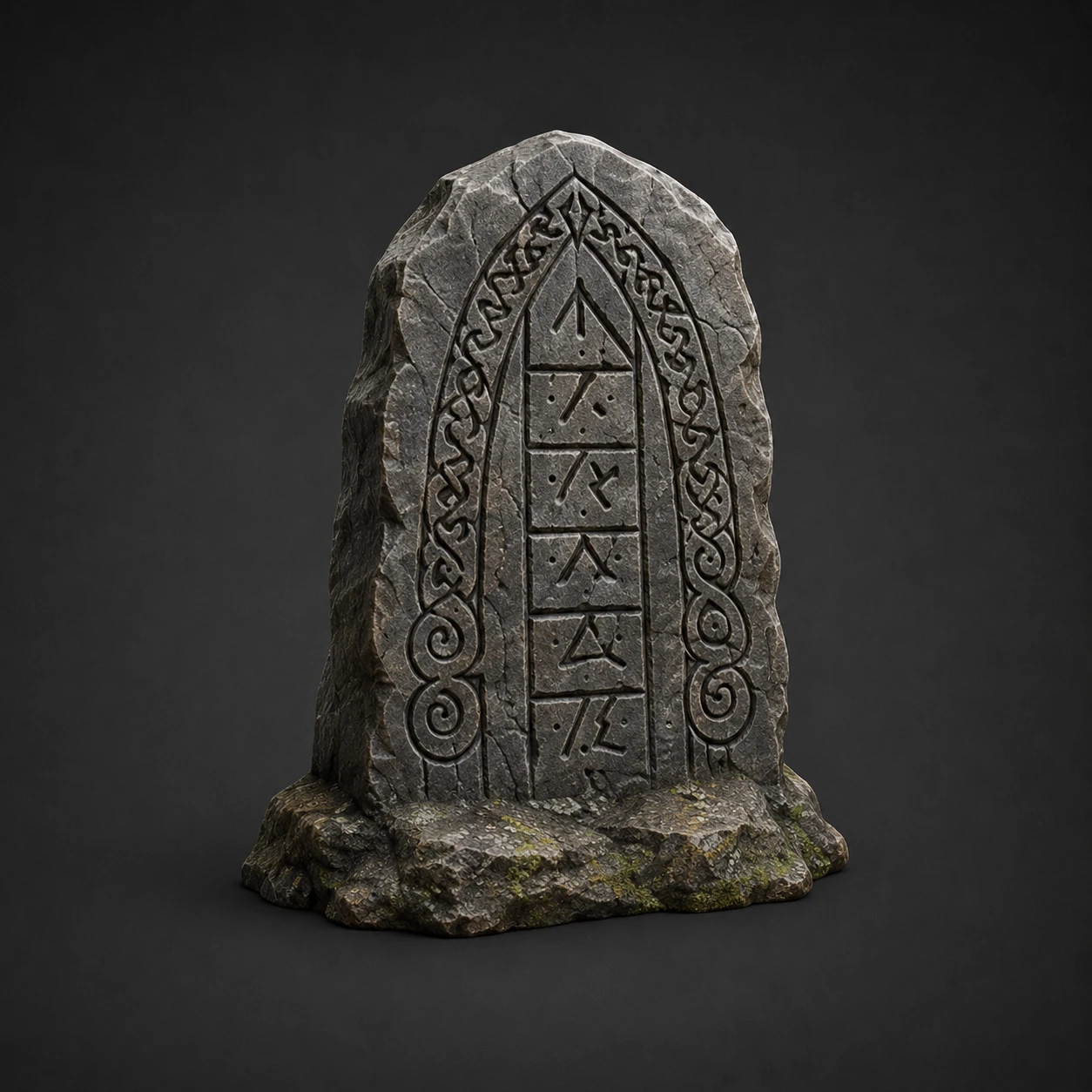
Place a runestone beside a burial mound, a thing assembly, or a crossroads where travellers would pass. Angle the inscribed face toward the path and keep the text short: a name, a raiser, one line of memory. Our Viking Ritual Relics pack includes a runestone slab model for outdoor memorial scenes.