Ritual Axe: Bearded Blade for Blót and Burial
A ritual axe in the Viking world was still an axe: iron head, wooden haft, sharpened edge. What made it ritual was context. The same bearded blade that shaped ship planks could open an animal at blót, hang as a votive in a wetland, or lie inlaid with silver at the feet of a dead magnate. Archaeology and saga literature both treat the axe as ordinary and sacred at once.
Skeggøx, beard, and the working edge
The bearded axe, Old Norse skeggøx from skegg (beard) and øx (axe), takes its name from the lower blade that extends below the butt of the head. That hook adds cutting length without much extra weight, and in a fight it could snag a shield rim or pull a weapon aside. For woodworking the same shape lets a smith grip close behind the head and shave along a plank.
Viking Age axe heads survive in large numbers because iron outlasts wood. Archaeologists classify them by blade length, beard depth, and socket type, but the basic pattern is stable from the 8th century into the 11th. Hafts ranged from short one-handed lengths to shafts over a metre for the long-bladed "Danish" axe type described on the National Museum of Denmark axes page.
Iron for every household, silver for the few
Unlike swords, which were costly and often inherited, axes were common across social ranks. World History Encyclopedia on Viking warfare notes that axe heads turn up in rich warrior graves beside spears and mail, but also as the only weapon in simpler burials. That spread suggests the axe was everyday kit as much as battlefield gear.
At the top end, magnates owned parade weapons. Iron heads were inlaid with silver wire or sheet, sometimes copper, in patterns of birds, foliage, or human masks. These pieces were heavy with display value. They could still cut, but their finish marks status, funeral honour, and the blurred line between weapon and cult object.
Blót blood, feast meat, and the slaughterer's skill
Old Norse religion centred on offerings to the gods, and blót was the sacrificial feast at the heart of it. World History Encyclopedia on Freyr describes 10th-century Trøndelag rites where horses and pigs were killed, blood sprinkled on idols and walls, and the meat cooked for a communal meal with sacred toasts. The same article records Yule oaths sworn over a sacrificial boar before it was killed.
An axe was the practical tool behind that theatre. Literary tradition treats knowing how to sacrifice and how to butcher as learned skills, on a par with rune carving in prestige. After the killing, feast culture took over: meat and drink passed in the hall, often from a drinking horn at sumbl. The axe opened the ritual; the horn and cauldron closed the social bond.
Archaeology adds a quieter track. Weapons, including axe heads, were deposited in wetlands and cult places, sometimes with animal bone. That pattern reads as gift or abandonment to the gods rather than battlefield loss. Not every axe in a bog was "ritual," but repeated deposition of the same object type is hard to explain as accident.
From wetland deposit to magnate's parade weapon
By the late 10th century, Christian mission work was reshaping Scandinavia, yet elite burials still carried weapons. Cross axes with a perforated blade forming a cross motif appear in Denmark; the National Museum axes overview argues they were robust enough to use but more likely kept for ceremony. Owners were not necessarily Christian, but the form shows the mixed religious climate of the period.
Meanwhile the bearded axe remained the standard sidearm in art and grave goods. The shift is not from axe to something else, but from plain iron to symbol-loaded iron: inlaid birds, trees, crosses, and beasts that could be read in more than one faith at once.
The Mammen axe at the National Museum of Denmark
The clearest Viking Age "ritual axe" in a museum case is not from a bog but from a chamber grave. In 1868 a farmer digging the mound Bjerringhøj at Mammen in Jutland hit a richly furnished burial. Dendrochronology dates the grave chamber to the winter of 970 to 971 CE. A magnate lay on down cushions in an oak coffin inside a timber chamber, dressed in silk and embroidery; at his feet lay two axes.
The famous piece is the silver-inlaid iron axe, National Museum inventory C133, described in the museum article An axe with double meaning. The decoration defines the Mammen art style, named after this find: a spreading tree on one face, a crested bird on the other, plus a human mask near the haft. The museum presents both sides as deliberately ambiguous. The tree may be Yggdrasil or the Christian Tree of Life; the bird may be the rooster Gullinkambi from Norse myth or the Phoenix from Christian legend.
A plain second axe (C134) sat beside it. A large wax candle, buckets, and imported textiles filled the chamber. Scholars link the deceased to the circle around King Harald Bluetooth, but his personal faith is unknown. The inlaid axe is best read as a ceremonial parade weapon buried to mark rank at a moment when pagan and Christian symbols could share one blade.
Cross axes, deposition, and uncertain labels
Modern catalogues use "ritual axe" loosely. Some mean wetland deposition. Some mean inlaid grave axes like Mammen. Some mean the rare cross axes, such as the Ludvigshave example in the National Museum collections. None of these categories excluded combat use entirely; the distinction is intent and context, which graves and bogs only hint at.
Wooden hafts rot, so counts favour decorated iron. Plain axe heads are underrepresented in museum displays but dominated in life. When a scene calls for a ritual axe, a bearded form with modest metalwork is more typical than a silver parade piece. Reserve the inlaid head for a chieftain's funeral or oath ceremony, and remember that Mjolnir pendants served a different protective role on the body, not at the slaughter stone.
In your scene
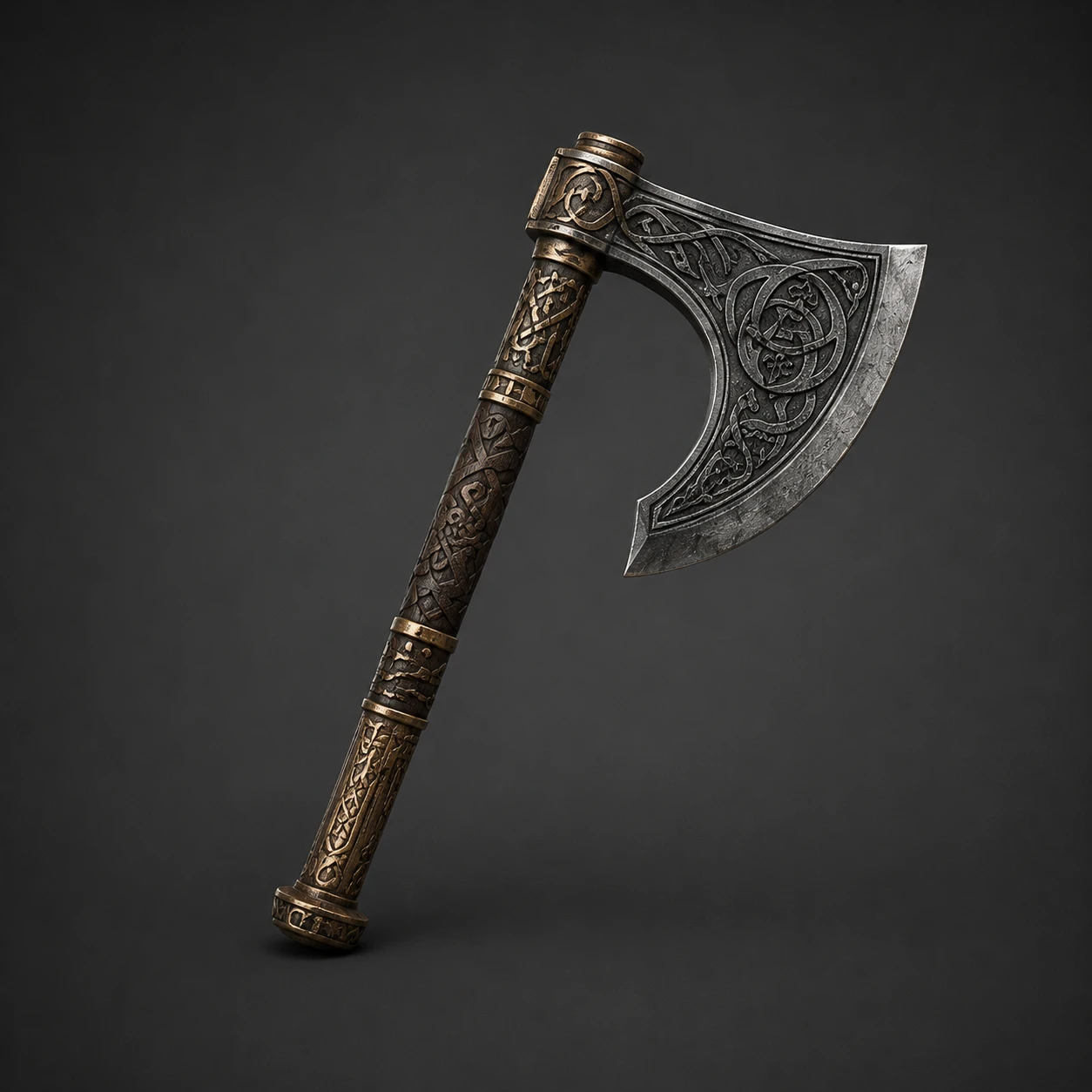
Place a bearded axe at a blót stone, leaning by a wetland offering, or crossed on a magnate's coffin. Keep most hafts short for one-handed use; add silver inlay only for elite burials. Our Viking Ritual Relics pack includes a ritual axe model for outdoor clearings, longhouse corners, and funeral sets.