High Seat in the Mead Hall: Where a Viking Chieftain Ruled
The high seat was the place in a Norse longhouse where the head of the household sat to receive guests, share ale, and display rank. Saga language treats it as the honoured position at the centre of the hall benches, sometimes as a throne for kings and earls. For artists and game builders, a carved high seat chair signals that the room belongs to someone who hosts sumbl feasts and settles disputes from the fireside.
Bench ends, carved posts, and the name high seat
A Viking Age hall was a long wooden building with a central hearth, wall benches, and movable trestle tables. Most people sat on benches without backs. The head of the farm, the jarl, or the visiting king took the seat of highest honour, often at the mid-point of the long wall benches where everyone could see him. Saga writers call this position the high seat, contrasting it with lower benches where retainers and guests ranked by status.
Flanking posts sometimes marked the spot. Icelandic settlement legend describes settlers throwing high-seat pillars into the sea so the gods could choose where a new farm should stand. World History Encyclopedia's account of Iceland's settlement records that Ingólfr Arnarson cast his high-seat pillars overboard near Iceland around 874 CE, then sent slaves to find where they washed ashore before founding Reykjavík at that landing. The pillars were wooden posts dedicated to Thor, tying household authority to ritual and land.
Whether every farm owned a separate chair is unclear. Archaeology has found very few backed seats from the Viking Age. More often we recover carved animal heads that may have topped posts beside the seat, or elite burials with beds and benches instead of thrones.
From family longhouse to royal mead hall
Longhouses served as kitchen, workshop, and sleeping quarters for an extended household. Wealthier estates added a larger hall for feasts where poets, traders, and warriors gathered. World History Encyclopedia on Norse alcohol and feasting describes the mead hall as more than shelter: building one and stocking fine ale or mead was how a chieftain proved prestige. The pattern mirrors Beowulf's Heorot, where a Danish king's hall is the stage for gift giving, storytelling, and formal drinking.
Rank mattered inside that space. Later medieval great halls formalised the idea that only the lord sat on a chair while guests used benches. Viking Age Scandinavia probably used benches more widely, reserving backed chairs for royalty or wealthy farms, but the visual logic is the same: a fixed seat at the centre of the hall marked who controlled hospitality.
Sumbl, service, and the seat that faced the room
The formal drinking party called sumbl turned seating into ritual. The lady of the house opened the feast by serving her husband first, then the highest ranking warriors, keeping order as horns and ale passed around the fire. World History Encyclopedia's Norse alcohol article quotes historian Mark Forsyth on how women managed the flow of drinks and calmed the room. Oaths sworn over the bragarfull cup were binding because drink came from the gods.
That makes the high seat a governance tool as much as furniture. Gift giving, marriage negotiations, and feud settlement all happened within sight of the chieftain's place. Pair the seat with a drinking horn and hanging cauldron in a scene and viewers read feasting authority immediately.
Postholes, poetry, and changing layouts
Archaeologists distinguish ordinary farmhouses from high-status mead halls by size, central hearths, and rows of interior roof posts. Excavated halls in Scandinavia show how builders scaled up the same longhouse plan for political display. Saga scenes describe Odin watching all worlds from his high seat in Asgard, so the furniture idea reached myth as well as farm life. Separating literary throne scenes from dug-up farms remains essential. A hall interior in fiction can reasonably mix benches, a chair, and carved posts even when a single excavation cannot prove all three together.
The Oseberg animal heads at the Museum of the Viking Age
The richest Viking Age grave goods tied to high-status seating come from the Oseberg ship burial near Tønsberg, Norway, sealed around 834 CE. Britannica's Oseberg ship article lists five carved wooden animal heads among the chamber goods, each carved differently, with handles at the base of the neck. Four were tied together with rope inside the burial chamber; one stood on the forward deck. The museum text notes that scholars do not know their original function, but the handles suggest they could have been mounted on a wall or a throne.
World History Encyclopedia's Oseberg animal head record identifies head number two among the set of five, dated to about 820 CE, displayed with the ship at the Museum of the Viking Age in Oslo. The gripping-beast style carving matches the Oseberg ship's prow and the carved wooden animal heads discussed in our companion article. If you model a high seat chair with beast-headed posts, you are following a thread from this burial, not inventing fantasy trim.
The same mound held beds, carts, and textiles from two high-status women, documented in the Oseberg funeral ship find. No intact high seat chair survived the mound, which cautions against treating any single carved chair prop as a copy of a standard Viking catalog item.
What archaeology undercounts in timber halls
Wood rots quickly in Scandinavian soil. Benches, tables, and chair frames disappear while metal tools, bones, and postholes remain. That imbalance makes saga halls sound more chair-heavy than the ground confirms. Decorative posts and rare backed seats in ship burials prove skilled woodcarving for the elite, not mass production for every farmhouse.
Reconstructions in museums and heritage parks therefore combine burial finds, saga phrases, and later medieval chairs. Uncertainty is honest: a farm head may have ruled from a marked bench while a queen's grave held a small stool for weaving. Use the high seat when your scene needs visible rank, and keep carved beasts, textiles, and firelight as part of the same power display.
In your scene
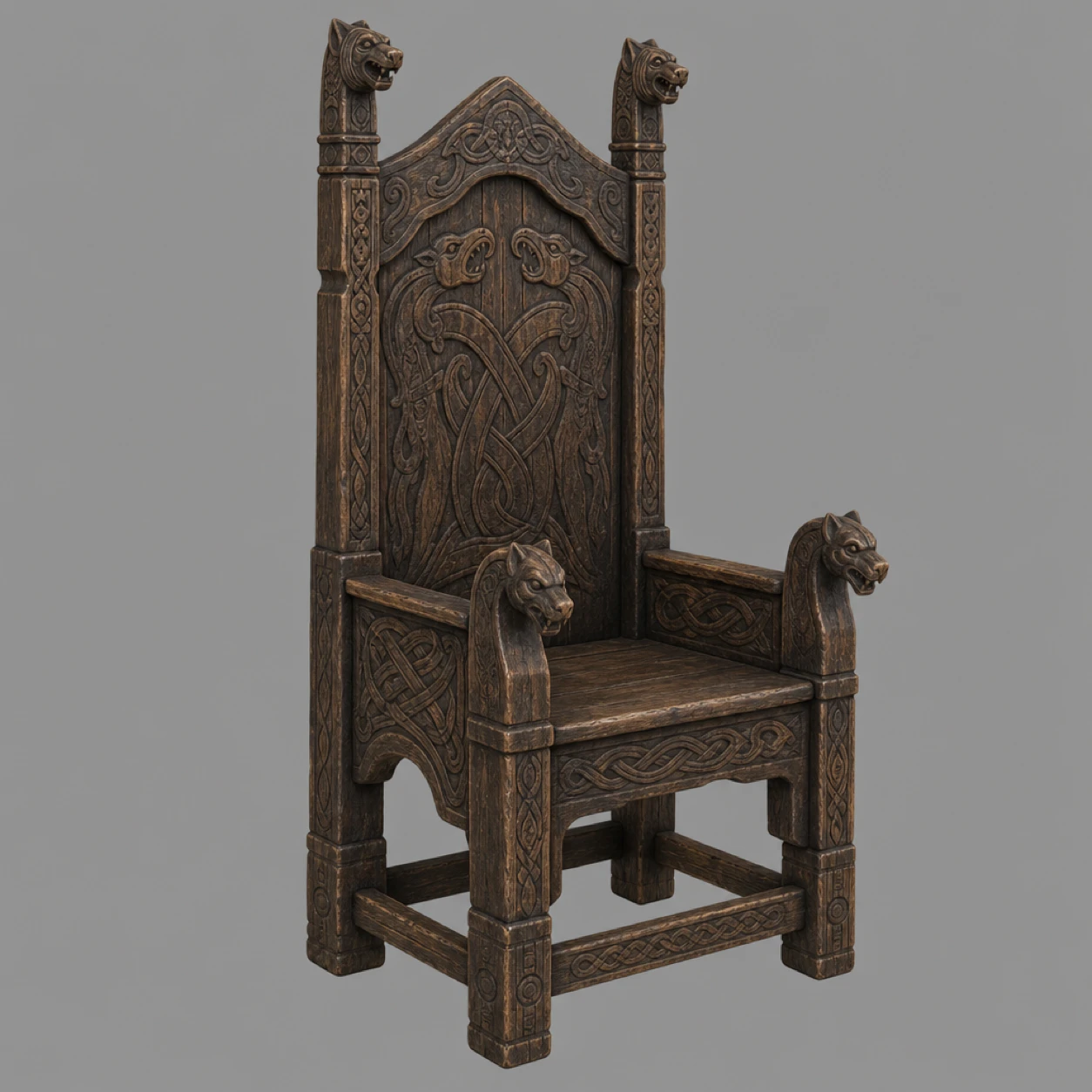
Place the high seat chair on the long wall facing the hearth, above the bench line, with room for a table and passing guests. Flank it with carved posts or hang tapestries to frame the chieftain's silhouette against the fire. Our Viking Hall Relics Vol. 2 pack includes a high seat chair model alongside cauldron, hnefatafl board, and other longhouse props for feast halls and Norse settlements.