Oseberg Cart: Gunnar, Serpents, and Freyja's Cats
The Oseberg cart is a carved wooden wagon from the richest Viking Age ship burial in Norway. It is not a farm cart or a fantasy wagon. Workers pulled it from the Oseberg mound in 1904, alongside the oak hull that held two women and a deck crowded with animals, textiles, and ritual gear. The cart survives because the mound sealed it in wet clay for more than a thousand years, and its panels still carry myth scenes that scholars read as Gunnar in a snake pit and cats linked to the goddess Freyja.
Oak body, ash shafts, and myth on the panels
Viking carts were rare even when new. The Oseberg example is built from joined timbers with a box that could be lifted off the running gear, a practical detail for loading it aboard a ship or dragging it over soft ground. Britannica describes it as a wooden cart carved and decorated like the ornate sleighs found in the same grave.
The carving is the point. On the front panel a man lies on his back while serpents strike at him, a scene widely tied to Gunnar from Old Norse legend, who was thrown into a snake pit after he could no longer play the harp that had charmed the reptiles. The back panel shows cats in relief. Britannica links those felines to Freyja, whose mythology includes a chariot drawn by cats. Interlaced animals, gripping beasts, and human faces fill the side boards in the early Viking decorative style that art historians often call Oseberg style. The cart reads as portable sculpture meant to be seen in motion, not a plain transport box.
An old wagon laid in a mound dated to 834
The cart entered the grave as part of the Oseberg burial on the Lille Oseberg farm near Tønsberg, uncovered in 1903 and excavated through 1904 and 1905. Dendrochronology on the burial chamber timbers points to 834 CE, while the ship itself was built around 820 CE in western Norway. World History Encyclopedia places the Oseberg find among the earliest preserved Scandinavian sailing ships and notes the burial as perhaps the richest Viking grave ever excavated.
Inside the chamber behind the mast lay two women on a bed inside a tent-like wooden structure. Raiders broke into the mound in antiquity and disturbed the bones, so their exact relationship remains debated. What survived intact was the staging: fifteen horses, six dogs, two cows, carved animal heads, chests, kitchen tools, imported buckets, and the cart with three ornate sleighs plus a simpler working sledge. Britannica argues that many of these objects were made for the funeral rather than retired from daily use, which would make the cart a commissioned piece for a single procession.
Wagons in burial display and woven procession scenes
Ship burials were public statements of rank. Dragging a decorated wagon into a mound beside a seaworthy hull told onlookers that the dead could travel by land as well as water in the next life. The Oseberg textiles strengthen that reading. Embroidered tapestries from the grave depict people, animals, houses, and carts in procession, suggesting that wagons and riders formed part of the visual language of elite funerals in ninth-century Vestfold.
The same grave held multiple vehicles for a reason. Three highly carved sleighs and one working sledge sat near the cart, each with its own ornament program, including tin-plated nails and painted patterns on one sledge. Together they imply a staged journey: perhaps a last ride to the mound, or a symbolic circuit performed before the ship was sealed. World History Encyclopedia notes that Scandinavian ship burials often included sacrificed animals and rich grave goods with strong regional variation, and Oseberg is the reference case for how much land transport could accompany a hull.
From ceremony to sealed chamber
We do not know whether anyone drove the Oseberg cart on the day of the burial. Roads in ninth-century Norway were tracks, not paved routes, and scholars have argued for decades over whether the wagon was purely symbolic or could still turn when assembled. The iron fittings and socketed shafts show skilled joinery, yet the carving would have been vulnerable on a long haul. What is clear is that the cart was valued enough to ship inland, lower into the mound, and leave beside a queenly display of horses and woven colour.
After excavation, conservators faced the same problem as with the ship timbers: waterlogged wood dries unevenly and cracks. The cart, sleighs, and animal-head posts all needed stabilising treatment in the twentieth century, and the ongoing Saving Oseberg project at the University of Oslo now monitors alum-treated wood from the find. The cart therefore belongs to both Viking Age ritual and modern conservation science.
The cart in Oslo beside the Oseberg ship
Today the wagon stands in the Museum of the Viking Age in Oslo, part of the Museum of Cultural History, near the reassembled Oseberg ship whose carved prow and clinker strakes draw most of the foot traffic. Britannica records the ship at roughly 21.5 metres long with pine deck planks on an oak hull, and notes that a new museum building began construction in 2023 to slow decay of the Oseberg, Gokstad, and Tune vessels.
Walking the gallery puts the cart in context. You see the same interlace that runs along the ship's rail, the same taste for animal heads on posts, and the same blend of practical joinery with narrative panels. The cart is smaller than the hull but no less deliberate: every face on the box was meant to be read by someone standing at ground level during a slow procession. Photographs from the 1904 dig show it still muddy, shafts detached, and carving crisp enough that modern moulds could later produce replicas for experimental archaeology.
One complete wagon, and arguments that continue
No other Viking Age burial has returned a cart this complete with its carved panels intact, which makes Oseberg the typological anchor whenever archaeologists find a wheel fitting or wagon fragment elsewhere in Scandinavia or northern Germany. Similar vehicles appear in wealthy women's graves in Denmark and Germany, but usually as partial remains, so generalising from Oseberg requires caution.
Debate still turns on function and belief. Was the cat panel an invocation of Freyja, a fertility goddess with funeral associations in later poetry? Does the snake scene recall Gunnar, or a generic warning about betrayal? Did the older of the two buried women own the wagon, or did attendants assemble all the vehicles for her send-off? DNA and isotope studies on the skeletons may narrow their origins, yet the cart's stories remain interpretations layered on secure facts: carved wood, dated mound, and a burial that paired land craft with a funeral ship meant never to sail again.
In your scene
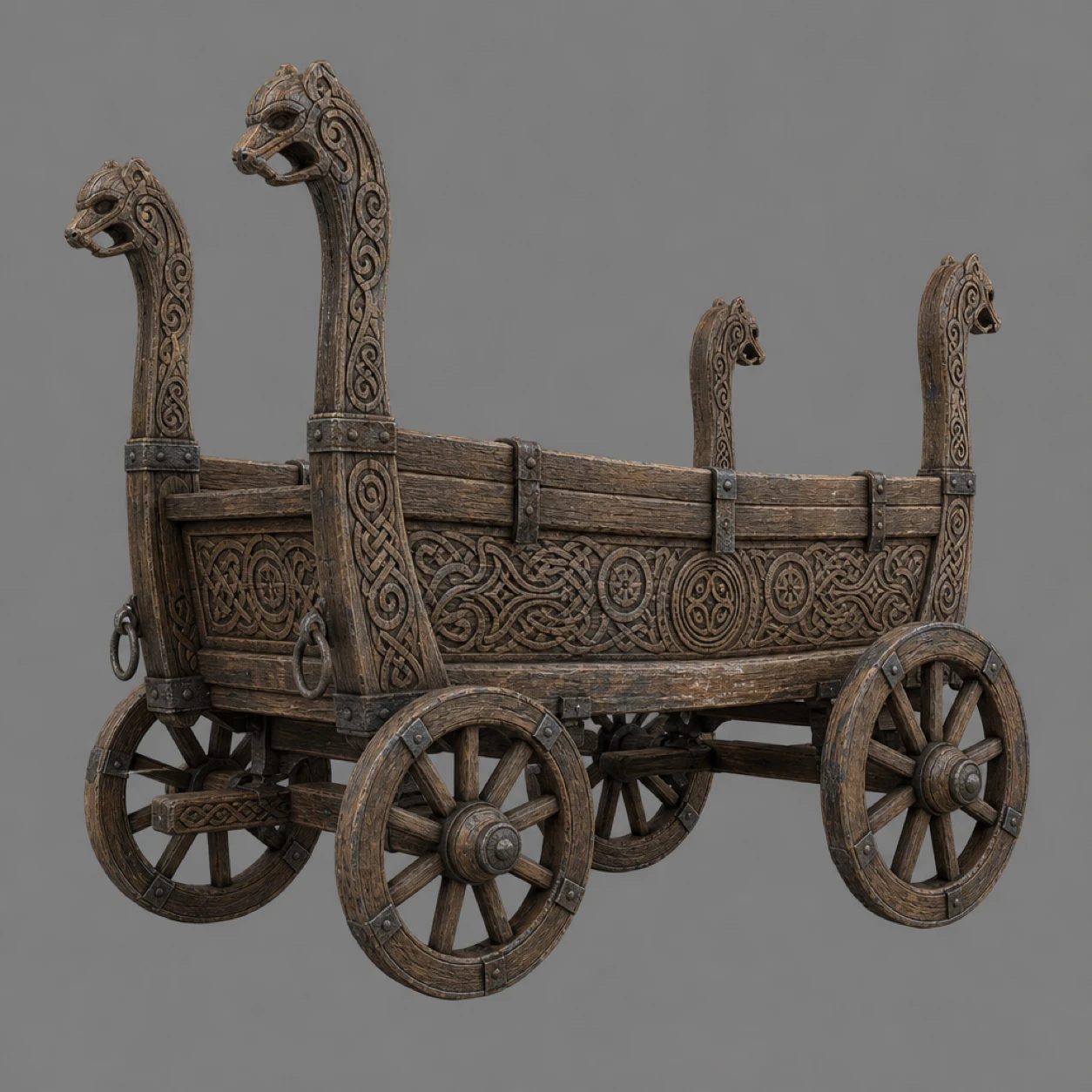
Place the Oseberg cart at the centre of a burial procession, with horses in harness and carved sleighs waiting beside a turf mound, or park it inside a chieftain's hall as prestige furniture too fine for farm work. Pair it with our Viking Hall Relics Vol. 2 pack when you need a historically grounded wagon rather than a generic medieval cart.