What Is an Ogham Stone? Ireland's Edge-Carved Alphabet
An ogham stone is a standing stone carved with letters from ogham, an early medieval alphabet used mainly for Irish and, in a few cases, Pictish or Latin text. Instead of rounded letter shapes, ogham writes with groups of straight strokes cut along, across, or on either side of a central line. On a typical monument that line is the natural arris, the sharp edge of the stone itself. Inscriptions usually run vertically and are read from the bottom upward. Most surviving examples record a personal name, often in a formula like "X, son of Y," and mark a grave, a boundary, or a family's claim to land.
Strokes on the arris and the twenty-letter grid
The core ogham alphabet has twenty letters in four groups of five, called aicmí. Each letter is built from one to five strokes on one side of the stem, or for vowels, short notches across it. Later scribes added five forfeda, extra characters for sounds that developed as Irish changed. The script is compact, which suits narrow stone edges and may also have made messages harder to read at a glance.
Spelling follows Primitive Irish, the language stage before Old Irish of the manuscript period. That lets linguists date inscriptions by sound changes even when archaeology gives no independent age. Names appear in the genitive case: you are reading "of So-and-so," not a modern nominative label. Word spacing is inconsistent; damaged arrises can erase strokes. Readers often rely on published drawings and 3D scans because faint cuts are easy to miss in raking light alone.
From the 4th century to reuse in souterrain roofs
Orthodox stone inscriptions are generally placed between the 4th and 7th centuries AD on linguistic grounds, with some later scholastic ogham on manuscripts running into the 9th century. The alphabet itself may be older than the earliest stones, since rare letters appear in the system but not in monumental texts. Origins are disputed: links to Latin, runes, or southern Irish invention all have advocates, and medieval Irish legend credits the god Ogma, which tells us more about later myth than about archaeology.
Distribution is uneven. Ireland holds the majority of roughly 400 known inscriptions; counties Cork and Kerry alone account for a large share, and the Dingle peninsula is especially dense. Wales, Cornwall, Devon, Scotland, the Isle of Man, and a handful of English sites carry smaller groups, often where Irish-speaking communities crossed the Irish Sea. Many Welsh stones add a Latin face, bilingual display for a literate church audience and a local audience tied to the older script.
Stones rarely stayed put. Early medieval builders reused carved pillars as lintels, gateposts, or souterrain roof slabs, breaking inscriptions and scattering findspots. Modern collectors moved others to estate drives and museum lawns. A stone standing in a neat row today may have spent centuries buried in a field or built into underground storage passages.
Memorials, kin names, and markers on the land
Ogham stones were not public notices in the modern sense. They named the dead, affirmed descent, or warned that a territory had an owner. Formulas mention a person's father and sometimes a tribal ancestor, the kind of information that mattered where land and obligation passed through kin networks. A few inscriptions add Latin or later crosses when Christianity arrived, layering new belief onto old stones rather than replacing the landscape all at once.
The script also appears on portable objects and, in later centuries, in manuscript margins, but the standing stone is the image most people recognise. For Iron Age and early medieval Ireland, where timber and earth dominated building, a carved pillar was a durable statement: this name belonged here. That is why ogham stones cluster along routeways, church sites, and tribal heartlands in Munster rather than appearing randomly across every field.
The Dunloe stones and a reused souterrain lintel
Eight ogham pillars now stand at Coolmagort near Beaufort, County Kerry, in state guardianship as the Dunloe Ogham Stones. Seven came to light in 1838 at Coolmagort, where they had been recycled as lintels for an early medieval souterrain, an underground passage used for storage and possibly refuge. An eighth stone, on the left of the present row, was found at Kilbolane church site. They were assembled in their current line in 1945.
Several inscriptions name members of a group linked to the ancestor Toicacas, a reminder that these stones spoke for lineages, not isolated individuals. One reads in part MAQI-TTAL MAQI VORGOS, naming a son of Fuirg in the genitive chain typical of the corpus. Reading them on site means walking the arris bottom to top, exactly as carvers intended, while remembering that each block once stood elsewhere and served another structure before antiquaries rescued the texts from farm walls.
Lost wood, broken edges, and readings still argued
Most ogham was probably cut on wood that rotted away; stone preserves a biased sample of a wider writing habit. Breaks, weathering, and reuse remove strokes; scholars reconstruct missing letters with brackets in editions. A single stone may carry more than one hand or phase of carving, as at Kilbolane, where three separate texts run on one pillar.
Chronology by language is powerful but not exact: two inscriptions with similar grammar need not be contemporaries. Pictish ogham in Scotland remains partially undeciphered. Even well-studied Irish texts occasionally revise when better photography reveals an extra notch. The corpus is small enough that each new discovery or 3D model can shift a reading.
In your scene
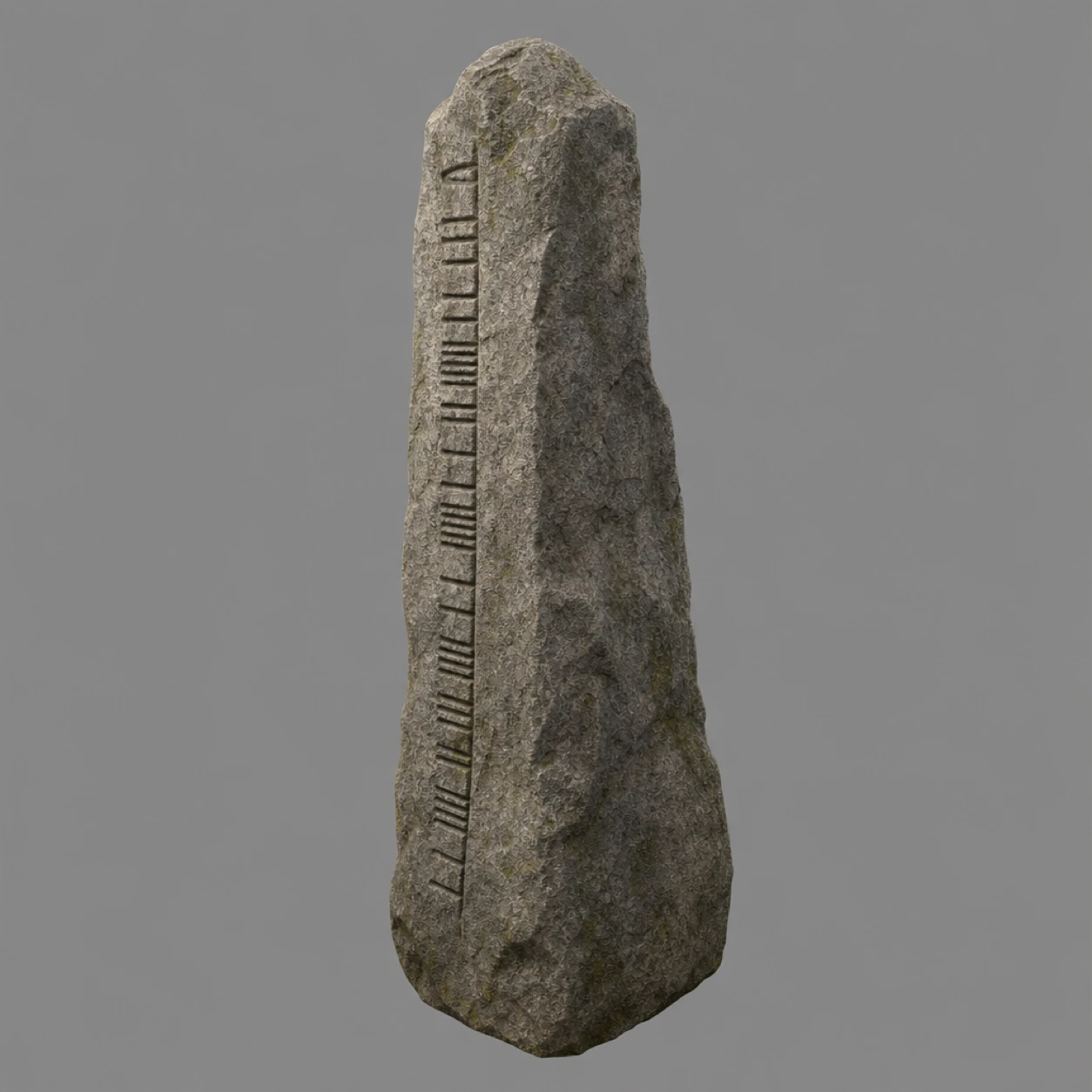
Place an ogham stone where a path meets a hill-fort rampart or sacred grove, angled so the edge cuts catch light. You do not need a readable inscription in your level; the stroke pattern on the arris signals early medieval Ireland more quickly than a Latin cross alone. Our Celtic Ritual Relics pack includes an ogham stone model suited to ritual sites and coastal headlands in the Irish Sea world.