What Is an Ifa Tray? Yoruba's Opon Ifa for Divination
An Ifa tray is a wooden divination board, called an opon Ifa (also written ọpọ́n Ifá), used by Yoruba diviners in southwestern Nigeria and in related practices across West Africa and the diaspora. In a consultation, the board's flat centre is dusted with powder. The diviner records the outcome of castings as marks in that powder, then chants the matching verses that counsel the client. The tray is not a decorative platter. It is the working surface of Ifa, the system through which people consult Orunmila, the orisha of wisdom and fate, for help with misfortune, marriage, travel, and other decisions that matter.
Opon Ifa: board, rim, and the face of Eshu
Most trays are flat wood, often circular, sometimes rectangular or oval, with a raised carved rim and a smoother inner field for powder. The Smithsonian National Museum of African Art describes the companion tools that travel with the board: an iroke Ifa (tapper) used to signal the deity, an agere Ifa cup that holds the sixteen sacred palm nuts, and the opon Ifa itself, where the diviner marks the odu, the corpus of verses that prescribe what to do next. English labels may say "divination tray," "divination board," or "Ifa tray"; Yoruba names keep the ritual job visible.
The rim almost always carries at least one carved face. Museum labels identify that face as Eshu (also written Esu), the messenger who mediates between human and spirit worlds and oversees the session. Cleveland Museum of Art's twentieth-century tray shows four Esu faces on the rim, with kneeling petitioners, a leashed sacrificial animal, and liminal creatures such as turtles, mudfish, and snails. Those animals can live on land and in water; Cleveland reads them as signs of the diviner's work between realms. Cowrie-shell bands carved on some borders echo shells that may be cast during a session.
Orunmila's counsel in Yoruba towns
Clients come to Ifa when a problem is serious enough to need Orunmila's knowledge. Smithsonian board labels put it plainly: for serious problems, Yoruba people go to an Ifa diviner to consult Orunmila, the god of fate. A numerical pattern is obtained and recorded on the board; the diviner then recites the verses tied to that pattern. The Art Institute of Chicago notes that trays are used by male or female diviners, a reminder that museum language about who may sit at the board can differ from older textbook shorthand that names only the male babalawo ("father of secrets").
Ifa is a lived practice, not a single archaeological freeze-frame. It remains active in Yoruba communities and in Afro-diasporic religions that keep related divinatory systems. The board on a museum shelf is one tool from a larger kit. Without the powder, the nuts or chain, the tapper, and a trained voice that knows the verses, the carved wood is silent.
Powder, palm nuts, and odu marks
Cleveland's object text walks through the core gesture. The priest sprinkles wood powder over the smooth inner surface. As sacred palm nuts are cast, the diviner records the results by marking the powder, and those markings point to the proper chants. Smithsonian cup labels add the wider kit: the tapper announces the deity; the sixteen palm nuts are manipulated during the ritual; the marks on the opon Ifa identify an odu from the verse corpus that tells the client what action will secure a better outcome.
Sources disagree on small procedural details, and that disagreement is useful. Cleveland associates an ivory tapper with marking the powder. Smithsonian language ties the tapper more to signalling the deity. Both can be true across workshops and lineages. What stays stable is the board's job: a prepared field where chance castings become readable signs, then spoken counsel.
From Owo workshops to named carvers
Trays in Western collections are mostly late nineteenth- or twentieth-century wood. Smithsonian's Disney-Tishman board from Owo, Nigeria, is dated late nineteenth to early twentieth century and measures 36 × 38 × 2 cm. Cleveland's example is catalogued simply as "1900s," diameter 42 cm, thickness 3.2 cm. The Metropolitan Museum of Art holds several Yoruba opon Ifa, including object 1983.603.11, a wood tray 38.7 × 39.4 × 2.5 cm, dated nineteenth to twentieth century and given by Martin L. Schulman in 1983.
Border carving is status and persuasion as well as cosmology. Crowded rims with Eshu, petitioners, animals, and kingship images advertise a serious tool. Some boards stay nearly anonymous. Others carry a named workshop hand. That range matters when you read a museum label: the object may document a regional style, a donor gift history, or, more rarely, a known carver.
Areogun's tray you can still see
One named example is the Art Institute of Chicago's Tray (Opon Ifa), reference 1999.289, carved by Areogun (c. 1880–1954) of Osi-Ilorin, Nigeria, mid-twentieth century, probably the 1930s. The museum lists wood and pigment and gives dimensions of 45.8 × 44.5 × 1.3 cm. The label states that the tray features Eshu as divine mediator. His face is framed by mothers kneeling to make offerings in bowls. A priest with a staff below one of them refers to Osanyin, the deity of herbal medicine. A carved cowrie-shell band recalls real shells cast onto the tray in session.
Areogun's board is useful because it is not a generic "African tray." It ties a working Ifa surface to a documented Yoruba sculptor, a town, and a mid-century date range. Compared with Cleveland's anonymous four-face rim or the Smithsonian Owo board's dense animal and kingship imagery, the Art Institute piece shows how the same ritual type can carry different narrative programs around a shared Eshu focus.
What labels still leave uncertain
Exact session rules vary by lineage, and museum captions compress them. Whether every mark is made with a tapper tip, a finger, or another tool is not settled by a single label. Dates are often broad ("1900s," "19th–20th century") because wood ritual gear was used hard and collected late. Village workshops and patrons are frequently unrecorded; donor credit lines replace carving biographies.
Do not treat every carved face as a portrait of Orunmila. The rim face that museums name is Eshu, the messenger and force of chance, not the wisdom deity being consulted. And do not confuse the opon Ifa with the agere Ifa cup that holds the nuts, or with decorative bowls that never saw powder. The tray's identity is the powder field and the odu marks, not the rim alone.
In your scene
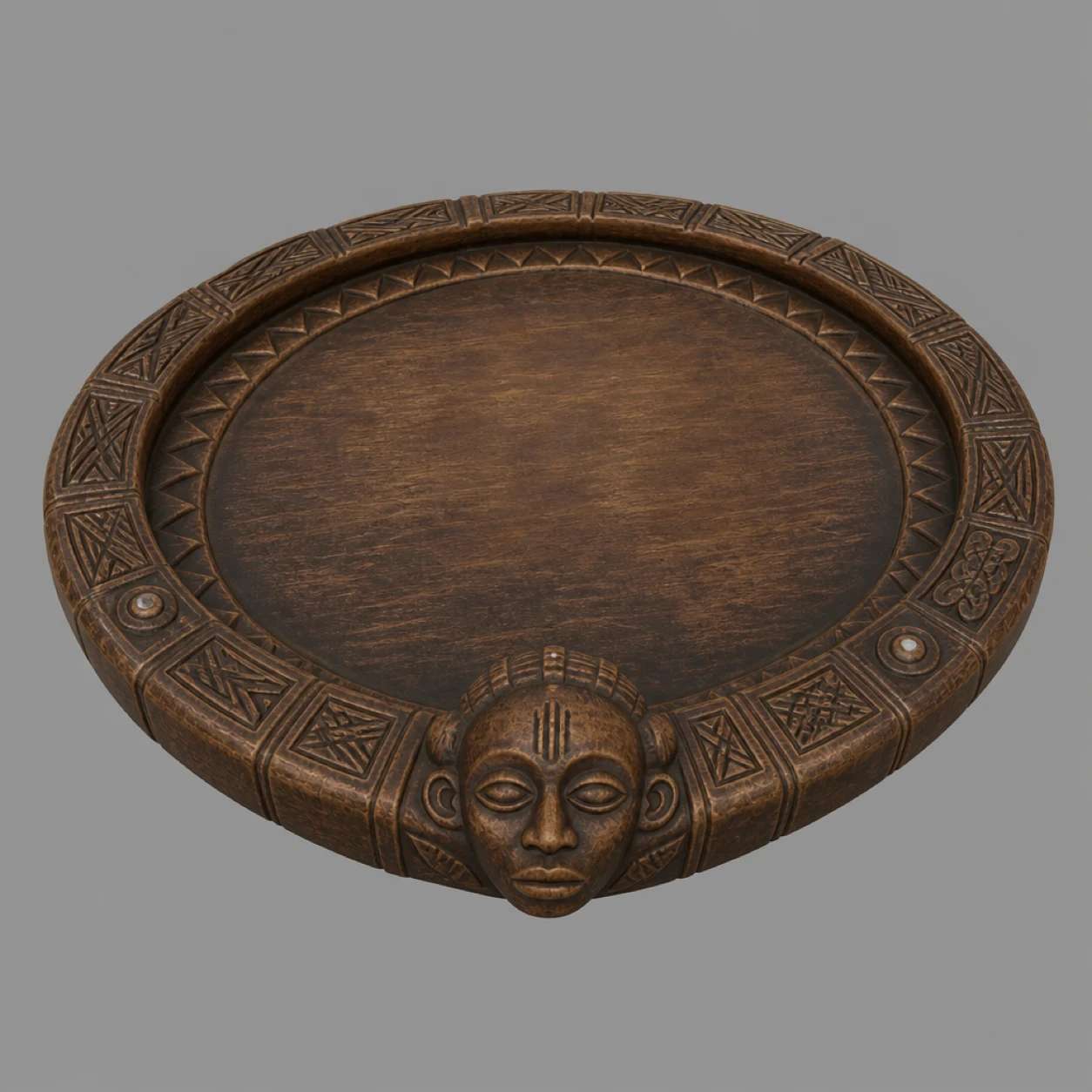
An Ifa tray reads as a low, rimmed board with a clear centre for powder and at least one Eshu face watching the session. Place it with a tapper and nut cup nearby if you want the full kit, or alone as the quiet heart of a diviner's room. For matching Yoruba and court props, including the talking drum, see the African Kingdom Relics pack.
Sources
- Art Institute of Chicago: Tray (Opon Ifa) by Areogun, 1999.289
- Cleveland Museum of Art: Divination Tray (ọpọ́n Ifá), 1993.235
- Smithsonian National Museum of African Art: Divination board, nmafa_2005-6-69
- Smithsonian National Museum of African Art: Divination cup label on Ifa implements, nmafa_85-1-9