Ayo Board: Yoruba Count-and-Capture Play on Wood
An ayo board is the wooden playing surface for ayo (also ayoayo, ayò ọlọ́pọ́n), the Yoruba count-and-capture game from southwestern Nigeria. English labels often fold it into the broader family name mancala, or set it beside West African oware and wari. The board itself is the opon ayo: usually two parallel rows of six cuplike holes where players sow hard seeds by hand. Strategy matters more than luck. The aim is to capture a majority of the pieces, or at least leave the opponent unable to move well.
Opon ayo, cups, and the seeds in play
The standard Yoruba layout that museums and field notes treat as typical is a 2-row, 12-hole board. Each player sits on one long side and owns the six cups nearest them. Counters are hard, grayish-green, inedible seeds rather than carved pawns with individual identities. Boards can be plain scooped wood, hinged boxes that store the seeds, or heavily carved prestige pieces with figures and snakes.
Britannica's survey of Nigerian arts lists ayo boards among everyday carved objects that serve secular functions, grouping them with kola bowls and noting that the game is also known as wari, played with seeds or pebbles in two rows of cuplike depressions. That short notice places the board inside Yoruba woodcarving practice, not only inside abstract game theory. The opon is a made object with a social life beyond any single rules sheet.
From Niger-Congo sowing games to Yoruba ayoayo
Mancala is a family name, not a single patented ruleset. The British Museum's collection notes call it a generic term for games still played across Africa, Asia, the Caribbean, parts of South America, and the Middle East. Pieces can be seeds, shells, or whatever comes to hand; boards can be dug into earth, carved into rock, or shaped from wood because the sound of sowing into cups is part of the game. The same notes name ayo in Nigeria and wari across West Africa and the Caribbean among the best-known two-row versions.
Smithsonian curators describe ayoayo as the Yoruba form of this family and gloss the name as "real ayo," a men's term used to distinguish their game from versions associated with women and children. How far back any one wooden opon goes is a different question from how old sowing games are in West Africa. Surviving carved boards in museum cases are often twentieth-century. Claims that push the family into deep prehistory are easy to find online and hard to pin to a named Yoruba board with a secure excavation date.
Evening shade, spectators, and boards as status
In Yoruba towns the game belongs as much to social time as to abstract strategy. Players gather after work under shade trees or on verandahs. Passers-by comment, joke, and track who is winning. Finely carved boards were not only toys: the Smithsonian notes that elaborately decorated examples were emblems of elevated political or social status and could be given as prestigious gifts to important visitors. Supporting figures, paired humans, and snake motifs turn a counting board into a display of carving skill and rank.
That status layer matters when you look at a silent museum piece. A plain ground-dug set of holes and a Barbier-Mueller gift board with ten supporting male figures are the same game family, but they send different signals about who owns the play and who is meant to watch.
From earth cups to carved prestige gifts
At the humble end, players scoop holes in soil, sand, or tree roots and use whatever seeds are at hand. At the high end, professional carvers produce wooden boards that travel as gifts and later enter ethnographic collections. African captives also carried related count-and-capture games to the Americas during the Atlantic slave trade, which is one reason Caribbean wari / warri sits so close to West African two-row play in museum labels.
What changes over time is less the basic geometry of two rows of cups than the materials, patronage, and venues: courtyard and market shade, then colonial collecting, museum exhibition, classroom demos, and digital remakes. The living game still depends on memory of local rules. The museum board freezes one carved surface and usually loses the exact house rules that once went with it.
The Smithsonian Yoruba gameboard you can still see
One named object is the National Museum of African Art's Gameboard, object 93-2-1, gift of Monique and Jean Paul Barbier-Mueller. The museum attributes it to a Yoruba artist in Nigeria, dates it to the early to mid-twentieth century, and lists the medium as wood. Dimensions are 9 × 65.5 × 18.6 cm. The form is a two-row, six-cup board with crouching figures between the cups and a standing male and female pair at one end.
Smithsonian label text states that this elaborately decorated example is supported by 10 male figures and finished with a male-female couple at one end and a pair of snakes at the other. It was shown in the museum's Gameboards exhibition (1998) and in Art of the Personal Object (1991–2007), and it appears as no. 79 in the 1999 Selected Works catalogue. That paper trail makes it a concrete witness: not a generic "African mancala," but a Yoruba opon ayo carved as a status object within living memory of museum collecting.
Names, rulesets, and what remains uncertain
Do not treat ayo, ayoayo, oware, wari, and commercial Kalah as one identical rulebook. They share sowing and capture on cup boards, yet capture conditions, direction of play, and endgame feeding rules vary by community and by the collector who wrote them down. Smithsonian text stays at the family level: capture a majority of pieces or immobilize the opponent; strategy over luck. Exact seed counts and capture sequences belong to local practice and to specialist rule collections, not to every museum label.
Maker names are often missing. Dates on early-to-mid-twentieth-century gifts are ranges, not workshop stamps. Deep origin stories that leap from a modern Yoruba board to Egyptian pyramids or to a single invention date should be treated with caution unless a specific excavated board is cited. What is secure is narrower and more useful: Yoruba players use a two-row opon ayo; related two-row games are widespread; carved boards can mark status; diaspora play carried close cousins across the Atlantic.
In your scene
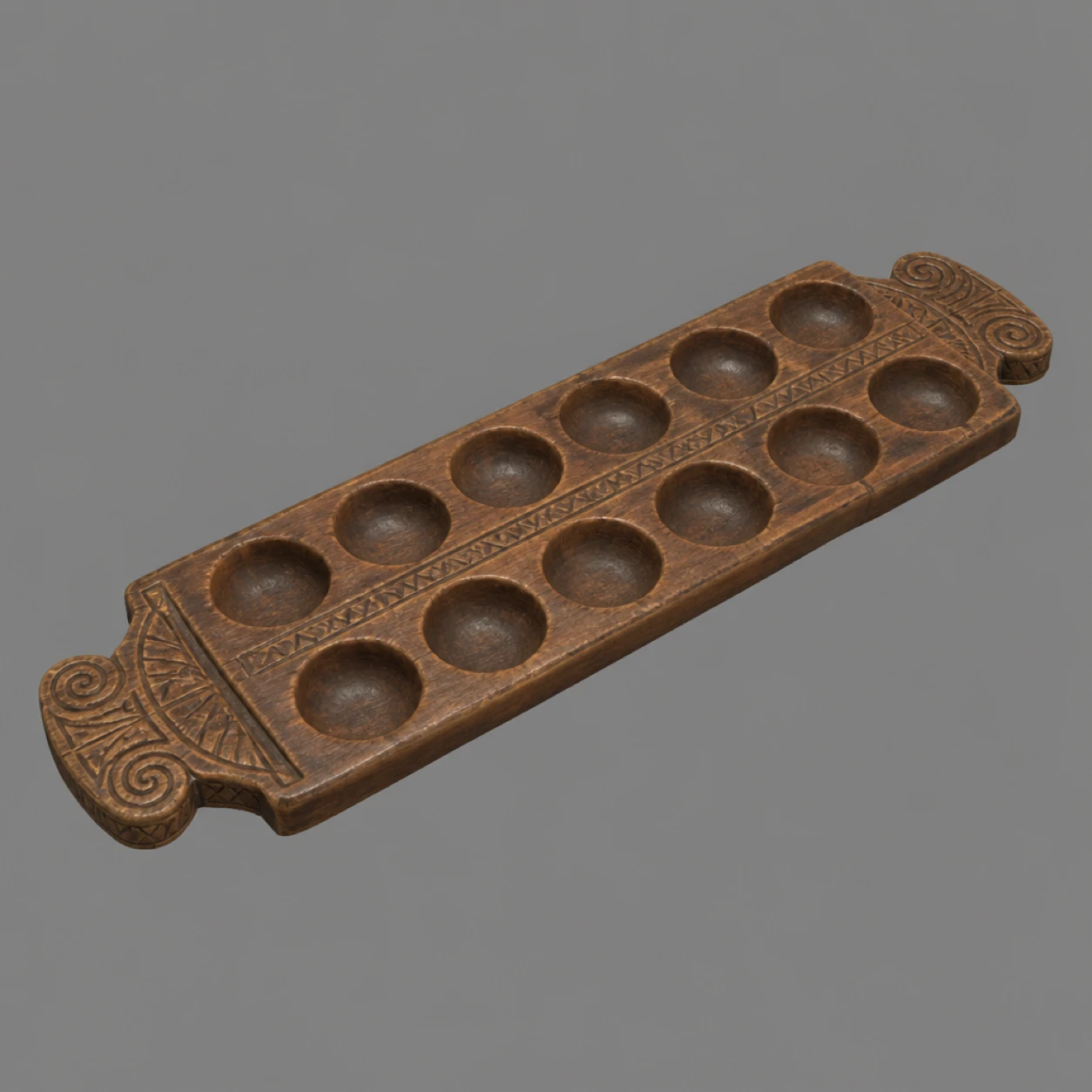
An ayo board reads as a horizontal social prop: two rows of cups, optional end stores, seeds ready to sow, space for two players and a small crowd. Place it where people pause after work, not only on a palace altar. For matching West African court and town props, see the African Kingdom Relics pack.