Late Uruk Temple Offerings: The Warka Vase in Alabaster
In April 2003, looters wrenched a tall carved vessel from its case at the Iraq Museum in Baghdad. The foot snapped off with the display stand. In June, three young men returned fourteen alabaster fragments in a red Toyota. That was not any storage jar. It was the Warka Vase, a slim alabaster offering vessel carved in relief around 3000 BCE for an Inanna temple complex at Uruk. The name Warka comes from the modern Arabic label for the ruin mound where Sumerian Uruk once stood in southern Iraq.
Alabaster, three registers, and reed-bundle signs
The Warka Vase, also called the Uruk vase, is a carved alabaster vessel just over a meter tall. World History Encyclopedia dates it to the Jemdet Nasr period, roughly 3000 to 2900 BCE. Its relief is divided into three horizontal registers, though cataloguers sometimes count four because a narrow band splits the lowest tier.
The bottom register shows water, plants, and crops: date palm, barley, and wheat. Above that band, alternating rams and ewes march in profile. The middle register carries a procession of nude men with bowls and jars of fruit and grain. The top register is a full scene, not a repeating pattern. A female deity stands before a shrine marked by two reed-bundle standards, the emblem of Inanna. A figure in a ceremonial kilt leads the procession toward her. A nude attendant offers a bowl of produce. The carved stone was heavy, precious, and meant to be read from bottom to top as gifts move from field to goddess.
From the 1933 dig to Jemdet Nasr dating
German archaeologists excavated the vase in fragments in 1933 to 1934 at an Inanna temple complex at Uruk. World History Encyclopedia dates it to the Jemdet Nasr period, roughly 3000 to 2900 BCE. Some catalogues give a slightly wider bracket around 3100 to 2900 BCE. The honest range is stylistic: the vase belongs to the late Uruk world when southern Mesopotamian cities were building temple economies and the first experiments in writing.
Uruk itself was among the largest urban centers of that age. World History Encyclopedia describes it as a hub of trade and administration in the late fourth and third millennia BCE, with the Eanna district dedicated to Inanna. The vase fits that moment: monumental stone carving in service of a city goddess.
Procession to Inanna at the Eanna district
Inanna, later known to Akkadian speakers as Ishtar, was the patron deity of Uruk. Her temple complex at Eanna received votive gifts that tied earthly harvest to divine favor. The Warka Vase pictures that logic in stone. Wild plants and flocks rise through the registers until a ruler-priest delivers produce to the goddess at her gate.
Many guides call the top scene a sacred marriage between king and goddess, a ritual meant to secure fertility for the land. Specialists treat that reading as contested. The relief clearly shows an offering procession ending at Inanna's shrine. What is secure is the political-religious job: the Mesopotamian ruler as chief priest presents agricultural wealth to the goddess who owns the city's fortune.
World History Encyclopedia describes the vessel as a votive or sacred vase, ceremonial stone rather than table pottery.
From German dig to museum looting and return
After excavation the vase entered the Iraq Museum in Baghdad. It had already been broken and mended in antiquity. That survival mattered little to the looters in 2003. They toppled the case and tore the vessel from its reconstructed base.
On 12 June 2003 three unidentified men drove to the museum gate with fourteen pieces wrapped in a blanket. World History Encyclopedia reports that the base and upper margin suffered significant damage in the theft. Conservators reassembled the vase, and it returned to display in the museum's Sumerian Gallery. The episode turned a late-fourth-millennium temple offering into a symbol of Iraqi heritage at risk, then of partial recovery. The original still sits in Baghdad.
The Warka Vase at the Iraq Museum you can still see
The object to anchor is the vessel itself, on display in the Sumerian Gallery of the Iraq Museum in Baghdad. World History Encyclopedia describes it as about one meter tall, carved from alabaster and dated to the Jemdet Nasr period, 3000 to 2900 BCE. Museum photography shows the full height beside a standing viewer, which makes the scale clear: this was a temple monument, not table pottery.
Read the relief from the bottom up. Marsh plants and a queue of rams and ewes fill the lowest band. Nude bearers with bowls and jars climb the middle register. At the summit, Inanna stands before reed-bundle standards at her shrine while a robed figure leads the offering and an attendant presents a bowl of fruit and grain. Close views show ancient repair lines, evidence that the vase mattered long before modern museums existed.
Among Uruk stone vessels, this example is exceptional for narrative length and size. World History Encyclopedia ranks it among the earliest surviving works of Mesopotamian narrative relief from the city that also produced the Uruk Trough and the Mask of Warka.
Sacred marriage, registers, and what scholars dispute
Not every detail on the vase is settled. The identity of the robed leader is usually read as a king or ruler-priest, but the stone does not name him. The female figure is widely identified as Inanna from the reed-bundle emblems; some older labels called her a priestess. Register counts vary because the plant and animal bands can be split or merged. Date brackets differ by a century or more depending on whether excavators stress the find layer or typological parallels.
Weight and exact rim diameter vary in published notes, but the scale is consistent: alabaster had to be quarried, transported, and worked by skilled hands for a single ceremonial purpose. Where guides invoke the sacred marriage, treat that as interpretation, not inscription.
In your scene
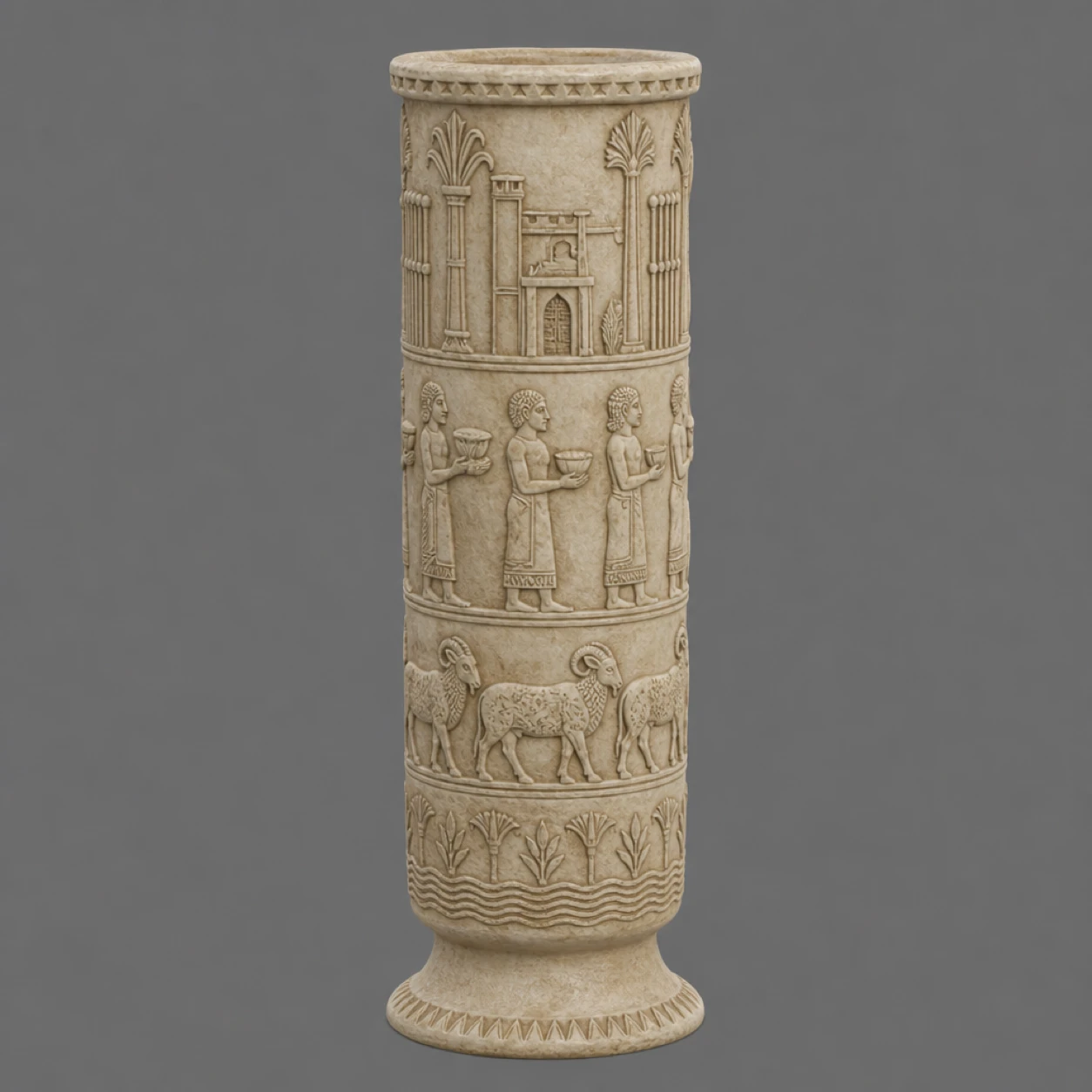
A Warka vase reads as temple furniture, not tableware. Give it height (near human scale), a stone or podium base, and space for the eye to climb three registers from plants and flocks to Inanna's reed-marked shrine. For a full Mesopotamian temple set, see the Mesopotamian Temple Relics pack.
Sources
- World History Encyclopedia: The Warka Vase
- World History Encyclopedia: The Warka Vase at the Iraq Museum
- World History Encyclopedia: Uruk
- World History Encyclopedia: Warka Vase bottom register
- World History Encyclopedia: Warka Vase middle register
- World History Encyclopedia: Offering to Inanna, Warka Vase top register
- Encyclopaedia Britannica: Warka Vase