What Is a Votive Statue? Tell Asmar's Wide-Eyed Temple Worshiper
Someone left a small stone man in the temple cellar, hands locked together and eyes fixed forward, so the god would never run out of a worshipper. That is the practical shock behind the Sumerian votive statue: not a portrait for the wall, but a stand-in body set among other gifts in a crowd of figures to keep attention on the shrine day and night. A votive statue, often called a worshiper figure in museum labels, is a carved human image commissioned as a gift to a temple deity. The donor paid for stone, shell, and bitumen so the figure could occupy sacred space on their behalf long after they walked away.
Clasped hands, shell eyes, and the staring gaze
The type Wildform models matches the standing male worshiper from Early Dynastic Mesopotamia: feet together, bare chest or a simple rolled edge at the shoulders, a flounced skirt, and both hands clasped at the chest. The head is oversize for the body, the nose sharp, the beard sometimes indicated with bitumen paint. The defining feature is the eyes. Carvers hollowed the sockets and set white shell for the eyeballs, black limestone for the irises, and bitumen to fix them in place. The result is an unnerving wide-eyed stare that reads as perpetual attention rather than a snapshot expression.
Materials vary by workshop and city. The Metropolitan Museum of Art catalogues its famous Tell Asmar example as gypsum alabaster with shell, black limestone, and bitumen. World History Encyclopedia describes other figures from the same site as veined gypsum. Labels and excavators do not always agree on whether to call the stone gypsum or limestone. What matters for recognition is the composite construction: soft carved body, hard imported eyes, and black adhesive that also darkened hair and beards.
Early Dynastic Eshnunna and the Square Temple of Abu
These figures cluster in the Early Dynastic period, roughly the third millennium BCE, when Sumerian city-states competed through temple wealth and irrigation works. Eshnunna, modern Tell Asmar in the Diyala region east of Baghdad, was one such centre. World History Encyclopedia places votive worshipers from the hoard inside the Square Temple of Abu, the local god, in levels dated Early Dynastic III, about 2600 to 2400 BCE in that caption. The Met dates object 40.156 slightly broader, Early Dynastic I-II, about 2900 to 2600 BCE. The overlap is normal: temple cellars accumulated gifts across generations, and period labels shift with the stratigraphy you measure.
They stood in the temple interior, often grouped by size and material, so a visitor met a silent crowd facing the cult statue. World History Encyclopedia's survey of Mesopotamia notes that every major city built a temple complex at its centre. Donors who could afford stone bought a permanent place in the god's house.
Presence in stone rather than a single prayer
Mesopotamian religion treated divine images as inhabited after the proper rituals. The Met's label on object 40.156 applies the same logic to humans: people were considered physically present in their statues. The figure therefore did not merely represent someone who once prayed. In temple thought it was a substitute body that continued the act. Museum prose often says the statue was placed to pray perpetually on behalf of the person it represented. Scholars debate how far that wording should be read as active prayer versus attentive standing presence. The pose never changes, the eyes never close, and the gift was meant to outlast the donor's lifetime.
Some Tell Asmar figures hold cups rather than clasped hands, as in the pair now in the Iraq Museum in Baghdad. Royal inscriptions name kings and kin; many smaller stones carry no text. The clasped-hands male type remains the textbook image because museums outside Iraq, especially the Met, made one example famous.
From packed cellars to dispersed museums
The best-known group from Tell Asmar, often called the Tell Asmar hoard, comprises twelve statuettes from the Square Temple context; World History Encyclopedia says seven are on display in the Sumerian Gallery of the Iraq Museum in Baghdad. Other pieces entered Western collections in the 1933 to 1934 dig season, which is why students meet the wide-eyed worshiper in New York textbooks while Iraq keeps a related cluster at home.
Later rulers commissioned larger inscribed prayer statues. Gudea of Lagash is the famous example with clasped hands and a ruler's cap. Early dynastic votives established the grammar: frontal pose, exaggerated eyes, gift to the temple cellar.
The Met's standing male worshiper, object 40.156
The clearest named anchor outside Iraq is the Metropolitan Museum of Art's Standing male worshiper, accession 40.156, purchased with the Fletcher Fund in 1940. The Met attributes it to Sumerian Eshnunna (Tell Asmar), dates it about 2900 to 2600 BCE, and gives the dimensions as 29.5 by 12.9 by 10 cm. The figure stands with clasped hands and wide-eyed gaze, placed in the Square Temple, perhaps dedicated to Abu, to pray perpetually for its donor. As of the museum's online record, the sculpture is not on view.
Compared with the cup-bearing pair in Baghdad, 40.156 is the austerity version: no libation bowl, no animals incised on the base, only the locked hands and staring shell eyes. That spare profile is exactly what makes it the usual match for modern reproductions of the Tell Asmar worshipper. It carries no preserved inscription naming a king, so it stands for the anonymous devotee class that filled temple floors, not a single documented patron.
Gypsum, inlaid eyes, and questions labels still leave open
Bitumen beards flake. The word prayer on a gallery card compresses a theology of embodied presence that cuneiform prayers express in more nuance.
Date ranges will keep shifting as Diyala chronology is refined. Material names will keep alternating between gypsum and limestone in different catalogues. What remains secure is the cultural job: a stone substitute that kept a human attention pointed at the god while the living worshipper went back to the fields. The wide eyes were the point.
In your scene
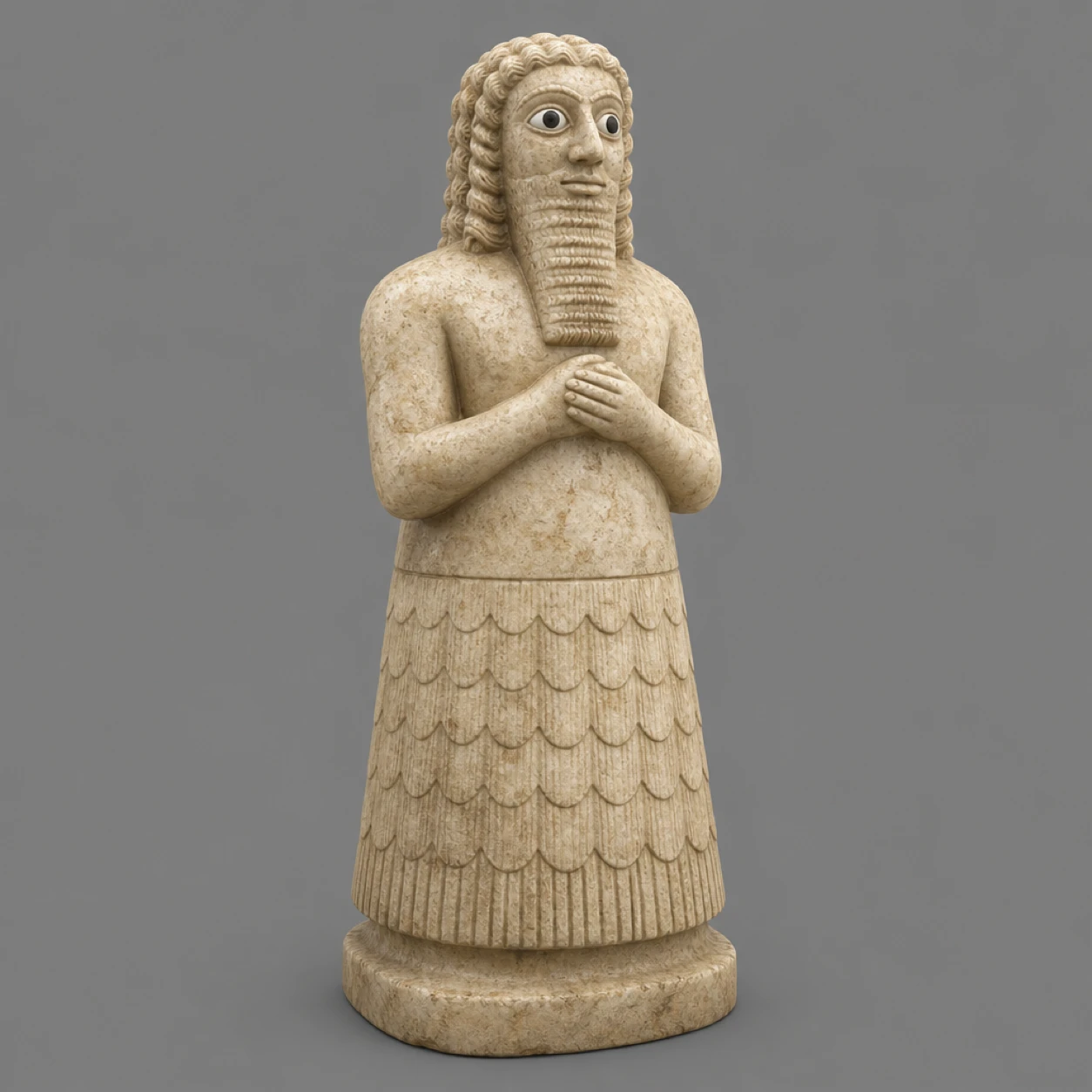
A votive statue belongs on the temple floor, not on a market stall. Face it toward the cult image or sanctuary doorway, group several at different heights, and keep the clasped-hand pose and oversized inlaid eyes consistent. For a full Mesopotamian shrine set, see the Mesopotamian Temple Relics pack.