Tlemaitl: Copal Smoke and the Rattling Fire Ladle
A tlemaitl is a hand-held clay censer from central Mexico, better described as an incense ladle than as a fire drill. The Nahuatl name joins tletl (fire) with maitl (hand or arm), so the object is literally a "fire-hand": a shallow bowl on a long handle used to scoop live coals, sprinkle copal resin, and lift fragrant smoke toward the gods. It is not the wooden mamalhuaztli that drilled new fire at the fifty-two-year ceremony, and it is not a stationary temple brazier. The tlemaitl moved with the priest.
Fire-hand, bowl, and the rattling handle
Colonial dictionaries and the Florentine Codex gloss the word as an incense ladle, a clay censer, or a portable hand brazier. The form is unmistakable in manuscript art: a spoon-shaped pan attached to a cylindrical handle that can run longer than the bowl is wide. Many handles were hollow and packed with small ceramic pellets or pebbles so the ladle rattled when shaken, turning each offering into a sound as well as a smell.
The bowl itself was often perforated or left openwork so heat and smoke could pass through. Copal, the aromatic resin of Mesoamerican conifers, was dropped onto hot coals inside the pan. Surviving ceramics range from plain orange ware to polychrome ladles painted after firing. Size varies widely, from pieces that fit in one hand to examples approaching half a metre in length in museum collections.
From Classic ladles to Mexica temple craft
Ladle-shaped censers appear across Mesoamerica long before the Aztec empire. Archaeologists find fragments in domestic middens and in deliberate ritual dumps where vessels were broken after use. Sahagún's sixteenth-century informants still called the same tool by the same name, which suggests continuity in practice even as imperial Tenochtitlan scaled up temple ceremony.
In the Basin of Mexico, excavations around the Templo Mayor precinct have produced polychrome tlemaitl fragments, including serpent-headed handles recorded by early twentieth-century archaeologists. The type was not exclusive to the Mexica. Mixtec and other highland potters made closely related ladles, sometimes painted with symbols tied to Tezcatlipoca, the Smoking Mirror god. What changed under Aztec rule was chiefly frequency and visibility: incense accompanied state ritual on a schedule that Spanish friars thought worth writing down in detail.
Tlenamaquiliztli before deity images
Aztec sources name the incense rite tlenamaquiliztli, the "offering of fire." A priest called a tlenamacac worked at the hearth or brazier, lifted coals into the tlemaitl, and scattered copal so smoke rose in a thick column. Sahagún's Nahuatl text, preserved in the Florentine Codex, describes priests grasping the ladle, raising it in dedication to each of the four directions in the courtyard, then casting it into the hearth so the offering could continue to burn.
World History Encyclopedia notes that Aztec worship included burning incense alongside music, processions, and sacrifice. Ceramic braziers at Tenochtitlan held copal and other offerings while smoke was understood to carry gifts to the gods. The portable ladle let a priest bring that same logic to a deity image, a rooftop, or a domestic altar without moving the hearth stone. Incense was not a background detail. Neglecting fire offerings at the wrong hour could draw punishment in the priestly colleges Sahagún describes.
Handles shaped as serpents and smoking mirrors
Elite ladles often carried more carving than a farmer's plain pan. Serpent heads cap many excavated handles, echoing the fire serpent imagery that runs through Mexica art. Other examples repeat round obsidian-mirror motifs associated with Tezcatlipoca. Those decorations are not random ornament. They tie the tool to deities who saw through smoke and darkness.
The rattle inside the handle may have marked the moment when smoke was offered, much as a slit drum marked dance. We cannot recover the exact rhythm, but the combination of resin smell, rising heat, and clicking pebbles made the ladle a multisensory device. That helps explain why broken ladles turn up in structured deposits beside figurines, brazier feet, and other ritual ceramics rather than in ordinary kitchen waste alone.
Folio 46r and a tlemaitl in London
The Getty Research Institute's Digital Florentine Codex (Book 8, folio 46r) shows two men each holding a tlemaitl beside rites for Huitzilopochtli. The painted ladles look like large pottery spoons with glowing dots in the bowl, and the Nahuatl caption on the page refers to "their incense ladles." Both figures wear blue cloaks marked with bone signs associated with fasting, which links the object to disciplined temple service rather than casual household burning.
For fired clay, the British Museum Mexico gallery displays a Mixtec pottery incense ladle about 56 centimetres long (object Am1856,0422.90). It is painted with round obsidian-mirror motifs tied to Tezcatlipoca, the Smoking Mirror god, and its hollow handle was built to rattle when shaken. The spoon-shaped form matches the painted ladles on folio 46r, only larger and more richly decorated than the everyday coal scoop in Sahagún's text.
Broken ladles in pits and what smoke leaves behind
Most archaeological tlemaitl evidence arrives as sherds: a perforated bowl rim, a hollow handle section with rattle balls still inside, or a serpent head snapped from its shaft. Complete vessels are rare because the closing act of the rite could involve throwing the ladle into the fire, as Sahagún's text describes for some ceremonies. Even when a ladle was not burned, ritual dumps from Postclassic sites often contain deliberately broken ceramics discarded together after a feast or dedication.
Smoke itself leaves almost no trace beyond resin residue in a bowl. Scholars therefore lean on colonial Nahuatl, codex images, and typology of clay forms to reconstruct practice. Counts of daily incense offerings differ between summaries of Sahagún's books, so modern writers should treat the exact timetable as partly uncertain while accepting the broader pattern: fire and copal were offered repeatedly, by day and by night, across temple and town.
In your scene
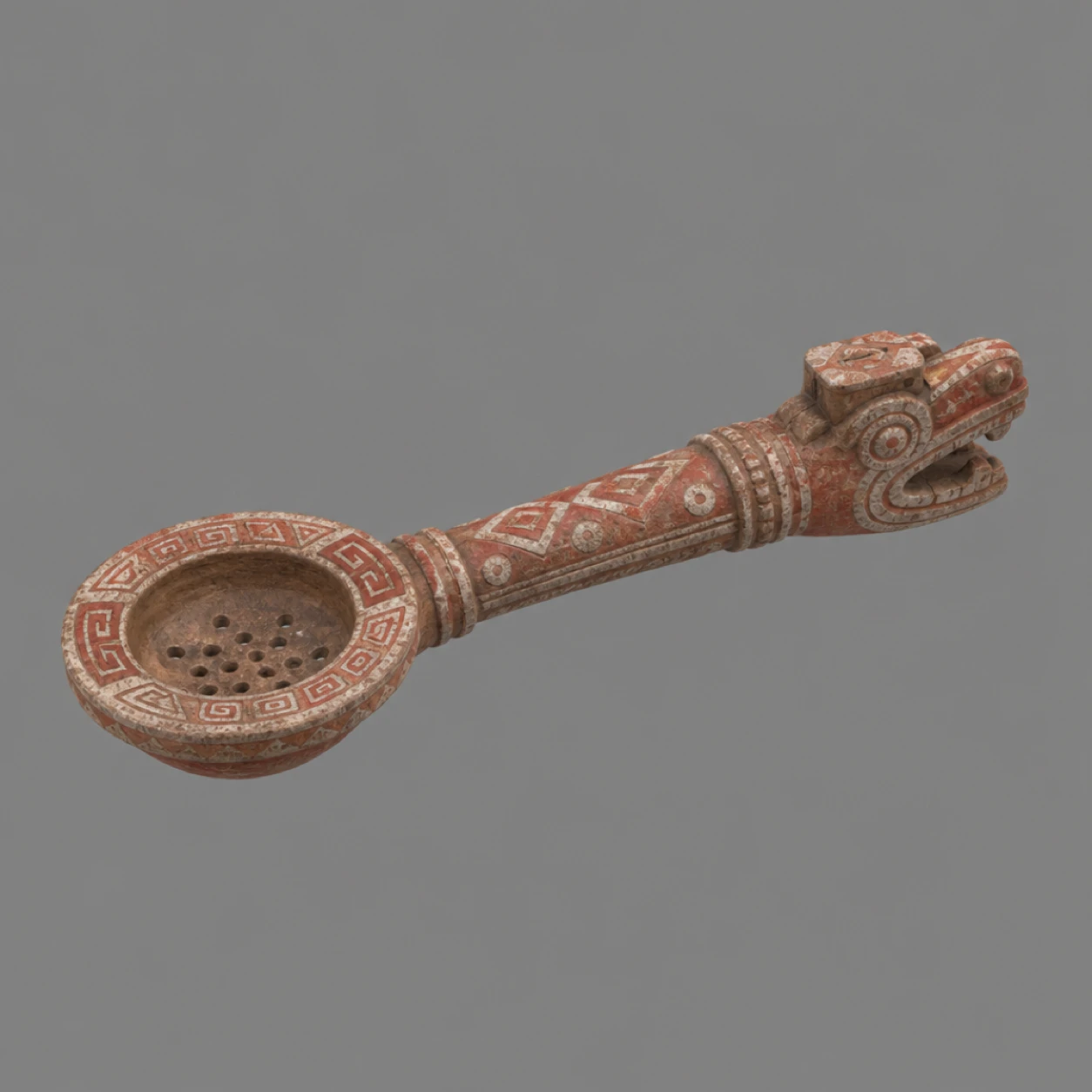
A tlemaitl beside a brazier or at a priest's feet signals active incense rite, not a cold altar. Pair it with copal smoke, low torchlight, and the click of a rattle handle for temple courtyard atmosphere. Our Aztec Temple Relics pack includes a tlemaitl for ritual chambers and pyramid scenes.