Serpent Arm Rings: Twisted Silver and the Midgard Worm
A Viking arm ring is a band of silver or gold worn on the upper arm, often made from twisted rods with overlapping terminals. It could mark status, pay for goods, or seal a gift from a chieftain to a follower. When the terminals are cast or hammered as serpent heads, the same object ties bullion economy to the Midgard Serpent of Norse myth.
Twisted rods, open bands, and biting heads
Most Viking Age arm rings are plain bullion jewellery: rods of silver twisted together, sometimes with a simple punch pattern, and ends that overlap so the band could be opened or nicked for weight. Gold examples exist but are far rarer than silver. The National Museum of Denmark notes ornamented gold and silver arm rings from finds such as Hornelund and Orupgård among elite hoards.
Serpent-head terminals are a separate tradition. In Norse literature Jörmungandr, the Midgard Serpent, encircles the world and holds his tail in his mouth until Ragnarök. Britannica treats him as Thor's chief enemy; World History Encyclopedia adds that an 11th-century rune stone in the National Museum of Denmark already shows Thor's fishing trip with the beast. Cast or stamped snake heads on a wrist or arm band read that mythology onto the body, even when the metal itself is ordinary hacksilver.
Modern replicas often pair twisted bands with paired serpent finials biting toward the wearer's arm. Archaeological Viking rings more often end in flat or rounded terminals, with zoomorphic heads more common on earlier Migration Period gold work than on the mass of 10th-century silver hoard bands.
Why sagas say oath ring but hoards say Bronze Age
The English label oath ring confuses two different worlds. The National Museum of Denmark explains that open gold arm rings with funnel-shaped ends were named oath rings in the 19th century because scholars read Icelandic sagas about court oaths and applied the story to prehistoric gold. Those Bronze Age rings date from roughly 1700 to 500 BCE, long before the Viking Age.
Viking arm rings are a different object in a different economy. Sagas still describe lords giving rings at feasts and warriors swearing on a sacred arm ring, but the archaeological default is silver weight and trade, not a single courtroom prop. When Peter Pentz and colleagues discuss recent Danish gold hoards, they allow that Viking arm rings may have served as alliance gifts or oath rings for elite followers, yet the physical evidence starts with bullion and hoard burial.
Wallet on the arm: silver weight and the ring-giver
Silver drove the Viking bullion economy. Ingots, coins, and chopped jewellery could all be weighed for payment; arm rings sat in the same system. World History Encyclopedia describes hacksilver as silver cut repeatedly to match exact transaction weights, a habit that returned when coin production collapsed in post-Roman Europe and that Viking hoards across Britain and Scandinavia illustrate on a huge scale.
An arm ring was portable wealth you could wear to a meeting and break apart if the deal required it. World History Encyclopedia compares the Norse arm ring to a wallet and notes that rings also marked social ties: a generous lord in Beowulf is a ring-giver who rewards loyal warriors. Women wore arm rings too, as grave finds and museum jewellery catalogues confirm alongside brooches and beads.
That dual role, currency and gift, fits hoards such as Terslev and Vester Vedsted, where neck rings, arm rings, and chopped bars were buried together in the late 900s CE with the latest coins as terminus post quem.
From plain rods to punched broad bands
Arm ring styles shift across the 9th to 11th centuries. Early Norwegian rod rings appear in hoards after about 860 CE; twisted rod types spread through Denmark and Sweden in the later 900s and remain common in Gotlandic deposits into the 11th century. Alongside them, broad-band rings made from a flat strip of silver carry dense punch decoration: T-stamps, transverse bars, and crosses arranged in rows.
Some rings stay whole in graves; others show hack marks where pieces were cut away for trade. The National Museum of Denmark lists an ornamented silver arm ring from Orupgård on Falster beside heavier gold bands, evidence that decoration and plain bullion travelled in the same elite circuits.
Serpent-headed variants belong mainly to the imaginative layer: myth, modern craft, and occasional zoomorphic terminals on unusual pieces, not to the thousands of plain twisted hoops in silver hoards.
A Cuerdale broad-band ring at the British Museum
One stamped arm ring lets you walk the numbers in a museum catalogue even when it is not on display. The British Museum holds registration OA.10303, a Hiberno-Scandinavian broad-band arm ring of the 9th to 10th century, probably from Scotland and linked to the Cuerdale Hoard material.
The band is a rectangular strip of silver, 68 mm long, 60 mm wide, and 19 mm deep, weighing 52.02 grams. Terminals taper to rounded overlapping ends rather than serpent heads. The outer face carries punched ornament: interlocking rows of T-stamps, vertical bar-stamps, and a diagonal cross, 49 impressions in all, plus a large nick on an inner angle where someone tested or cut the metal. Curators note it was probably associated with two other silver arm rings from the same hoard register.
The Cuerdale deposit, found in Lancashire in 1840, is among the largest Viking silver hoards in Britain. Its arm rings show the punched broad-band type at full strength: portable, measurable, and designed to be split. Held beside a serpent-headed prop, the piece reminds us that most real Viking arm rings were abstract silver, not mythic beasts.
Serpent myth, serpent metal, and what we cannot prove
Jörmungandr's story is well documented in medieval texts built on older poetry: thrown into the sea by Odin, grown large enough to gird the earth, destined to fight Thor at the end of the world. World History Encyclopedia stresses that Christian monks preserved most of those narratives centuries after the pagan Viking Age, so we should not assume every arm-ring wearer mapped the snake on their arm to that exact theology.
Conversely, serpent imagery on metal does appear in Viking-related contexts. Rune stones and picture stones show intertwined snakes; a sword guard from Smalls Reef off Wales, reported by World History Encyclopedia, mixes beasts and snake-like animals in silver and brass. Zoomorphic terminals on a few arm rings are known from specialist study, but they are rare compared with plain twisted hoops.
Whether a serpent-head arm ring marked cult membership, Thor's enemy, or simple fashion is unresolved. Archaeology gives weight, alloy, and hoard context; sagas give oath and gift language; myth gives Jörmungandr. A scene prop can combine all three, but history keeps them in separate evidence piles.
In your scene
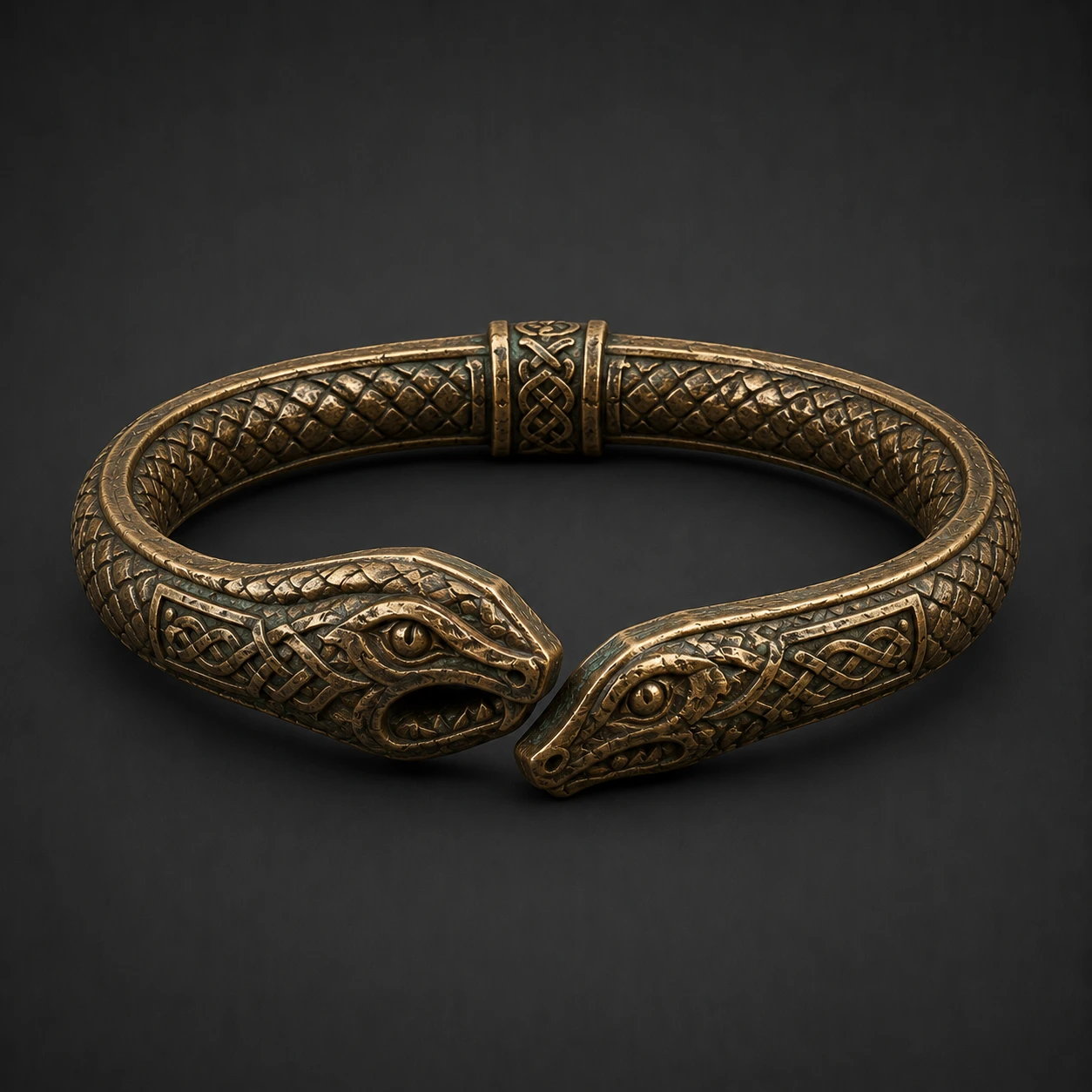
Wear a serpent arm ring on a jarl's forearm, in a hoard chest, or on the wrist of a warrior accepting a lord's gift. Keep the band heavy and the heads small, and pair it with a Mjolnir pendant or a carved Valknut if the character mixes bullion display with protective signs. Our Viking Ritual Relics pack includes a serpent arm ring model for longhouse tables and ritual corners.