Scutum: Rome's Curved Legionary Board from Round to Rectangle
The scutum was the large shield that defined Roman legionary fighting from the manipular army through the early empire. Latin writers used the word for the legionary's long, curved board, distinct from the lighter oval shields of most auxiliaries. In formation a line of scuta overlapped into a shield wall; in drills men locked them into the famous testudo to advance under missile fire. Paired with the short gladius in the right hand and the galea on the head, the scutum turned a rank of soldiers into mobile cover that could push as well as parry.
Semi-cylinder, boss, and the legionary board
A legionary scutum was not flat. World History Encyclopedia's survey of Roman armour describes it as semi-cylindrical, built from plywood layers and covered with calfskin, measuring about four feet by two and a half feet. That curve let the rim rest on the shoulder on the march while the centre bowed away from the body, giving room for the arm behind the grip.
The imperial face viewed from the front was rectangular, not round, with a central metal boss (umbo) of iron or bronze alloy. Polybius, cited in World History Encyclopedia's Roman army article, knew an earlier Republican shield that was circular in plan; by the empire the stereotypical legionary board had straight top and bottom edges and a protruding boss used to strike an opponent as well as to protect the hand. Vegetius later claimed each cohort painted different emblems on its shields and that soldiers scratched names on the back, but modern scholars treat those late claims cautiously because hard evidence is thin.
From Polybius's round shield to the imperial rectangle
Republican hastati and principes in Polybius's account carried oblong shields in the manipular line, while his detailed description of the Republican scutum itself (6.23.2-5) pictures a circular board. World History Encyclopedia summarizes the imperial change: when seen from the front the legionary scutum became rectangular, still semi-cylindrical in section, still built around a boss. The same source notes that shield shape evolved from oval toward a more rectangular profile between the mid-Republic and the third century CE without a single overnight redesign.
Every legionary was expected to carry one after the Marian reforms made kit standard issue. World History Encyclopedia's armour article stresses that a legionary was never without his scutum, often painted with his legion's symbol and number, and usually protected in transit by a leather cover removed for battle or triumph. Cavalry and auxiliaries carried smaller, flatter shields, which is why tombstones and reliefs let archaeologists tell citizen legionaries from auxiliary troops at a glance.
Testudo, the shield wall, and work beside the gladius
Roman battle doctrine treated the scutum as structure, not decoration. Legionaries advanced in close order, overlapping boards so a front rank presented an almost continuous barrier. When enemies showered the line with javelins or stones, men raised shields overhead and along the flanks in the testudo, the "tortoise" formation shown on Trajan's Column and echoed in modern museum guides to the Legion exhibition.
Inside that shell a soldier's right hand held the gladius for short thrusts while the left arm controlled the scutum. The pairing mattered: the sword's reach only works when the shield buys the inches. Polybius praised the reliability of Roman arms and the way the scutum covered the body during a stab. Officers and centurions wore the same basic equipment as rankers, though crest direction on the galea marked command. Together helmet, board, and blade defined what Mediterranean audiences meant when they said "legionary."
Plywood layers, calfskin, and painted unit faces
Construction followed a practical recipe. World History Encyclopedia names plywood strips glued into a curved blank, then wrapped or faced with animal hide. Bronze or iron edging protected the rim, and the boss was fitted through a central hole. Weight was substantial: the British Museum's Legion exhibition materials estimate about 5.5 kg for a complete legionary long shield, comparable to a packed marching load.
Paint turned each board into a unit signboard. Literary sources and art show eagles, wreaths, and animals tied to victory and to specific legions. Soldiers also personalized shields within regimental rules, which is why surviving art varies even when the wooden core was mass-produced. Leather covers kept rain and camp dust off the painted surface until an army formed for combat. After the mid third century CE legionaries gradually adopted the flatter oval shields common among auxiliaries, ending the long reign of the tall curved scutum in many provinces by the AD 250s.
The Dura-Europos scutum in the Legion exhibition
The only complete surviving Roman legionary long shield stood at the centre of the British Museum's 2024 exhibition Legion: life in the Roman army. The exhibition page lists it among the headline objects as a Roman scutum, and the museum's large-print guide calls it the sole intact legionary scutum known from archaeology despite countless originals that once filled forts from Britain to Syria.
The shield was excavated at Dura-Europos on Rome's Syrian frontier, part of the Yale-French campaigns of the 1920s and 1930s, and it belongs to the Yale University Art Gallery's collection. It travelled to London on loan for Legion, where curators displayed it beside other kit that rarely survives: wood, leather, and paint instead of corroded iron alone. The piece dates to the early AD 200s. Dry frontier air preserved layers of wood and leather strips bound with bronze edging. Today the semi-cylindrical profile has curled further with age, but the painted surface remains legible on a military red ground: an eagle with a laurel wreath, winged Victories, and a lion, the sort of victory iconography Roman soldiers wanted enemies to see over the rim.
The central boss is missing, and excavation photographs show the shield flattened into fragments before reconstruction. The grip worked like a suitcase handle behind the boss hole; the museum notes it was stored without ever being fitted with the metal umbo. That detail fits a garrison cloakroom more than a battle snapshot, yet the object still answers questions sculptors and writers could only guess at. Auxiliary troops mostly carried flat oval shields, while this semi-cylindrical form helped legionaries interlock in manoeuvres like the testudo. By the AD 250s many legions had already shifted to other shield types, which makes this lone survivor from a siege-buried tower on the Euphrates even more valuable for historians.
Wood, leather, and why almost none survived
Organic shields decay almost everywhere Roman armies marched. Northern European soil devours plywood and hide within decades unless waterlogging or desert dryness intervenes. Metal bosses, rim bindings, and shield covers sometimes survive in rivers and forts, but complete boards are vanishingly rare. The Dura-Europos example owes its life to burial during Sasanian siege operations around the mid third century and to the arid climate that followed when the city was abandoned.
Scholars still debate Vegetius's late claims about cohort emblems and soldiers' names scratched on the back. Relief sculpture and column carvings remain the main evidence for proportions and paint schemes on ordinary kit, and those sources flatten perspective. Reenactors and game assets often exaggerate the curve or print identical legion numbers on every prop. Real scuta were taller than a man's torso, heavier than a modern replica panel, and individually painted. When typology charts disagree on the exact century a rim style changed, the honest move is to quote ranges, as with the early AD 200s date bracket on the Dura-Europos shield in the British Museum guide.
In your scene
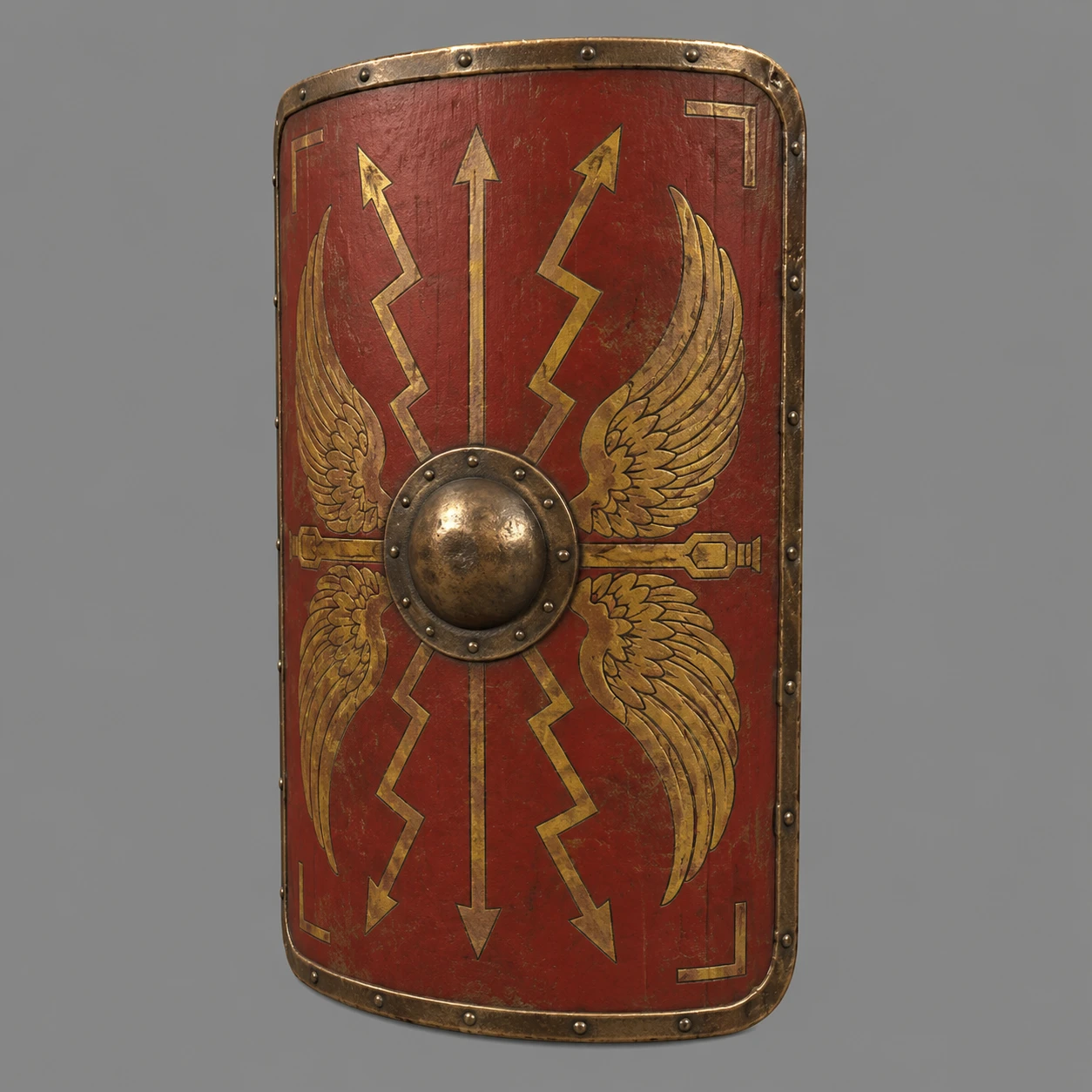
Lean the scutum upright with the curve bowing toward the viewer so a painted eagle or legion symbol reads on the face, or rest it beside a bench with the grip side inward like kit racked after drill. Pair it with a galea and gladius to complete the legionary silhouette, and overlap two boards slightly if you show a shield-wall moment. Our Roman Empire Relics pack includes a scutum model sized for barracks corners and parade-ground props.