Gladius: Rome's Short Sword for the Shield Wall
The gladius was the short sword that defined Roman infantry fighting from the late Republic through the early empire. Romans borrowed the form from Iberian warriors, kept the name gladius Hispaniensis, and carried it beside the rectangular scutum on the right hip. The blade was double-edged, pointed, and short enough to thrust in the tight space between overlapping shields. That pairing turned a legionary line into a wall of wood and iron where the sword did its work in quick, controlled stabs rather than wide slashes.
Hispaniensis, Mainz, and Pompeii blade shapes
Writers group Roman short swords into broad families even though no two excavated blades match perfectly. The early gladius Hispaniensis had a straight iron blade with a sharp point (mucro) and cutting edges on both faces. World History Encyclopedia gives a typical length of up to about 65 cm (25 inches), with a wooden grip that could be plated in bronze or silver.
By the late Republic archaeologists label a shorter, wider form the Mainz type, named after Rhine finds. In the first century CE a still shorter profile appears, the Pompeii type, known from blades preserved at Pompeii and Herculaneum. World History Encyclopedia's overview of the Roman army treats the Mainz and Pompeii types as successive imperial patterns, both still carried on the right side and still meant primarily for thrusting. Recent museum work has complicated the neat timeline: some Republican examples once called "short" are as long as early imperial long swords, and Polybius describes soldiers cutting as well as stabbing. Typology is a guide, not a calendar every legion followed on the same day.
From Iberian mercenaries to legionary kit
Rome probably first met the Spanish sword during the Punic Wars of the third century BCE, when Iberian troops fought as Carthaginian allies. The short blade suited hand-to-hand combat where a long Celtic sword had no room to swing. After Rome adopted it, the weapon spread through the conquest of Gaul and beyond. World History Encyclopedia notes that legionaries and auxiliaries both used it effectively against enemies armed with longer blades.
Adoption was gradual rather than instant. Soldiers often bought or maintained their own arms, so an army on campaign could field mixed lengths and styles. The gladius remained the signature sidearm of the heavy infantryman for centuries, while cavalry and some later troops favoured the longer spatha. By the third century CE the spatha grew more common and the classic gladius faded, though Rome's enemies had already copied the short sword because they had seen what it could do at close range.
Thrust and cut behind the scutum
Roman training stressed the stab. Legionaries were taught to thrust while keeping the torso covered with the shield rather than opening the body for a slash. Polybius praised the sword's point and the reliability of its edges on both sides (6.23.6-7, cited in modern summaries). Livy, writing about fighting in Greece around 200 BCE, describes Macedonian panic at wounds from the Spanish sword: limbs struck off at the shoulder, heads nearly severed, bodies opened in ways spear wounds did not produce.
In formation the gladius worked with the scutum, not alone. World History Encyclopedia describes the imperial scutum as a rectangular shield with a central iron boss, the stereotypical legionary board. Polybius details the earlier Republican round version (6.23.2-5). Either shape let a man in the front rank present a continuous barrier while his right hand found gaps for the blade. Centurions and senior officers sometimes wore the sword on the left hip and carried finer metal scabbards, a visible mark of rank described in both literary and artistic sources.
Republican length, imperial shortening
Surviving blades suggest the Republican period favoured a longer edge, while first-century BCE finds trend shorter and broader toward the Mainz profile. First-century CE Pompeii-type examples shorten the tip again, which may have made cutting strokes easier without sacrificing the thrust. Because replacements arrived piecemeal, an entire legion never swapped every sword on a single order.
Art and archaeology also show how the weapon was worn. Mosaics and tomb sculpture depict a scabbard of sheet metal or wood and leather, hung from the cingulum belt by four loops on the right for ordinary soldiers. That placement kept the hilt clear of the shield arm. The same sources show officers with silver fittings or a baldric across the shoulder. Understanding those details matters when you compare a plain service blade to a parade-grade scabbard like the one discussed below.
The Sword of Tiberius at the British Museum
The most famous Mainz gladius on public display is the Sword of Tiberius in the British Museum, registration 1866,0806.1. It was found in the Rhine near Mainz, Germany, and entered the collection in 1866 through the donor Felix Slade. The British Museum's Legion exhibition guide describes it as iron and bronze with gilding and tinning, dated to about AD 14 to 19, and suggests it may have been an official gift or reward rather than everyday issue kit.
The scabbard is the story. Tinned and gilded bronze panels show imperial propaganda in relief. The British Museum's Legion exhibition guide reads the main scene as Tiberius in the pose of Jupiter, flanked by Victory and Mars Ultor, receiving a statuette of Victory from his general Germanicus, who cedes public credit for a campaign according to imperial protocol. A roundel below carries a portrait of Augustus. Scholars have offered other identifications for the figures over the years, but the museum label stresses dynastic loyalty and the army's duty to display victory as the emperor's gift. The iron blade itself is heavily corroded after river burial, but the fittings preserve the craftsmanship Rome lavished on symbols of military loyalty. You can study the piece in the museum's Greek and Roman collection and in the Legion exhibition materials, which treat it as a highlight of early imperial arms.
What survives in the ground and in museums
Complete gladii are rare because iron blades rust and wooden grips decay. Archaeology relies on blade fragments, scabbard mounts, and art that shows proportions. Mainz-type and Pompeii-type labels help curators sort finds, yet World History Encyclopedia warns that individual preference, private purchase, and uneven survival make a strict evolutionary line hard to defend. A "late" shape in one grave may simply be an older soldier's favourite weapon.
Scholars also revisit literary clichés. The gladius was not only a thrusting poker: ancient authors and modern blade studies both allow cutting when the formation opened. What stays constant is social meaning. Carrying the gladius marked a Roman infantryman, paired the man to his shield, and advertised a fighting style built for close order. When you place a gladius in a scene, the historical question is not only blade length but whether the figure is a ranker with a plain scabbard or an officer carrying an imperial narrative in gilded bronze.
In your scene
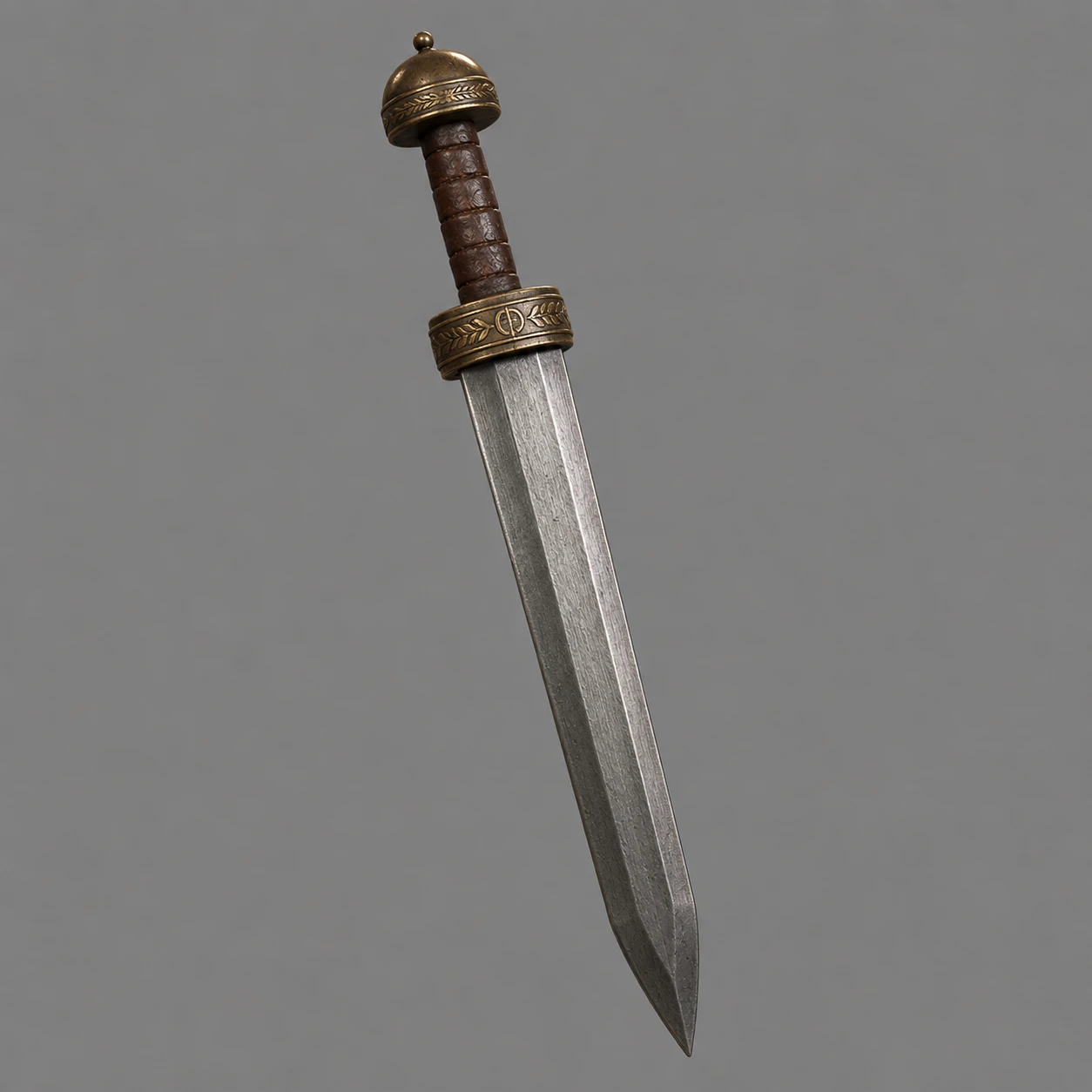
Hang the gladius on the right hip with the hilt forward, scabbard loops visible on the belt, and set the scutum in the left hand or leaning beside the soldier so the short reach of the blade makes sense. A gilded scabbard reads as officer gear or a victory trophy, not barracks issue. Our Roman Empire Relics pack includes a gladius model sized for legion camp interiors and temple antechambers.