What Is a Galea Helmet? Roman Legionary Headgear
A peaked copper-alloy helmet made in England between about 50 and 150 BCE sits in the British Museum as a Celtic piece, not a legionary one. The caption on World History Encyclopedia's record says that form inspired the Roman Coolus, a common army type before imperial helmets took over. The soldier who wore the later iron copy still called it a galea, whether the workshop had hammered a Montefortino, a Coolus, or an Imperial Gallic.
Galea, cheek guards, and the legionary profile
Most legionary helmets were hammered from a single sheet of iron into a deep bowl with a neck guard at the rear, a pronounced brow, and hinged cheek pieces (bucculae) that folded down to protect the jaw. Polybius, writing in the mid-second century BCE, describes that profile: iron bowl, neck guard, raised brow, hinged cheeks designed to catch and deflect blows to the face. Officers and enlisted men shared the same basic idea, though quality varied with pay and province.
Centurions often wore the same helmet type but marked rank with a transverse crest (crista transversa), a silver or dyed horsehair or feather plume worn side to side across the crown rather than front to back. In the imperial period some crests ran fore-and-aft instead, but the sideways plume remained the classic centurion signal on reliefs and reenactment fields.
From Montefortino bowls to imperial types
Helmet styles shifted slowly across centuries of recruitment reforms. The Montefortino type, named after graves at Montefortino in Italy, offered wide cheek pieces and a broad neck guard; Polybius knew it as the standard of the second century BCE and notes the famous feathered crest. The Coolus that followed kept the bowl shape but added a reinforcing peak above the forehead and wider cheek guards.
By the early empire the Imperial Gallic helmet carried a broader, ribbed neck guard for extra strength, while the closely related Imperial Italic type was less ornate but structurally similar. Later still, the Intercisa broke from the one-piece bowl: two iron plates joined by a central ridge and a small neck guard, a pattern that would dominate late Roman kit. Feathers or horsehair plumes could slot into fittings on several types, though not every soldier could afford or wanted a crest in daily field service.
In the shield wall, on parade, and at the standards
In battle the galea was the last line when a sword or sling stone reached the head above the scutum. Cheek guards traded hearing for coverage; the neck guard stopped downward cuts after a shield was knocked aside. Off the battlefield, helmets lined arms racks in barracks and hung from pegs during drill. Triumph processions and guard duty at the legionary eagle made polished iron and optional crests part of the army's public image.
Auxiliary units wore helmets too, often lighter or copied from provincial enemies. The Marian reforms of 107 BCE made the state issue kit to poorer recruits, so by Augustus's time a legionary's galea was as standard as his gladius and rectangular shield, even if workshops in Gaul or Italy stamped slightly different forms.
How Celtic metalwork fed the Coolus line
Romans borrowed freely from foes and neighbours. The Coolus type is widely linked to Celtic helmet design from Gaul and Britain, where La Tène metalworkers had long produced peaked copper-alloy bowls with decorated cheek flaps. Conquest and trade brought those forms into army workshops, where smiths reforged them in iron for legionary mass production.
World History Encyclopedia's Roman armour survey places the Coolus between the Montefortino and the imperial Gallic/Italic families and notes that some helmets carried feathers or horsehair crests. The borrowing was practical, not decorative: wider peaks and cheeks answered the same threats Celtic warriors had faced in ambush country along the Rhine and in Britain.
A La Tène helmet you can still see in London
World History Encyclopedia's British Museum record publishes a peaked copper-alloy helmet in La Tène style, made in England between about 50 and 150 BCE and now in the British Museum. The caption states plainly that this Celtic form inspired the Roman Coolus helmet, one of the commonest types worn until the so-called imperial helmet gradually replaced it from the second century CE onward.
The piece is a useful anchor because it is not a legionary relic but the upstream design Rome adapted. Peaked brow, alloy bowl, and frontier craft explain why Coolus finds cluster in western provinces before Gallic types spread empire-wide. Game artists often default to Imperial Gallic cheek guards; a Coolus inspired by Celtic sheet work reads equally Roman for an earlier fort scene.
Iron, crest fittings, and uncertain workshop labels
Thousands of Roman helmet fragments survive in rivers, forts, and cremation graves, but typology still depends on rim shape, cheek-hinge style, and decorative ribs that rust away. A bowl without cheek pieces might be Montefortino, Coolus, or a provincial copy; context and associated armour matter. Specialists disagree on precise century brackets for some Italic variants, and reenactors sometimes lump distinct types under one label.
Replica stalls and asset packs simplify the ridge count and eyebrow flanges. Real examples are heavier, closer to the skull, and rarely show the towering crests of Hollywood camps unless the piece belonged to an officer. When sources give ranges rather than single dates, the honest habit is to quote them broadly, as with the British Museum Celtic helmet at c. 50 to 150 BCE.
In your scene
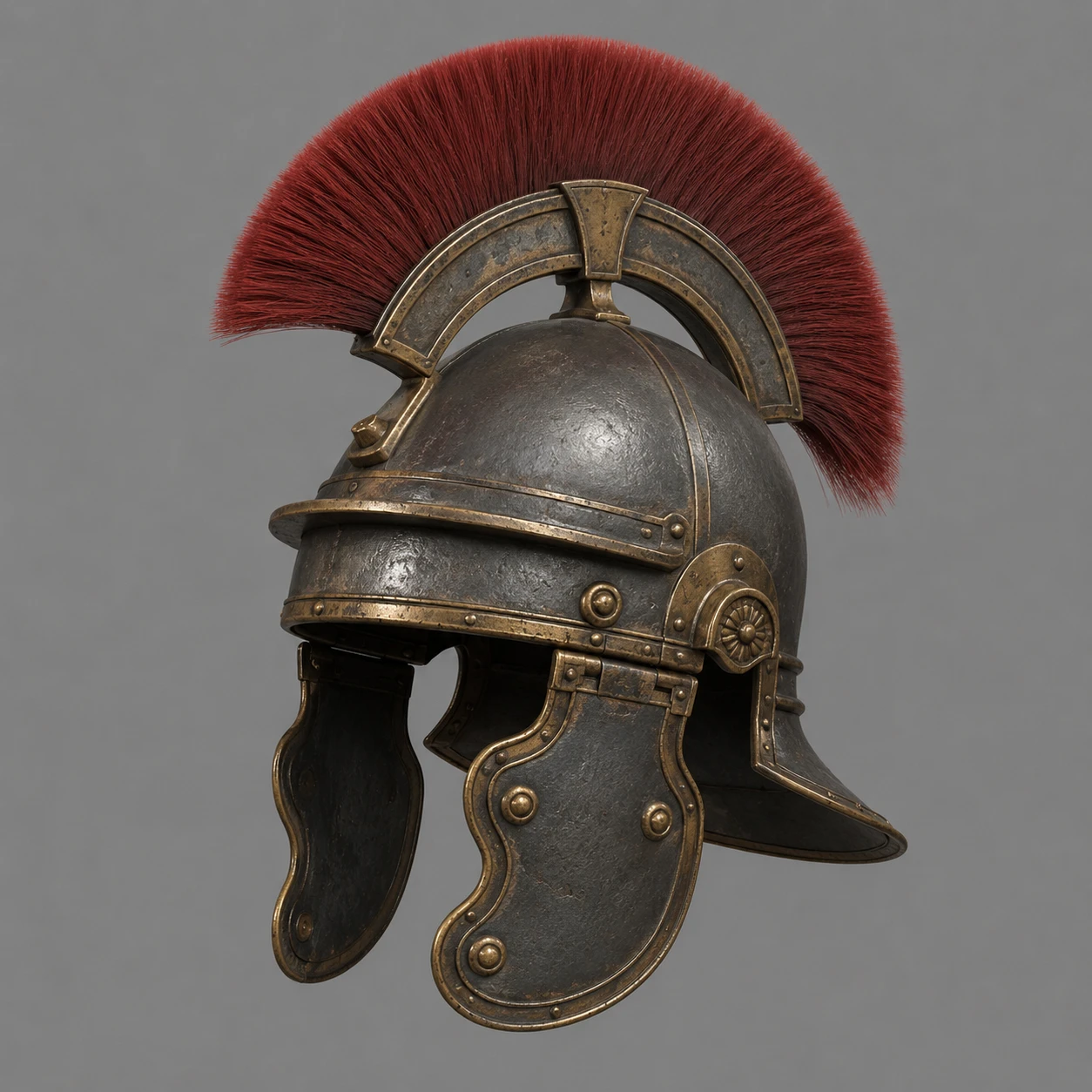
One galea on a bench beside a shield rack tells players "Roman fort" faster than a room of identical helmets. Cheek guards up or down changes the silhouette; a transverse crest marks a centurion without extra props. Our Roman Empire Relics pack includes a galea suited to barracks corners and parade-ground kit dumps.