Prestige Stool: Curved Seat for Living Chiefs, Blackened for Ancestors
A prestige stool in West African Akan culture is a carved wooden seat of office, not ordinary household furniture with a fancy name. Among Asante and related Akan communities in present-day Ghana, the curved rectangular seat, central support, and stepped base mark rank, loyalty to a higher ruler, and a personal bond between a living leader and the ancestors. The most famous example is the Golden Stool (Sika Dwa Kofi), the gold-covered national emblem of the Asante state. Most prestige stools in museums are the plainer wood seats of chiefs: carved from a single block, sometimes metal-inlaid or brass-clad, and charged with proverb imagery rather than with sheets of gold.
Curved seats, proverb supports, and the name of the office
The classical Akan stool has three stacked parts: a curved top that fits the body, a carved mid-section that carries the meaning, and a rectangular platform base. Carvers often work the whole piece from one log. Museum labels describe the mid-section in anthropomorphic language, calling the support the "neck" and the seat the "head" or "face." Everyday Asante stools share that silhouette; what changes is the central motif. An openwork column with four flanking legs is common. Named types encode proverbs: the Art Institute of Chicago describes a brass-covered stool that combines obi-te-obi-so-dwa ("one-sits-atop-another stool"), a sign of ranked people working together, with adenkyemdwa (crocodile seat) on the lower tier.
Chiefs receive a stool at installation. Its use is a public claim to office. The Art Institute notes that every Akan leader must receive a personal official stool, and that legitimacy often depends on using a communally owned stool at installation as well.
From forest wood to Asante court gold
Akan stool use is older than the Asante confederacy, but court histories bind the stool idea to the founding of that state. The Metropolitan Museum of Art's essay on Asante gold arts records court tradition that in 1701 the Golden Stool descended from the sky into the lap of Osei Tutu as a divine sign of his rule. Britannica likewise places the Golden Stool at the spiritual center of Asante unity: a wood form covered in gold that holds the soul of the nation and that even kings do not sit on. At ceremonies it appears on its own chair, often on elephant hide, more like a national flag than a throne for lounging.
Other stools remained wood. Loyal and esteemed chiefs held carved seats with metal inlay as a mark of royal patronage. Gold dust trade, tribute, and workshop labor concentrated in Kumasi, and brass or gold cladding on some ceremonial stools marked elite religious or political standing. The Art Institute notes that brass and silver were preferred metals of the Akan religious elite, and that hammered patterns on brass cladding can echo the designs on soul-washer badges (akrafokonmu). Dating for surviving wooden prestige stools in Western collections is often broad: many Met labels read "19th–20th century," and the Art Institute's brass-covered example is placed in the mid to late twentieth century, because carvers rarely signed works and export histories are incomplete.
When a stool falls: office, soul, and succession
An Akan ruler's stool sits at the center of personal and political life. The Met's label for a classical prestige stool states that only chiefs considered loyal enough to the king received permission to use certain forms. In some areas, transfer of chiefly power is completed when the successor first touches the predecessor's stool. Death itself is phrased through the object: people say "a stool has fallen." Before burial, a chief's body may be washed on the stool. After the funeral the seat can be knocked sideways to keep malevolent spirits from settling in it.
The Golden Stool raises the same logic to the scale of the nation. Britannica notes the belief that if it were destroyed or captured, the Asante nation would fall into chaos. It is a spiritual bond between the living people, not a chair for the Asantehene to occupy. Ordinary prestige stools do not carry that national charge, but they share the idea that the seat and the soul of office travel together.
From living seat to blackened ancestral altar
While a chief lives, the stool is for sitting, display, and public ceremony. After death, the stools of the most important leaders are blackened with smoke and ritual offerings, then placed on altars where the living communicate with the deceased. The Met's Asante gold essay and its object label for stool 1986.478.2 both describe this path from personal seat to ancestral conduit.
Not every stool becomes an altar piece. Household stools share the curved seat and base with chiefs' seats, yet they lack gold leaf and court patronage. Brass-covered ceremonial stools meant for public display, like the Art Institute's example, sit somewhere between household wood and court gold: intended to be seen, not worn smooth by daily use alone.
The Met's kontonkrowie stool in the collection
One clear museum example is the Metropolitan Museum of Art's Prestige Stool, object 1986.478.2, catalogued in the Michael C. Rockefeller Wing (listed as not on view at the time of writing). The Met attributes it to Akan peoples of Ghana and dates it to the 19th–20th century. It is wood, 36.8 cm high, 29.9 cm wide, and 52.7 cm deep (14 1/2 × 11 3/4 × 20 3/4 in), bequest of Bryce Holcombe in 1984. The form is the classical curved seat on four slightly bowed legs plus one openwork central column, all on a stepped platform, carved from a single piece with incised geometric designs rather than metal inlay.
The museum identifies the five-legged type as kontonkrowie, "the circular rainbow." The name points to the proverb that the rainbow is around the neck of every nation, a figure for a king's duty to unite and control the realm. The five supports also read as statecraft (one king among surrounding chiefs) and as cosmos (four cardinal directions and a central sun). This is not the Golden Stool. It is a chief's wooden seat of office of the kind the Met's Asante gold essay cites when it explains that carved stools were the prerogative of loyal notables and that, after death, such stools could be blackened and set on ancestral altars.
What labels settle and what they leave open
Museum catalogues rarely name the original owner of a wooden prestige stool. Dates often span a century. Export paths into European and American collections are unevenly documented, especially for pieces that left Ghana in the colonial period. Scholars also distinguish carefully between the unique Golden Stool, still a living Asante emblem, and the many carved stools that share its silhouette. A brass-clad Art Institute stool may have belonged to a priest or a politician with ritual status; a plain cylinder-support stool may have been a commoner's daily seat. Both can appear as "Akan stools" in a catalogue, and they are not the same social object.
Where two labels disagree on century or on whether a support is royal or proverbial, treat the disagreement as a limit of the evidence. The shared point across Met and Art Institute texts is simpler: among Akan and Asante communities, the carved stool is a seat of identity. It can mark living office, be turned sideways after a funeral, and, for the powerful dead, become a blackened link between generations.
In your scene
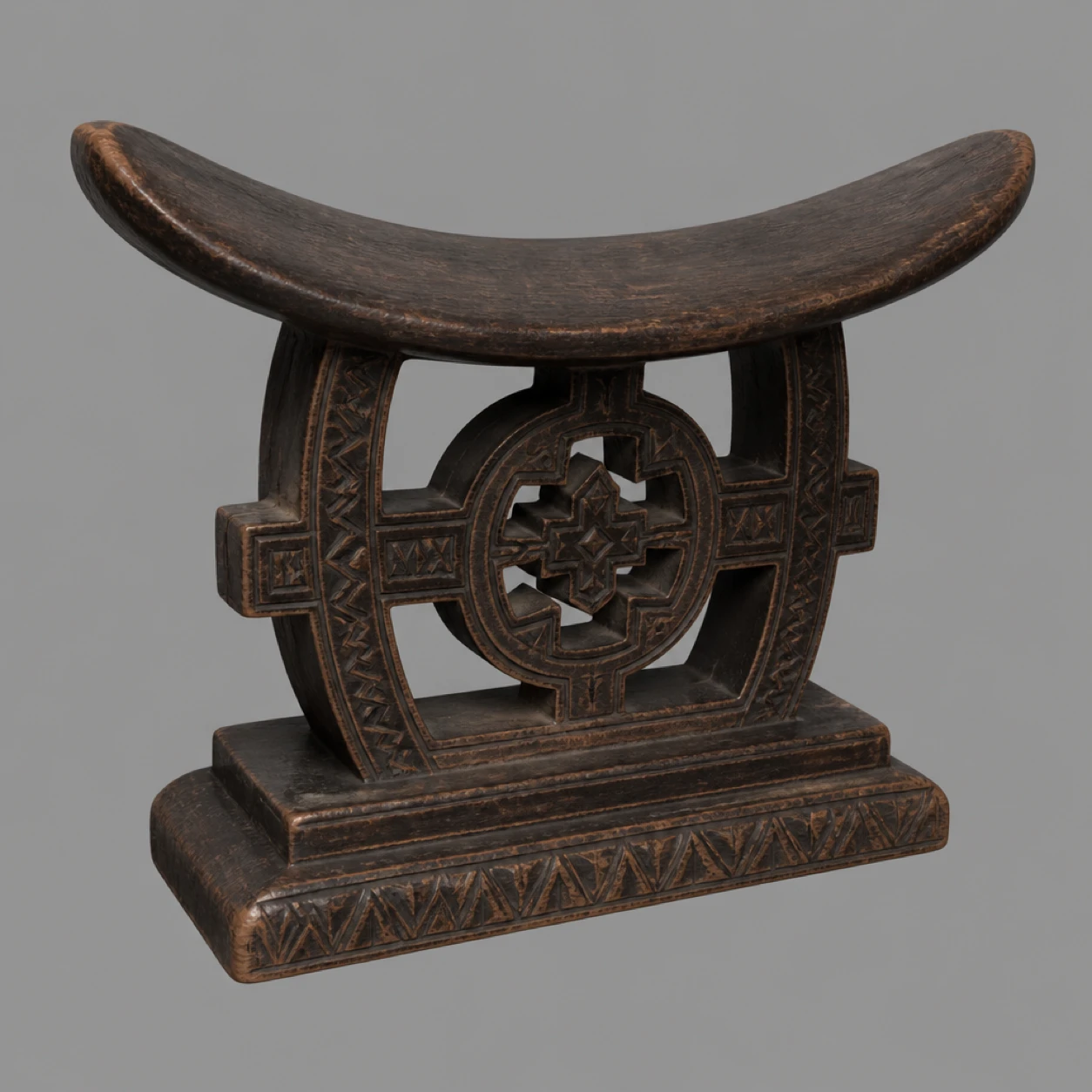
A prestige stool reads as court or shrine furniture, not as a tavern chair. Keep the curved seat, stepped base, and a legible central support, and reserve blackened finishes for ancestral altar contexts rather than a living chief's hall. For a wider West and Central African court set, see the African Kingdom Relics pack.