Maize Brazier: Copal Smoke for Chicomecoatl
A maize brazier in Mexica (Aztec) temple art is a ceramic incense burner shaped to honor agricultural gods, especially Chicomecoatl, the goddess of seed corn and sustenance. Priests filled its bowl with glowing coals, sprinkled copal resin over them, and let fragrant smoke rise before an altar or courtyard idol. Mold-made faces of maize deities, red slip paint, and ears of corn modeled on the front told worshippers which spirit received the offering. The brazier was not a cooking pot. It was a hearth for the gods, where smoke stood in for food, prayer, and the life-giving grain that fed Tenochtitlan.
Copal bowls, red slip, and Chicomecoatl on the front
Mexica braziers for temple use were usually terracotta, often coated in reddish-brown burnished slip. Some deity-faced censers reached about three feet in height, with the goddess worked in relief on the front panel. Chicomecoatl's name means "Seven Serpents" in Nahuatl. Britannica describes her as the goddess of sustenance and corn, often painted red and shown with a distinctive rectangular headdress or pleated fan of red paper, holding ears of maize in both hands.
On censers, her attributes were applied as mold-made clay appliqués so the smoke addressed the correct deity. World History Encyclopedia lists Chicomecoatl as goddess of food and especially seed corn, tied to the fourth month, Hueytozoztli. Copal itself, a pine resin burned across Mesoamerica, was offered as fragrant incense. When it smoldered, the rising column carried offerings upward, much as later Catholic incense would symbolize prayer.
Wildform's pack model reads as a compact courtyard brazier: a wide fire bowl, short legs, and maize motifs suited to a Chicomecoatl shrine beside a pyramid stairway.
From calpulli courtyards to the sacred precinct
Ceramic braziers appear at every scale of Mexica religious life. Britannica notes that many practices also occurred at home, with small idols and incense burners in household ceremonies. Neighborhood temples maintained their own fire offerings through priests who served local patron deities.
At the capital, the picture grew larger. The Templo Mayor at Tenochtitlan dominated a sacred precinct roughly 365 meters on a side, with dozens of structures surrounding the twin shrines of Huitzilopochtli and Tlaloc. State festivals, coronations, and mass sacrifices unfolded there, but daily honor also required incense, flowers, and food set before divine images. Braziers stood outside temple doorways or before altar platforms so smoke could billow without scorching wooden god-statues inside.
Huey Tozoztli, seed corn, and the maize goddess
Maize was not background agriculture. It structured the ritual calendar. Chicomecoatl presided over seed corn, the grain saved for planting, while Centeotl was honored as the god of late-ripening maize. Britannica also lists Xilonen as another name for Chicomecoatl, though the pantheon sources do not always agree on how maize deities divide their roles. World History Encyclopedia associates Chicomecoatl with Hueytozoztli, the fourth month in the solar year, when priests and farmers focused on young maize shoots and the seed that would feed the next harvest.
Festival accounts in colonial-era sources describe impersonators dressed in the goddess's paper crown and maize ornaments, fasting, feasting, and sometimes sacrifice at the climax of the rite. Scholars debate how literally to read those texts, and details vary between friars' chronicles and Nahuatl pictorial manuscripts. What archaeologists recover more safely is the material world behind the stories: censers with maize iconography, effigy fragments, and copal residue in temple dumps.
Rain mattered as much as seed. Tlaloc and Chicomecoatl often appear together in art because harvest required both moisture and grain. A maize brazier in a temple scene therefore signals agricultural ritual, not only a generic fire pot.
Tripod feet, rattles, and mold-made date glyphs
Not every brazier carried a goddess portrait. Some followed an hourglass profile on three hollow feet. The Metropolitan Museum of Art holds a Central Highlands tripod brazier dated 1430 to 1521 CE whose bulbous legs contain clay clappers, so the vessel rattled when moved. A molded band encircles the waist, and a cartouche on the front bears the date glyph "4 Reed," which curators link to the year 1431 CE and the third major enlargement of the Templo Mayor under Itzcoatl.
That object shows how ceramic workshops combined sound, calendar lore, and fire in one form. Mold seams are visible on the band and cartouche, evidence of mass production for ritual demand. Some braziers reached three feet in height; others were small enough for household altars. The range reflects Mexica religion's reach from palace precinct to neighborhood shrine.
A tripod brazier you can still see at the Met
The Met's tripod brazier (object 1979.206.360) makes a useful anchor for the type Wildform stylizes. It stands 14 1/8 inches high (35.9 cm) and about 16 inches wide (40.6 cm), thick-walled and heavy enough to hold coals safely. The museum's label states that braziers of this family were placed outside temples or in front of altars, where offerings of aromatic incense and sometimes animal remains were burned so smoke could carry them to the gods.
Pair that utilitarian form with a Chicomecoatl sculpture in the same collection for the maize cult in stone. The Met's standing Chicomecoatl goddess (1325 to 1521 CE, basalt, object 00.5.51) wears the towering quadrangular amacalli, or "paper house," headdress and holds maize ears in her right hand. During festivals, priests and impersonators wore similar paper constructions; the stone version preserves the silhouette when the fragile originals are gone. At 14 inches tall (35.6 cm), the figure is modest, consistent with household idols the Met notes were mass produced in Aztec times.
Clay, copal residue, and what texts disagree on
Excavations at the Templo Mayor and other Basin of Mexico sites have recovered thousands of ceramic fragments, copal balls, and deity effigies from offering caches. Survival favors stone and fired clay over paper regalia and wooden temple images. That imbalance shapes the record: we see more braziers and basalt goddesses than the costumes described in festival chronicles.
Colonial Nahuatl and Spanish sources preserve rich ritual detail for Hueytozoztli and related maize feasts, but they were written after the Conquest and filtered through missionary agendas. Modern scholars cross-check them against archaeology rather than treating any single chronicle as complete truth. When you place a maize brazier in a scene, you are evoking a cult attested in both sculpture and calendar, even where exact procession routes and sacrifice tallies remain disputed.
In your scene
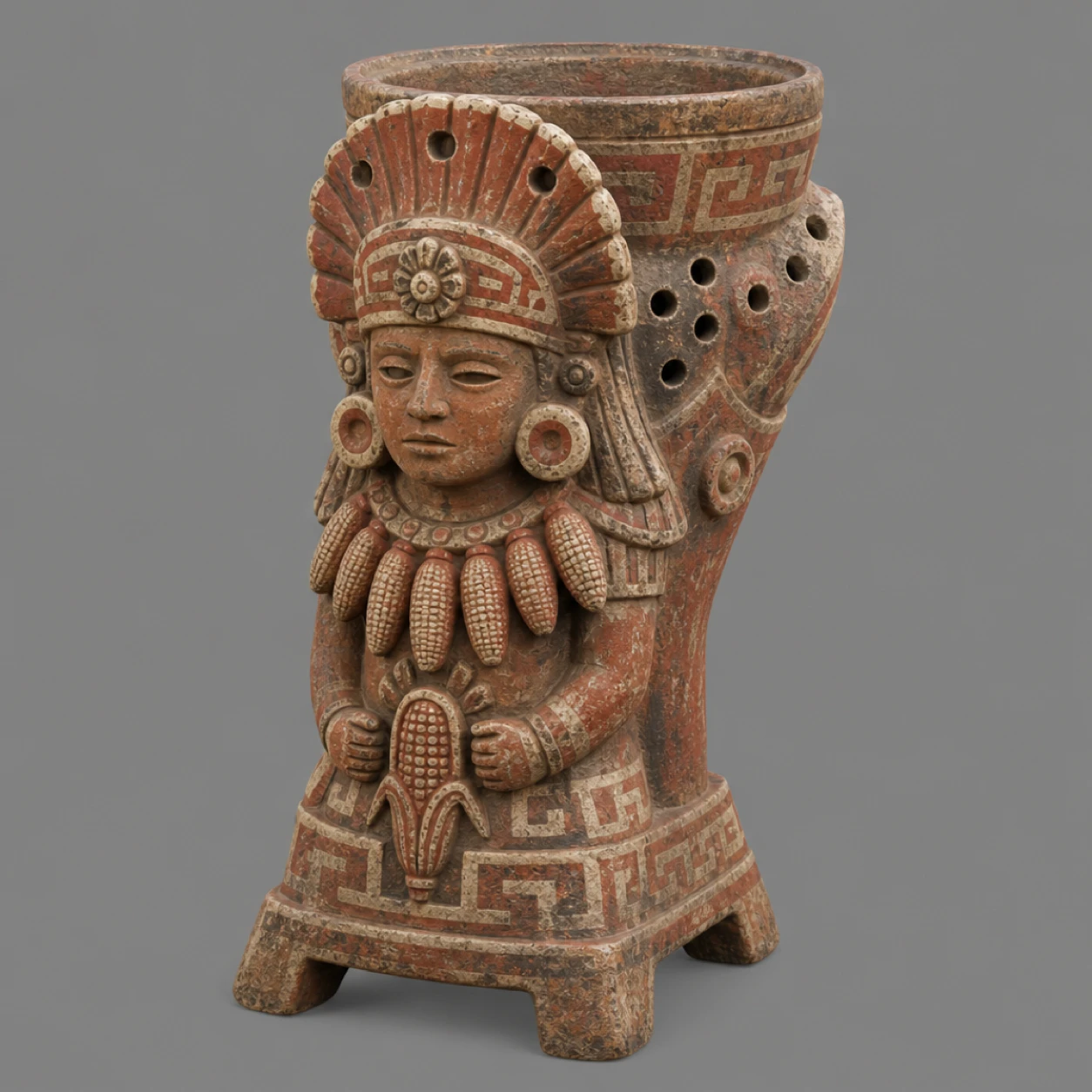
Set a Chicomecoatl-faced brazier on a courtyard platform before a pyramid stair, with slow copal smoke drifting across stone drums and offering bowls. Keep the fire low and central; Mexica braziers framed ritual space rather than lighting entire plazas. Our Aztec Temple Relics pack includes a maize brazier model sized for temple antechambers beside masks, drums, and calendar stones.