Lamassu: Assyrian Gate Guardians at the Palace Threshold
In 879 BCE Ashurnasirpal II hosted a ten-day feast at his new capital, Kalhu, modern Nimrud on the Tigris in northern Iraq. He claimed 69,574 guests ate, drank, and bathed before he sent them home in peace. The palace they entered was guarded by stone hybrids that still make visitors look up. A lamassu is that kind of creature: a bearded human head, the body of a bull or lion, and the wings of a bird of prey, carved in high relief to flank a doorway and stare outward at anyone who approaches.
Bearded head, bull body, and five carved legs
The word lamassu comes from older Mesopotamian religion. World History Encyclopedia's pantheon article describes Sumerian lama as a protective figure, often a standing woman in a long robe who intercedes with greater gods. Akkadian speakers knew her as Lamassu. By the Neo-Assyrian period the same name also covered the colossal hybrids at palace gates, even though those sculptures look emphatically masculine and martial.
Visually, a lamassu combines three registers. The human head wears a curled beard and often a horned cap that marks divinity. A broad belt across the chest signals royal power. The body is either bovine, with heavy hooves, or leonine, with clawed paws. Spread wings frame the torso. Most gate guardians are not statues in the round. They are corner figures carved from a single block so one face meets the street and another turns along the wall.
Count the legs and the carving reveals its trick. From the front you see two legs planted squarely. From the side the animal appears to stride, with four legs in motion. Sculptors added a fifth leg hidden in the overlap so neither view looks wrong. The Met's curator text calls this a deliberate choice so the guardian looks immovable head-on yet advances as you pass between the pair.
From Kalhu's mudbrick wall to the Northwest Palace
Neo-Assyrian kings ruled northern Mesopotamia from roughly the ninth to the seventh century BCE. Ashurnasirpal II, who reigned from 883 to 859 BCE, turned Nimrud from a provincial town into an imperial capital. He ringed about nine hundred acres with a mudbrick wall and raised his Northwest Palace on the acropolis. Britannica dates the monumental lamassu reliefs broadly from the ninth through the seventh century BCE, when Assyrian power peaked at cities such as Nimrud and Dur Sharrukin.
Artisans carved the largest gate figures in situ from monolithic gypsum or limestone blocks. Britannica notes that some weighed as much as 40 tons. Pairs typically stood at palace entrances and at important inner doors. Lion-bodied and bull-bodied forms both appear. At Nimrud, Ashurnasirpal's sculptors set human-headed winged bulls and winged lions at multiple thresholds, including the route toward the throne room.
Guarding the gate where ambassadors entered
A lamassu at the gate was apotropaic architecture: it turned harm away from the threshold it watched. Foreign envoys, tribute bearers, and court officials passed between the flanking figures to reach the king. The stone did structural work as well. The bulk of the block helped support the arched doorway above it, so the guardian was both sculpture and building stone.
Royal inscriptions often ran across the surface of adjacent palace reliefs. Ashurnasirpal's so-called Standard Inscription boasts that he set beasts of the mountains and seas, fashioned from white limestone and alabaster, in his gates to make the palace imposing. The lamassu pair carried that message in scale. You meet divine strength before you meet the monarch.
The British Museum holds a human-headed winged bull from Nimrud that belonged to a pair flanking a doorway. Layard and Hormuzd Rassam excavated it in the mid nineteenth century and shipped it to London with Ottoman permission. The museum acquired the sculpture in 1850. The Assyrian galleries also show winged human-headed lions from a palace entrance. The stone still does the old job of announcing imperial reach.
How a household spirit became an imperial colossus
The shift from small protective spirits to palace-sized hybrids is one of the strangest turns in Mesopotamian art. Early lama figures could guard household thresholds and private shrines. Assyrian kings repurposed that logic for state propaganda. A pair at the city gate projected the same watchfulness across an entire capital.
Later rulers followed the template. Sargon II built a new citadel at Dur Sharrukin with multiple lamassu guarding the throne-room entrance. Achaemenid builders later placed related winged bulls at Persepolis, though those Persian examples postdate the Assyrian empire itself. The Nimrud and Khorsabad colossi became the reference image for "ancient Mesopotamian guardian" in modern museums, even as many originals stayed in Iraq until war and iconoclasm destroyed several in situ examples in the 2010s.
The Met's winged bull from Nimrud
One of the clearest single objects to study is the Metropolitan Museum of Art's human-headed winged bull, object 32.143.1. The collection page currently lists it as not on view. The Met attributes it to Ashurnasirpal II's Northwest Palace at Nimrud and dates it to about 883 to 859 BCE. It is carved from gypsum alabaster and stands about 313.7 cm high, 67.3 cm wide, and 309.9 cm deep. The museum lists the weight at roughly 7257.4 kg. John D. Rockefeller Jr. donated it in 1932.
The Met also holds a human-headed winged lion, object 32.143.2, so the hoofed and clawed body types can be compared. Both wear the horned cap and belt described in the palace inscriptions. The bull's five legs are visible once you walk past the figure and look back from an angle. That is the optical effect the Neo-Assyrian sculptors engineered: stillness for the approaching guest, motion for the guest who has already crossed the line.
A gypsum relief of a winged human-headed bull from Room S at Nimrud sits in the British Museum (1850,1228.2), on display in Room 8. The museum notes that its pair is in the Metropolitan Museum in New York, without naming 32.143.1. The two records still show how nineteenth-century excavation scattered one palace across several continents.
Stone weight, lost pigment, and naming debates
Survival is uneven. Major museums in London, New York, Paris, and Chicago hold excavated gate figures, while Iraq's National Museum in Baghdad retains others. Britannica notes that artisans carved some gate lamassu from monolithic stone weighing as much as 40 tons, far heavier than the Met's roughly 7.3-tonne bull yet built for the same doorway job.
Microscopic traces of pigment on Neo-Assyrian sculpture suggest the carved beasts were not bare stone in their working life. Reds, blues, and whites may once have brightened beard, wings, and belt. That evidence is fragile, and full color reconstructions remain interpretive.
Scholars still argue whether every winged human-headed bull should carry the lamassu label. The Sumerian word began with a female protective figure; the Assyrian gate guardian reads male and military. Modern museum captions use lamassu for both lion and bull forms. The secure historical core is simpler: these were palace gate guardians meant to stop evil at the threshold and to show that the king inside commanded forces no envoy could ignore.
In your scene
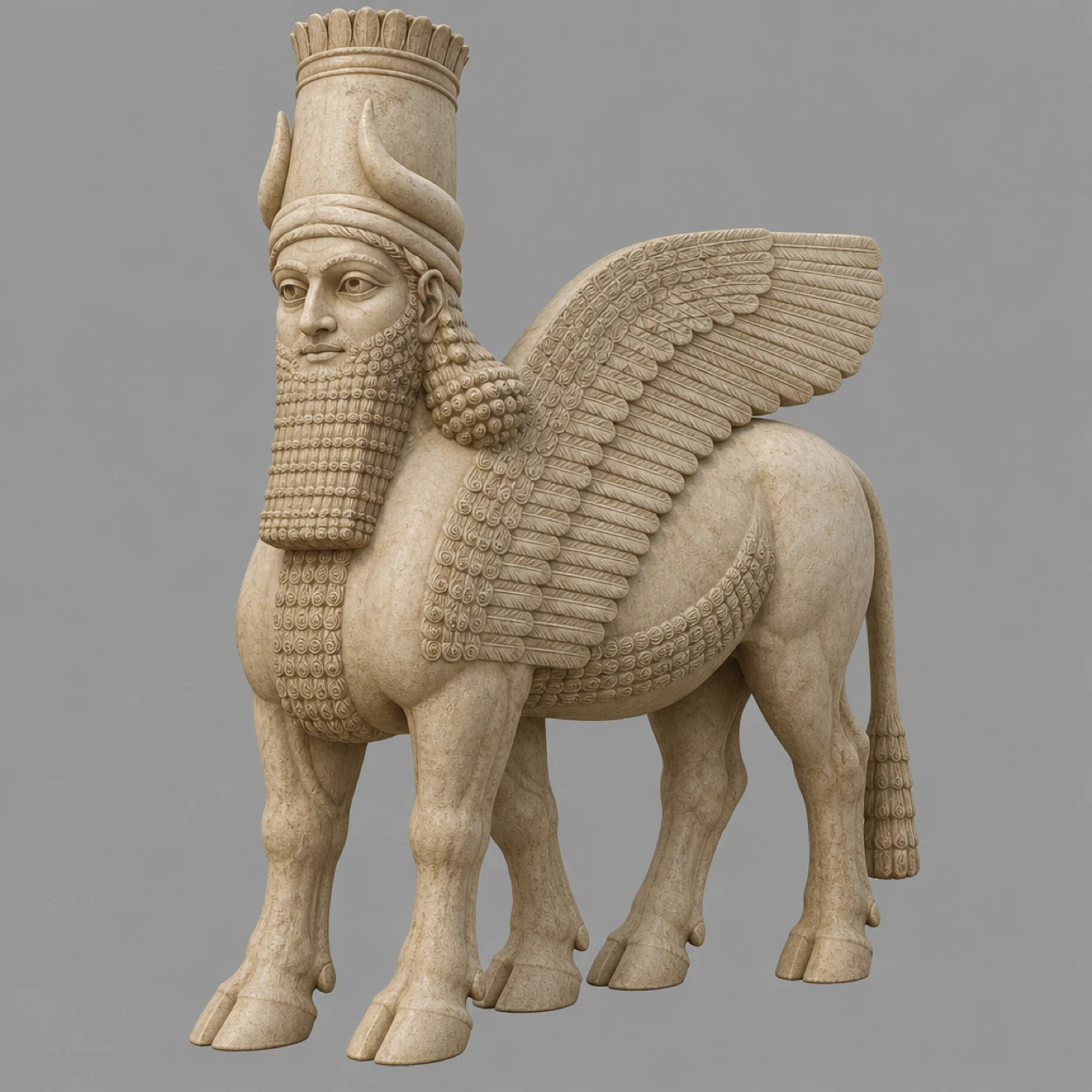
A lamassu belongs at a palace or temple gate, not as loose courtyard furniture. Place the figure where a wall meets a doorway, with bulk enough to feel like architecture, and leave visual space for a second guardian on the opposite side of the entry. For a full Mesopotamian set, see the Mesopotamian Temple Relics pack.