The Gundestrup Cauldron: Silver Panels from a Himmerland Bog
The Gundestrup cauldron is a gilded silver feast vessel found in pieces in a north Jutland peat bog in 1891. It is the largest known example of European Iron Age silverwork: about 69 cm across, roughly 42 cm high, and weighing a little under 9 kg. Thirteen embossed plates, five lining the interior and seven (of an original eight) on the outside, show gods, exotic animals, processions of warriors, and ritual scenes that still resist a single reading. The cauldron is not straightforwardly "Celtic" or "Danish." Scholars argue over where it was made, how it travelled north, and what each panel meant to the people who finally sank it in the bog.
Thirteen silver plates, repoussé gods, and glass eyes
Archaeologists reconstruct the vessel from a shallow silver basin, rectangular side plates, and fragments of rim tubing. Craftsmen shaped the scenes by repoussé, hammering the silver from behind so figures stand out in high relief, then adding punched detail and partial gilding. Many outer figures once had eyes of glass inlay; most inserts are now lost, leaving hollow sockets that still catch the light in museum display.
The imagery mixes worlds. Celtic helmets, oval shields, torcs, and carnyx war horns appear beside elephants, lions, griffins, and horned deities often linked with Cernunnos. A seated antlered figure on one interior plate holds a torc and a long serpent and is surrounded by stags, bulls, and smaller animals. Other panels show a goddess with wheels, bulls hunted or sacrificed, and rows of warriors on foot and on horseback. The base roundel may show a bull beneath a sword-wielding woman, perhaps a hunt or sacrifice scene added to repair damage. Nothing on the object labels it for us; the panels read like a mythological cycle without captions.
From Balkan workshops to a dismantled bog deposit
Most specialists date manufacture somewhere between c. 150 BCE and the early first century CE, though broader estimates still appear in older literature. The National Museum of Denmark notes that the metalworking looks Thracian, the kind of embossed silver work common in what is now Bulgaria and Romania, while many depicted objects are Celtic. A widely held view places production where Celtic and Thracian communities met, perhaps southwest Romania or northwest Bulgaria. Competing theories have pointed to Gaul or other regions; lead-isotope and technical studies have not settled the argument.
How the cauldron reached Himmerland is equally uncertain. Classical writers describe Cimbri and other northern peoples moving south in the second century BCE; some researchers suggest the vessel came north as diplomatic gift or war booty before its final deposition. On 28 May 1891 peat cutters working in Rævemose bog near Gundestrup found the cauldron taken apart, inner and outer plates stacked inside the base, as if hidden deliberately. Palaeobotanical work indicates the surrounding bog conditions changed over time, so the exact moment of deposition remains debated. What is clear is that someone valued the cauldron enough to sacrifice it, and valued it enough to break it down first.
Cauldrons at the feast and at the threshold of the Otherworld
In Celtic imagination and practice, the cauldron was never a mere cooking pot. Mythic cauldrons feed armies without emptying, restore the dead, or initiate heroes. Classical authors describe bronze cauldrons suspended over hall fires at feasts, flesh hooks lifting meat from the stew. A host who owned fine metalwork displayed wealth and obligation at the same time.
The Gundestrup panels speak that language in silver. One famous interior scene shows foot soldiers marching toward a much larger figure who dips a man into a vessel, while cavalry ride away above. Interpreters have read this as initiation, sacrifice to a god such as Teutates, or passage into an afterlife where status rises from infantry to mounted warrior. Another panel shows three warriors preparing to kill three oversized bulls with dogs and big cats looking on. Whether the scenes belong to one story or several cult traditions, they tie the object to communal ritual rather than everyday kitchen use. The cauldron is equipment for a world where feasting, death, and transformation belong together.
From Mediterranean trade routes to modern Copenhagen
After its discovery, the finders quarrelled over reward money while scholars began the long work of puzzling out origins. Conservators reassembled the plates; replicas now help visitors grasp the full circumference where one outer panel remains missing. The cauldron spent time in travelling exhibitions, including the British Museum's Celts show, but its home is the National Museum of Denmark in Copenhagen.
Standing before the restored vessel makes the scale tangible. The panels are only about 21 cm tall, yet packed with figures; the bowl could hold over 100 litres if filled. You can walk around the horned god, the bull hunters, and the warrior procession and watch different details emerge at each angle, the same shapeshifting quality Celtic art often plays with. Museum labels stress both the object's beauty and its resistance to quick national labels: Thracian hands, Celtic iconography, Danish findspot. That tension is the point.
What metallurgy, missing plates, and rival origins still hide
One exterior plate is lost, so the original rim sequence cannot be fully reconstructed. Scientific analyses disagree on narrow dating and on whether silver came from western or southeastern European sources. Every new Balkan hoard comparable to Rogozen refines style comparisons but does not automatically prove where Gundestrup was hammered.
Meaning is harder still. Nineteenth-century scholars saw pure Celtic paganism; later readers imported Indian or Near Eastern parallels for elephants and yogic postures. Modern Celticists often treat the cauldron as evidence of contact zones, places where artisans and patrons shared motifs across language lines. None of those frameworks has won by knockout. The object remains a Rosetta Stone without a agreed grammar: every panel offers detail, and few offer captions.
In your scene
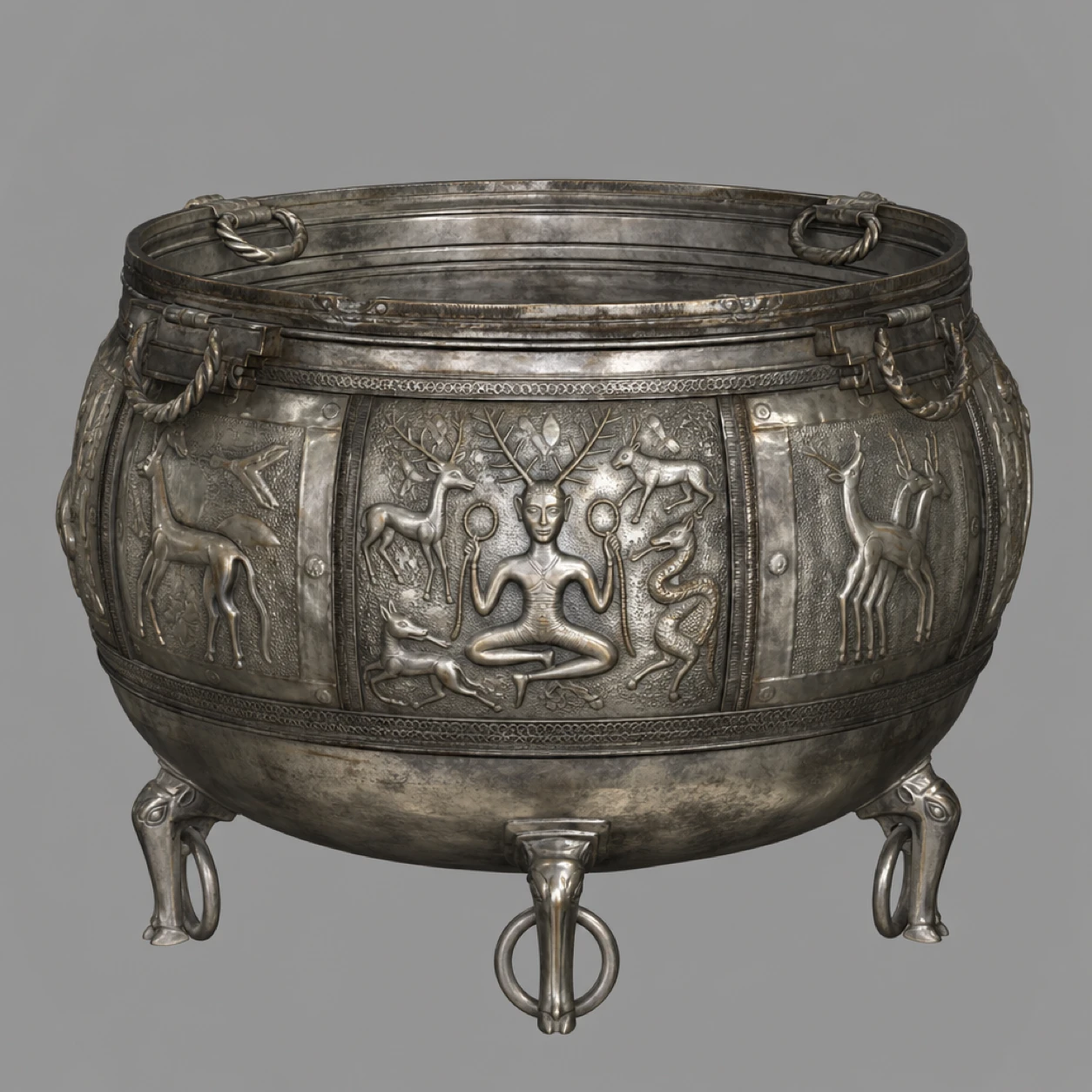
Use a Gundestrup-style cauldron as the focal prop of a ritual grove or chieftain's hall, not as background kitchen ware. Pair embossed silver panels with torcs, shields, or a carnyx player to signal Iron Age ceremony rather than generic fantasy camp. Our Celtic Ritual Relics pack includes a Gundestrup cauldron model sized for hill-fort interiors and druid enclosures.