Iron Age War Horns: The Celtic Carnyx
The carnyx was a long bronze war trumpet used by Celtic-speaking peoples across Iron Age Europe, roughly from the 3rd century BCE into the early centuries CE. Players held the instrument upright: a mouthpiece at the bottom, a straight or gently S-shaped tube rising to shoulder height or above, and a wide bell cast as an open-mouthed animal head, most often a boar. Classical authors describe the sound as harsh and piercing, suited to battle noise. Archaeology confirms the form on coins, sculpture, and a handful of fragile bronzes recovered from sanctuaries and bogs.
Boar's-head bells, upright tubes, and bronze tongues
Reconstructions based on finds suggest a height near 1.8 m, about the stature of the player. The bell could portray a boar, wolf, serpent, or other predator; some examples include a movable bronze "tongue" that rattles when blown, adding to the din. The tube is beaten sheet bronze, often in sections, with a horizontal mouthpiece branch and a vertical resonating length so the animal head projects above the ranks.
Art shows musicians in breeches and helmets blowing while infantry advance. The instrument is not a civilian horn for tunes; it is a field voice, meant to carry over shields and shouting. Dacian armies used related trumpets, and Roman artists copied the motif on victory monuments, but the carnyx name and the boar-head type belong to the La Tène cultural sphere in Gaul, Britain, and the Middle Danube. Depictions outnumber survivals by a wide margin, which is why each partial find draws so much attention.
From Telamon to Trajan's Column
Greek and Roman historians who watched Celtic armies move through Italy, Greece, and Asia Minor mention war horns that unsettled their troops. Polybius, describing the battle of Telamon in 225 BCE, writes of trumpets that blast together when the armies close. Later Roman coinage shows naked Gallic warriors with carnyx and severed head, enemy stereotypes turned into propaganda.
Celtic mints also put carnyces on silver staters: chiefs advertise martial identity by placing the horn beside chariots, horses, and torcs. The image travels faster than bronze; a soldier in Britannia or Corrèze could recognise the same silhouette. By the Roman conquest of Gaul, the carnyx was both a battlefield tool and a symbol on money and monuments, a sign of barbarian noise to enemies and of collective courage to those who followed the boar's head standard.
Sound, rank, and ritual before the clash
Commanders needed audibility when formations mixed foot soldiers, cavalry, and chariots. A vertical horn projects above helmet lines; several players can stagger calls along a line. Roman writers stress psychological effect, the moment when many carnyces answer each other and the line begins to move.
Archaeology adds ritual depth. At Tintignac in Corrèze, France, excavators found seven carnyx fragments in a Gallic sanctuary deposit alongside helmets, weapons, and a cauldron, objects deliberately broken or bent before burial in a pit. That pattern matches votive sacrifice rather than a lost baggage train. The Gundestrup cauldron, found in Denmark but probably made far to the south, shows three carnyx players behind marching spearmen on a panel often read as a passage into death or transformation. War, religion, and music overlap; the horn is not only for terrorising Romans.
The Gundestrup players and the Deskford boar's head
The clearest group portrait survives on silver, not bronze: the Gundestrup warrior plate in the National Museum of Denmark. Three musicians stand at the rear of a column, each blowing a carnyx whose bell ends in a boar snout. They wear tunics and helmets like the infantry ahead of them, linking sound to the same cultural world as shields and spears. The panel is a picture of practice, not a maker's diagram, yet it matches fragments found in Gaul and Britain.
Physical remains are rarer. The Deskford carnyx from Moray, Scotland, is the best-known surviving bell: a boar head with enamelled eyes and a fragment of tube, found in a bog in the early 19th century and displayed at the National Museum of Scotland, with a modern reconstruction showing the full height. Until the 2004 Tintignac discovery, only a handful of sites yielded identifiable pieces across Europe. Each new hoard changes the map, but the Gundestrup image remains the textbook illustration every reproduction, including game props, cites when animating a Celtic charge.
Fragmentary evidence and the limits of reconstruction
Complete carnyces are extraordinarily rare; most pits yield bent tubes and detached bells dismantled on purpose. Restorers must decide which fragments belong together, as at Tintignac, where one boar-head horn was rebuilt from pieces that likely came from a single instrument but lack a certain mouthpiece match.
Acoustic experiments on reconstructions produce a loud, wavering tone unlike modern brass, but we cannot know regional playing styles. Some bells depict fantastical beasts rather than boars, so "the" carnyx sound never existed as one uniform call. Roman accounts emphasise fear; Celtic coinage emphasises prestige. Both may be true at once on a battlefield where horns mark sacred as well as military time.
In your scene
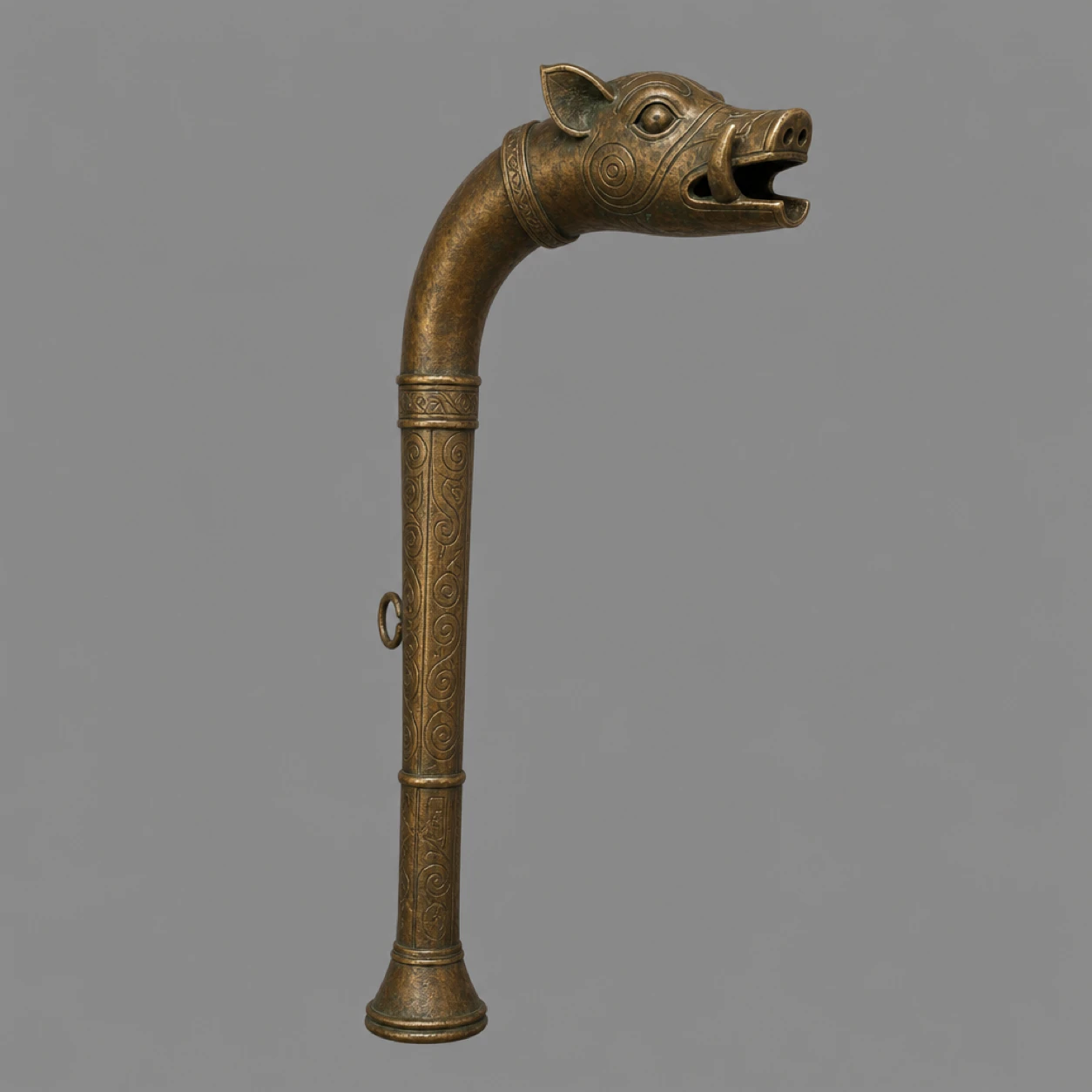
Place one or two carnyx players on a rampart or behind a shield wall, tubes vertical so the boar heads clear the line. The horn works as audio cue and set dressing: it tells the player a charge is coming without voicing dialogue. Pair it with the Gundestrup cauldron relief or an Iron Age torc for La Tène identity. Our Celtic Ritual Relics pack includes a carnyx model scaled for hill-fort scenes and ritual deposits.