The Gjermundbu Helmet: Ringerike's Only Complete Viking Helm
The Gjermundbu helmet is a round iron helm from a Viking Age cremation grave in Ringerike, Norway. It is the most complete helmet known from the Viking centuries, restored from nine fragments found in 1943. Unlike the horned helmets of modern illustration, the real piece has a short nose guard, a spectacle-shaped visor over the eyes and cheekbones, and rings at the neck that once held a mail curtain. It weighed about 1.5 kg and belonged to a wealthy mounted warrior buried with swords, spears, chain mail, and riding gear.
Spectacle visors, four iron plates, and the nose guard
Archaeologists class the Gjermundbu helmet as a "spectacle" type because a single forged band wraps around the eyes and cheeks like a pair of goggles. The nose piece is short and welded to that band rather than standing alone on the brow. Four iron plates form the bowl, riveted together in a pattern related to earlier Vendel and Anglo-Saxon helmets, but scaled for a late ninth or tenth century Scandinavian rider.
Small iron rings at the back of the rim show that mail hung from the helmet to shield the throat. World History Encyclopedia notes that the visor on the Gjermundbu find once carried narrow strips of bronze or silver inlay, now lost to corrosion. The top of the bowl rises to a low iron spike, a common crest form on early medieval helms. Nothing in the find suggests horns; those belong to nineteenth century opera, not to the grave goods under Ringerike turf.
From Vendel prototypes to a lone Viking survivor
Helmets were never common in Viking graves. Tens of thousands of graves have been opened across Scandinavia, yet complete helms can be counted on one hand. World History Encyclopedia explains that leather and textile caps probably protected most fighters, while iron bowls remained luxury items forged by skilled smiths.
Earlier "spectacle" helmets appear in seventh century Sweden at Vendel and Valsgärde, often in boat burials of elite households. The Gjermundbu example carries that tradition into the Viking Age, but almost no other Viking burial has produced a matching helm. Sutton Hoo's famous crested helmet sits in East Anglia a century earlier; Gjermundbu shows how the form lingered at the northern edge of elite warfare. Dating the grave is not settled to a single year: publication summaries range from the late ninth century to about 970 CE, depending on typology and cremation context.
Burial by fire, spears through the iron, and a rider's kit
The helmet came from Gjermundbu farm near Haugsbygd, Buskerud, where Gunnar Gjermundbo was levelling ground for an orchard in March 1943. He struck a cremation layer inside a turf mound and stopped digging. Sverre Marstrander and Charlotte Blindheim from the University of Oslo excavated two linked mounds over the following weeks, catalogued as grave I and grave II under museum number C27317.
The dead man was cremated with weapons and equestrian equipment: swords, axes, spears, shield bosses, stirrups, spurs, chain mail, gaming pieces, and cooking gear. Museum accounts describe the helmet as deliberately damaged for the funeral, pierced once by each spearhead from the grave. That act fits a wider pattern of breaking swords and bending shields so grave goods could not be reused lightly. The burial reads as a statement of status as much as protection for the afterlife.
Walking the restored helm in Oslo today
Visitors see the restored helmet in the Museum of Cultural History in Oslo, displayed with the rest of the Gjermundbu hoard. Standing before the bowl makes the weight believable: the plates are thick, the spectacle bars narrow the field of vision, and the mail hooks at the rear remind you that the wearer trusted iron at the face and mail at the neck. Conservators assembled the nine fragments after excavation; gaps and repair lines are part of the object's honest biography.
The same case often holds the mail shirt from the grave, one of the few Viking Age examples with a documented find spot. Together they argue that this man rode, fought at spear range, and could afford kit that most farmers never touched. Popular culture floods screens with helmeted raiders; archaeology whispers that only a thin elite owned such gear.
Why so few Viking helms survive, and what scholars still debate
Iron corrodes. Leather rots. Many "Viking helmets" in old museum drawers turned out to be misdated pieces or modern fantasies. Gjermundbu survived because cremation and mound soil preserved fragments long enough for twentieth century conservators to save them. Other graves may have held helms that dissolved entirely, or families may have passed weapons down rather than burning them.
Researchers still argue over the man's network: some tie the riding equipment to continental cavalry fashions, others to local chieftain display. DNA and isotope studies on cremated bone are harder here than on inhumed skeletons. What is secure is the helmet's shape, its damage marks, and its place as the benchmark every reproduction, including game assets, must cite.
In your scene
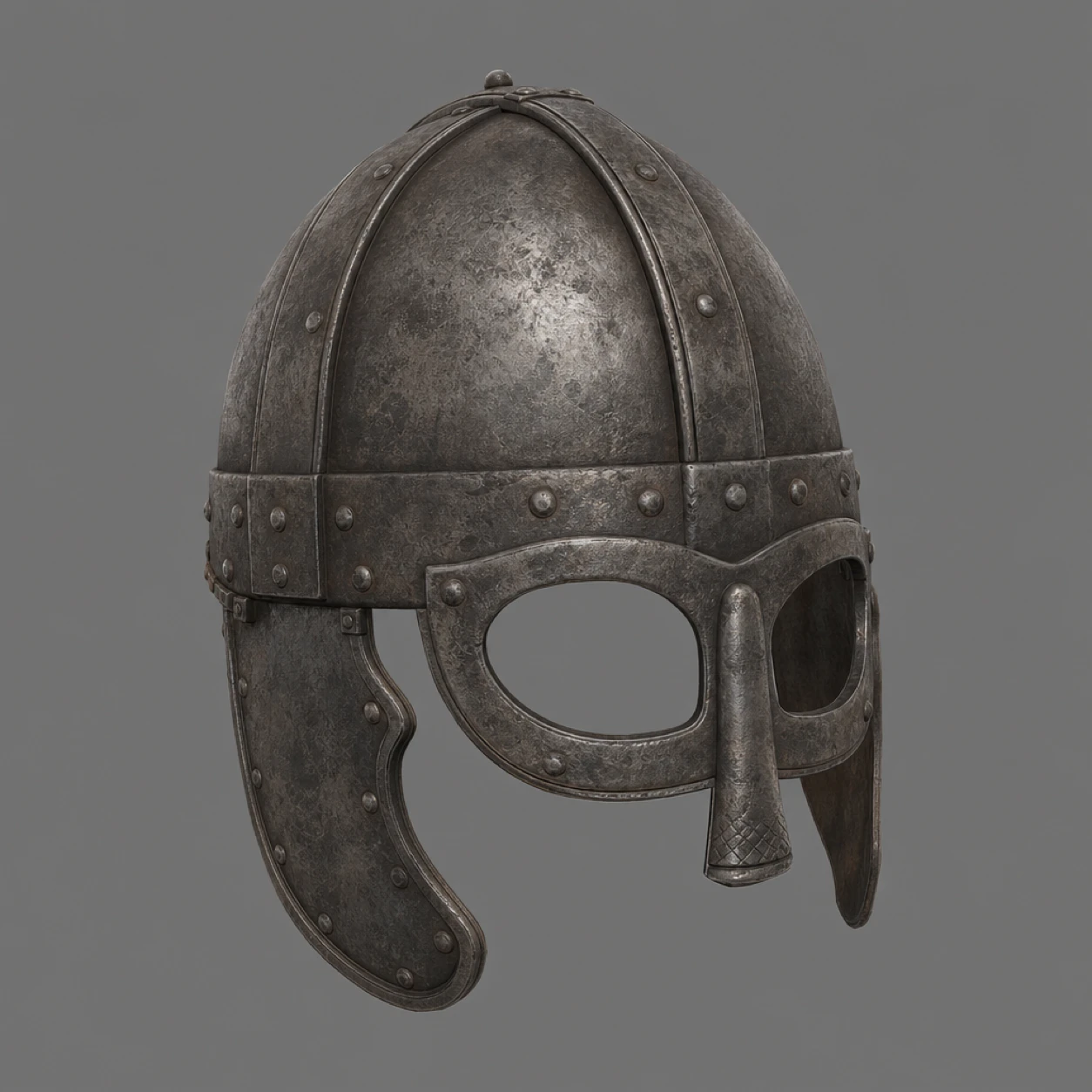
Place a spectacle-visored helm on a high seat or weapon rack in a longhouse hall, not on every raider in the fjord. Pair it with a funeral ship mound or riding gear to signal elite rank. Our Viking Hall Relics Vol. 2 pack includes a Gjermundbu-style helmet model for feast halls and chieftain interiors.