Forge Bellows: Air for the Norse Smith's Fire
A forge bellows is the hand-powered blower that feeds air into a smith's fire. In Viking Age Scandinavia it was built from wood and leather, often as paired bags worked in turn so the charcoal never lost its draft. The object rarely survives in the ground, yet hearth stones, carved panels, and Old Norse stories about dwarf smiths all assume the same tool at the edge of the flame.
Twin bags, wooden boards, and one nozzle
The basic shape is simple. Britannica's entry on bellows describes a hinged chamber with flexible sides: pull the boards apart and air rushes in through a one-way valve; push them together and the blast shoots out through a narrow nozzle. Viking reconstructions follow that logic with two leather bags mounted on wooden frames, their outlets joined into a single pipe aimed at the coals.
Materials were local. Oak or pine boards formed the rigid cheeks of each bag. Cattle hide, sealed with tallow or pitch, made the flexible walls. Toggles, pegs, or rope handles let a smith lift one chamber while pressing the other flat. Experimental archaeologists working from medieval images often cut the leather as curved panels rather than flat triangles, because a spherical bag holds more air per stroke. Nothing in the archaeology tells us whether every Norse workshop used exactly that cut, but the mechanics are clear.
From Iron Age bags to Viking workshops
Hand bellows long predated the Viking Age across Europe. What changes in the north is how confidently we can picture them beside Scandinavian forges. Complete bellows almost never survive: leather rots, wood burns, and workshop gear was reused until it fell apart. Archaeology instead gives fragments, images, and the stone parts of the hearth that outlasted the bags.
Soapstone forge blocks turn up in Norwegian and Danish contexts from the late Iron Age into the Viking period. Carved with a channel for the nozzle and a mouth for the flame, they protected the leather from direct heat. Paired with slag heaps, tuyeres, and finished tools, they show that smithing was ordinary village work, not only saga magic. The gap is the bellows themselves. For the Viking centuries we depend on art, literature, and comparison with better-preserved Iron Age finds elsewhere in Scandinavia.
At forge, bloomery, and longhouse hearth
Britannica on smithing lists the forge, anvil, tongs, and hammers as the blacksmith's core kit. In Norse society that kit served daily repair as much as weapon making. A farmer might need a ploughshare reset, a rivet drawn, or a horse shod. Larger sites supported specialists who could weld steel edges onto iron tools or cast simple fittings in bronze.
Air mattered because charcoal fires die without draft. Bellows raised the temperature enough to weld, to draw out bar stock, and to anneal work that had hardened too far. Bloomery smelting, turning bog ore into a spongy iron bloom, demanded far more air than a village smithy normally produced, and scholars still debate how Scandinavian smelters supplied that blast. The twin-chamber bag bellows known from images were built for the forge hearth, where one or two workers could keep a steady, if pulsing, stream of wind on the coals.
Two chambers, alternating strokes
The most detailed Norse pictures show paired bellows rather than a single great bag. On the 11th-century Ramsund carving in Södermanland, Sweden, one panel in the Sigurd legend places the dead smith Regin beside his severed head with tools scattered around him. World History Encyclopedia's description of the stone names those tools as the set Regin used to reforge the sword Gram. Art historians read the carved forms beside him as a double bag bellows of the type still built at living-history forges.
Norwegian stave churches also preserved wooden portal reliefs with the same legendary cycle. Britannica on stave churches describes doorways embellished with fine carving, often including pre-Christian motifs set into 12th-century buildings. Together with Ramsund, those panels suggest a regional habit: two bags, one nozzle, operators trading lift and squeeze so one chamber fills while the other empties. The airflow was never perfectly even, but it beat waiting for a single bag to refill.
Literature points the same way. In the Prose Edda tale where Loki wagers his head against dwarf smiths, Brokk works the bellows while his brother Sindri shapes treasure in the fire. World History Encyclopedia on Loki retells how Loki loses the bet and has his lips sewn shut, a story that later carvers linked to forge imagery. Their article on elves and dwarves places Regin in the same smithing world as Sigurd's foster father, a craftsman at the hearth rather than a distant god.
The Snaptun stone at the bellows mouth
The clearest archaeological anchor is not leather but stone. The Snaptun hearth stone, carved around 1000 CE, was found in 1950 on a beach near Snaptun in Horsens Fjord, Denmark. The rock is soapstone thought to come from Norway or western Sweden, worked into a curved shield for the front of a forge. A hole at the bottom accepted the bellows nozzle; a second opening above directed air up through the fuel bed while the stone kept heat and sparks away from the bags.
The carved face is what draws most visitors. A mustached head stares out with lips that look scarred or stitched shut. World History Encyclopedia's image essay on the stone explains the usual reading: the face is Loki, and the mouth recalls the Edda episode where dwarves sew his lips after the smithing wager. Whether that also makes Loki a fire god is disputed; the stone's practical job is certain. It is a bellows guard, one of the few Viking Age objects that shows exactly where the nozzle met the hearth. The piece is displayed in Denmark today, at the Moesgård Museum near Aarhus.
Held beside a hearth reconstruction, the Snaptun stone turns an invisible tool into a fixed point in the workshop. You can see where the smith knelt, which side faced the fire, and how stone outlasted the perishable bags.
What carvings show when wood rots away
Honest limits matter. No Viking Age bellows survives whole in a museum case. Ramsund and the stave church panels prove that artists knew the paired-bag form, but carvings simplify detail. Soapstone hearths are rarer than hammer scales or whetstones. Experimental reconstructions vary in size, from roughly twenty-inch chambers up to larger bags for demonstration forges, because the images never came with measured plans.
Norse smiths almost certainly shared designs across the 9th to 11th centuries, yet regional workshops would have sized bellows to the hearth, the ore, and the number of hands available. A longhouse forge beside a warp-weighted loom needed a smaller set than a dedicated smelting site. When sources disagree, the safe claim is narrow: Vikings used hand bellows, often doubled, at charcoal fires; the Snaptun stone shows how the nozzle met the stone; the rest is reconstruction disciplined by a handful of pictures and by saga scenes where the pump at the forge is never optional.
In your scene
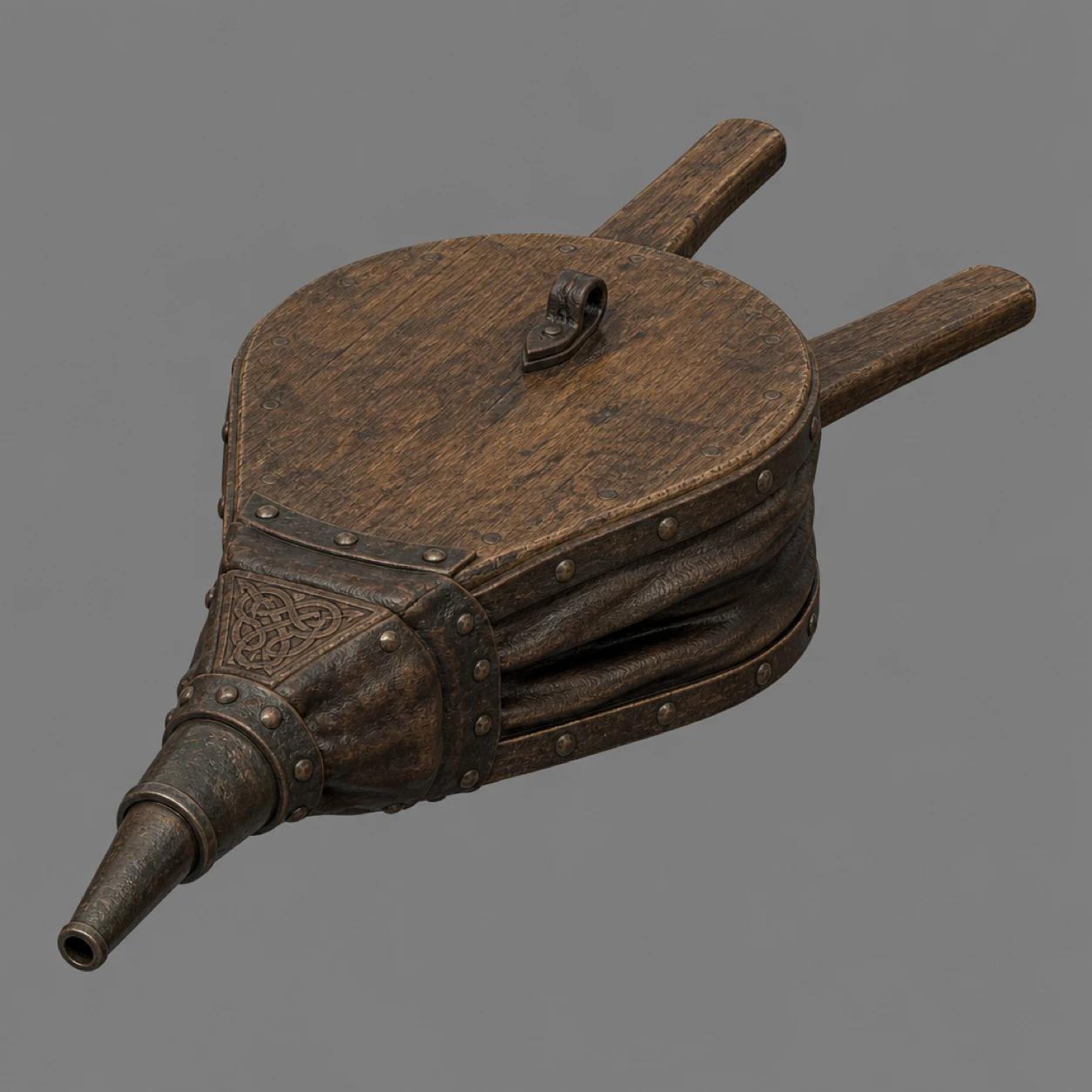
Pair bellows with a low stone or clay hearth, an anvil, and charcoal scatter, not a modern chimney stack. One figure can work the bags while another tends the metal. Our Viking Hall Relics Vol. 2 pack includes a forge bellows prop sized for a Norse longhouse workshop beside the warp-weighted loom and carved chest.