What Is a Cuauhxicalli? The Aztec Eagle Vessel for Hearts
A cuauhxicalli is a stone offering vessel used in Mexica (Aztec) temple rites to receive the hearts of sacrificial victims. The Nahuatl name joins cuauhtli (eagle) and xicalli (a gourd-shaped bowl), often translated as "eagle gourd bowl" or "eagle vessel." Priests placed the extracted heart in the hollow basin on top, sometimes burning it there as food for the sun. Many surviving examples are carved as eagles or jaguars, with the ritual bowl set into the animal's back.
Cuauhtli, xicalli, and the bowl on the eagle's back
Colonial-era dictionaries and Mexica chronicles describe the cuauhxicalli as a container for hearts and blood offered to divinities, especially the sun and the earth. The word could also refer to wooden pans or plates in everyday speech, but in temple contexts it marked a formal receptacle tied to state ceremony.
Visually, the type is easy to read once you know the cue: a circular depression on the upper surface, often surrounded by bands of feathers, jade beads, or stylised hearts. Eagle-shaped examples link the vessel to cuauhtli, the sun-associated bird of prey that Mexica warriors aspired to emulate. Jaguar-shaped versions, sometimes called ocelotl-cuauhxicalli, carry the night hunter instead. A third form is the chacmool, a reclining figure holding a bowl on the belly, which could serve the same ritual function.
Stone vessels at the summit of the Templo Mayor
Heart extraction was performed at the top of temple-pyramids in the sacred precinct of Tenochtitlan. World History Encyclopedia describes victims stretched over a sacrificial stone while a priest opened the chest with an obsidian blade and removed the heart. The heart was then placed in a stone cuauhxicalli or in a chacmool figure and burned as an offering to the deity honoured that day.
The Templo Mayor dominated the precinct with twin shrines to Tlaloc and Huitzilopochtli. Sacrifices fed both rain and war cults. Captives taken in battle were the most prestigious offerings. Mexica writers did not use the Spanish term "human sacrifice." World History Encyclopedia frames their offerings as repayment to the gods who had themselves sacrificed at the creation of the present world, a ritualised necessity rather than mere slaughter.
Opening the chest and offering the heart to the sun
Britannica records that sacrificial hearts were offered to the sun as quauhtlehuanitl, "eagle who rises," and burned in the quauhxicalli, "the eagle's vase." Warriors who died in battle or on the sacrificial stone were called quauhteca, "the eagle's people," and were thought to accompany the sun before entering hummingbird forms.
The ritual sequence is documented in Spanish chronicles and indigenous pictorial codices. World History Encyclopedia describes victims stretched over a sacrificial stone at the pyramid summit, the chest opened with an obsidian blade, the heart lifted and placed in a cuauhxicalli or chacmool figure, then burned as an offering to the deity honoured that day. The cuauhxicalli stood at the centre of this choreography as the point where blood entered the divine economy.
Eagle forms, jaguar forms, and chacmool bowls
Not every cuauhxicalli looks like Wildform's eagle prop, but the eagle type is among the best known from excavations. Archaeologists have recovered jaguar vessels from the Templo Mayor and other sites in the Valley of Mexico. Jaguar-shaped versions, sometimes called ocelotl-cuauhxicalli, carry the night hunter and link the bowl to the underworld as well as the sky.
Chacmool figures belong to the same ritual family. When a heart could not be burned on an eagle's back, a reclining chacmool with a midriff bowl received it instead. Both forms echo pottery jars used to store pulque, the fermented maguey drink. That shared silhouette suggests sculptors deliberately shaped sacred stone in the profile of familiar feast vessels.
The British Museum basalt cuauhxicalli
The British Museum holds a basalt offering vessel registered as Am6185, described on its catalogue slip as a cuauhxicalli found near Puebla. The upper body carries encircling bands of human hearts, feathers, and jade. The front bears a solar disk and the day sign 4 Movement, the glyph for the fifth and current era in Mexica cosmology. On the base beneath is 1 Rain; the reverse side shows a lunar symbol with 2 Rabbit, a calendrical name linked to the pulque god.
Curators note that the hollow basin on top and parts of the exterior carving were never finished. Tool marks and deliberate defacement along the sides suggest work stopped abruptly, perhaps when Spanish forces disrupted temple production in the early 1500s. The object therefore records both the ambition of Mexica stone carving and the moment that ambition was cut short.
Defaced surfaces and vessels left unfinished
Several cuauhxicalli in museum collections show similar interruption. Some were buried as dedicatory deposits within the Templo Mayor and recovered in twentieth-century excavations; others, like Am6185, entered European collections without precise findspots. Scholars caution against treating every eagle sculpture with a back hollow as a heart bowl, but the combination of basin, solar imagery, and heart bands on finished examples makes the identification secure for major museum pieces.
Basalt and andesite were favoured for large vessels because they could hold fine feather and glyph detail under temple lighting. Smaller ceramic bowls may have served parallel roles in household or calpulli rites, though stone examples dominate published catalogues. Exact counts of surviving cuauhxicalli are difficult to state because typology debates continue, but the type is firmly attested in both archaeology and colonial Nahuatl texts.
In your scene
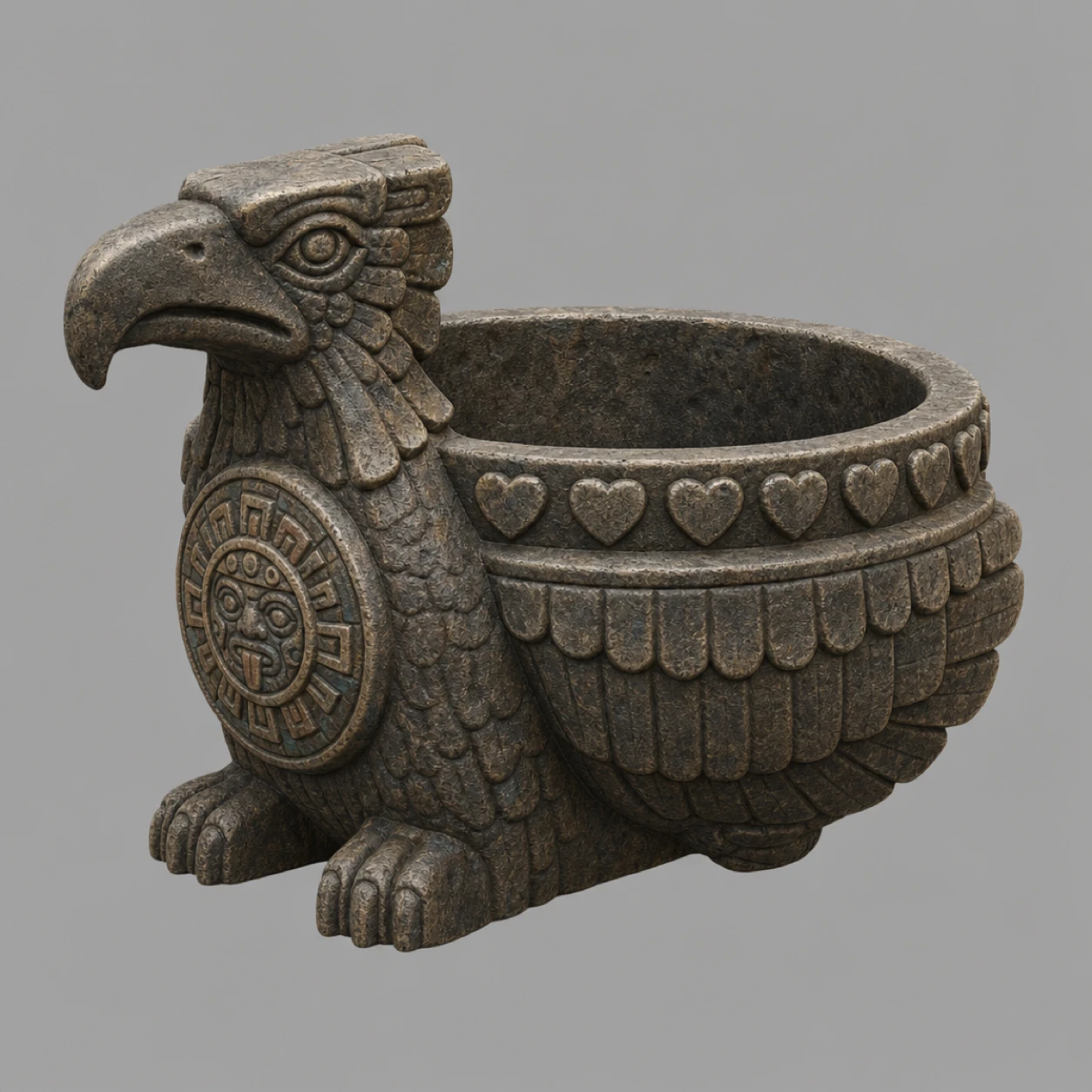
Place a cuauhxicalli on a pyramid summit platform or beside a sacrificial stone where the hollow bowl reads at glance height. Eagle silhouettes signal Mexica ritual immediately to anyone who knows the type. Our Aztec Temple Relics pack includes a stylised eagle cuauhxicalli suited to temple summits beside a chacmool or sun stone.