Quiquiztli: Aztec Breath, Wind, and Ritual Sound
A conch trumpet in Aztec Mexico was called a quiquiztli, a large marine shell turned into a wind instrument by cutting away the pointed tip to form a mouthpiece. Priests, warriors, and temple attendants blew it to mark sacred time, announce processions, and carry sound across pyramid courts where drums and slit drums already thundered. The quiquiztli was not casual music. Its tone linked breath, wind, and the sea to gods who moved creation forward.
Shell, mouthpiece, and the name quiquiztli
The instrument starts as a univalve mollusk shell, often from warm Atlantic or Caribbean waters traded inland to the Valley of Mexico. A player removes the apex, leaving a hole to buzz the lips against, much like a brass horn without metalwork. Aztec examples in art and archaeology are usually left in that natural state, without the extra finger holes or carved mouthpieces that Maya or earlier Teotihuacan makers sometimes added.
Nahuatl vocabulary kept roles precise. The shell trumpet is quiquiztli, and a specialist blower was a quiquizoani, a musician named for the instrument he played. The Metropolitan Museum of Art notes that an illustration in the Codex Magliabecchi, drawn in the mid-1500s, labels an Aztec quiquizoani with his right hand inserted into the shell's opening. That hand position alters pitch by changing the air column inside the spiral, a technique European horn players would adopt centuries later.
Do not confuse quiquiztli with decorative conch pieces in mosaic art. The British Museum's turquoise mask of Xiuhtecuhtli uses cut Strombus shell for teeth, but those inlays are visual, not blown.
From Gulf coast shells to imperial ritual
Conch trumpets appear across Mesoamerica long before the Aztec Empire. Early Formative burials in the Basin of Mexico already held shell horns, and Classic Maya artists carved ancestors and serpent breath onto trumpets they considered voices of the dead. By the Late Postclassic period, when Tenochtitlan dominated the Triple Alliance, the quiquiztli belonged to state ritual at a capital fed by tribute that included exotic shells.
World History Encyclopedia dates a surviving Aztec example to the Postclassic era, roughly 1325 to 1521 CE, the span from the founding of Tenochtitlan to the Spanish conquest. That chronology fits codices and temple offerings that show conch players at the front of processions, sometimes with dark painted sound marks curling from the bell to suggest a deep, carrying note.
At the temple gate, in procession, on the battlefield
In Tenochtitlan the quiquiztli worked as a signal as much as a song. It could open incense offerings, mark stages of night watches, or lead priests through crowded festival routes around the Templo Mayor. Spanish observers during the 1521 siege heard conch shells mixed with drums when captives were sacrificed on the pyramid, a sound Cortés and his men could not silence from their camps outside the city.
World History Encyclopedia's account of the fall of Tenochtitlan describes how drums, conch shells, and screams from the Great Pyramid of Tlatelolco reached the besieging Spanish force during the sacrifice of captured conquistadors in June 1521. The passage does not name the Nahuatl word, but it confirms that conch horns remained central to public ritual even as the empire collapsed.
War used the same instrument. Reliefs and colonial descriptions picture conch blasts accompanying marching warriors, and sixteenth-century accounts of the siege report mournful quiquiztli calls as prisoners climbed the steps of the great temple. The tone terrorized enemies because it was already tied to sacrifice and divine arrival, not because the shell was new to battle.
From Quetzalcoatl's breath to the nightly watch
Aztec thought wrapped the trumpet in creation stories. A Met curator interview on shell instruments recalls the tradition that Quetzalcoatl breathed life into the universe with sound from a giant conch, turning breath into cosmology. Wind gods such as Ehecatl, an aspect of Quetzalcoatl, share that airy logic, and the moon deity Tecciztecatl sometimes appears emerging from a shell in painted sources, linking sky, water, and the spiral form.
Daily rhythm mattered too. Colonial-era descriptions compiled from indigenous informants report conch blasts marking divisions of day and night in temple service, though exact counts vary between sources and are hard to pin to a single calendar reform. Treat those numbers as indicative rather than fixed law. What stays consistent is the role: audible time, audible presence of the sacred.
A conch trumpet you can still see
Museum labels occasionally confuse Nahuatl terms, so anchor on a published object rather than a generic photo caption. World History Encyclopedia illustrates an Aztec conch shell trumpet held at the Musée du Cinquantenaire in Brussels, assigned to the Postclassic period and described as used in rituals, festivals, and religious processions. The piece is not as famous as the turquoise serpent in London, but it is a documented trumpet rather than a carved inlay or pottery figurine.
Compare it to the highly carved Mixtec and Aztec horns in other collections, where dancers, skeletons, and deity staffs cover the outer surface. The Brussels example helps show the range from plain ritual shell to prestige carving, both functioning as quiquiztli when a player could sound them.
Carved shells, codices, and what survives
Archaeology has recovered conch trumpets from Templo Mayor offerings in Mexico City, often alongside objects tied to water, fertility, and sacrifice. Many are fragmentary or plain, which understates how splendid carved examples looked when feathered and painted. Codices remain crucial because they show performance: who stood at the head of a procession, how sound was drawn, and how the player's hand entered the bell.
Scholars still debate fine points, including how many daily blasts colonial texts preserve and whether every large shell species named in Nahuatl belonged to the trumpet class. The instrument's meaning is less disputed than its timetable. The quiquiztli called gods, marked ritual time, and carried over water and wind symbolism from earlier Mesoamerican religions into the soundscape of the Aztec capital.
In your scene
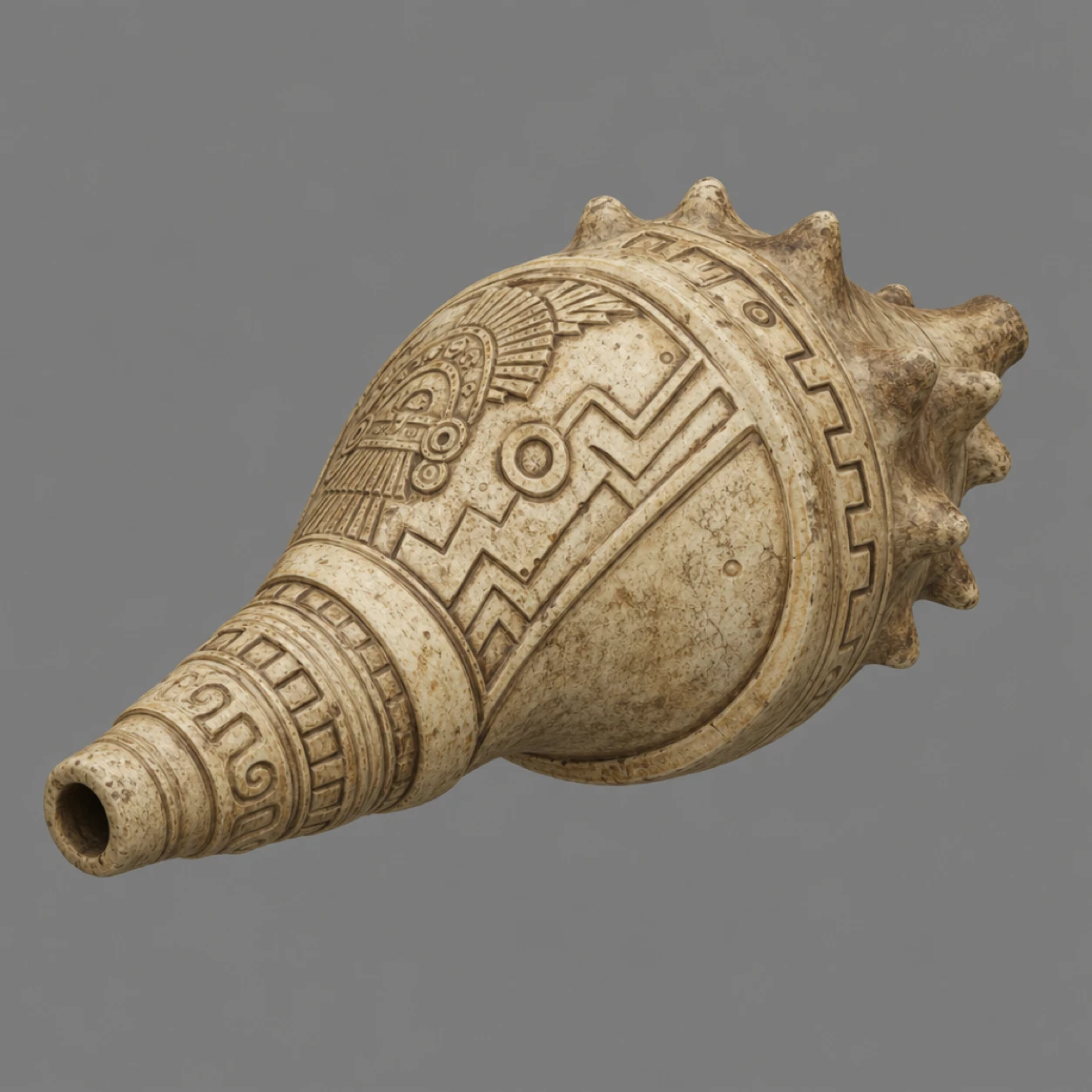
Place a quiquiztli in a priest's hands at the base of a pyramid stair, or at the head of a festival procession crossing a courtyard. Pair the deep shell tone with drums from the same pack so the scene reads as Mesoamerican temple ritual rather than generic fantasy fanfare. Our Aztec Temple Relics pack includes a conch trumpet model sized for ritual chambers and open plazas.