Cernunnos Panel: Antlers, Torcs, and a Ram-Headed Snake
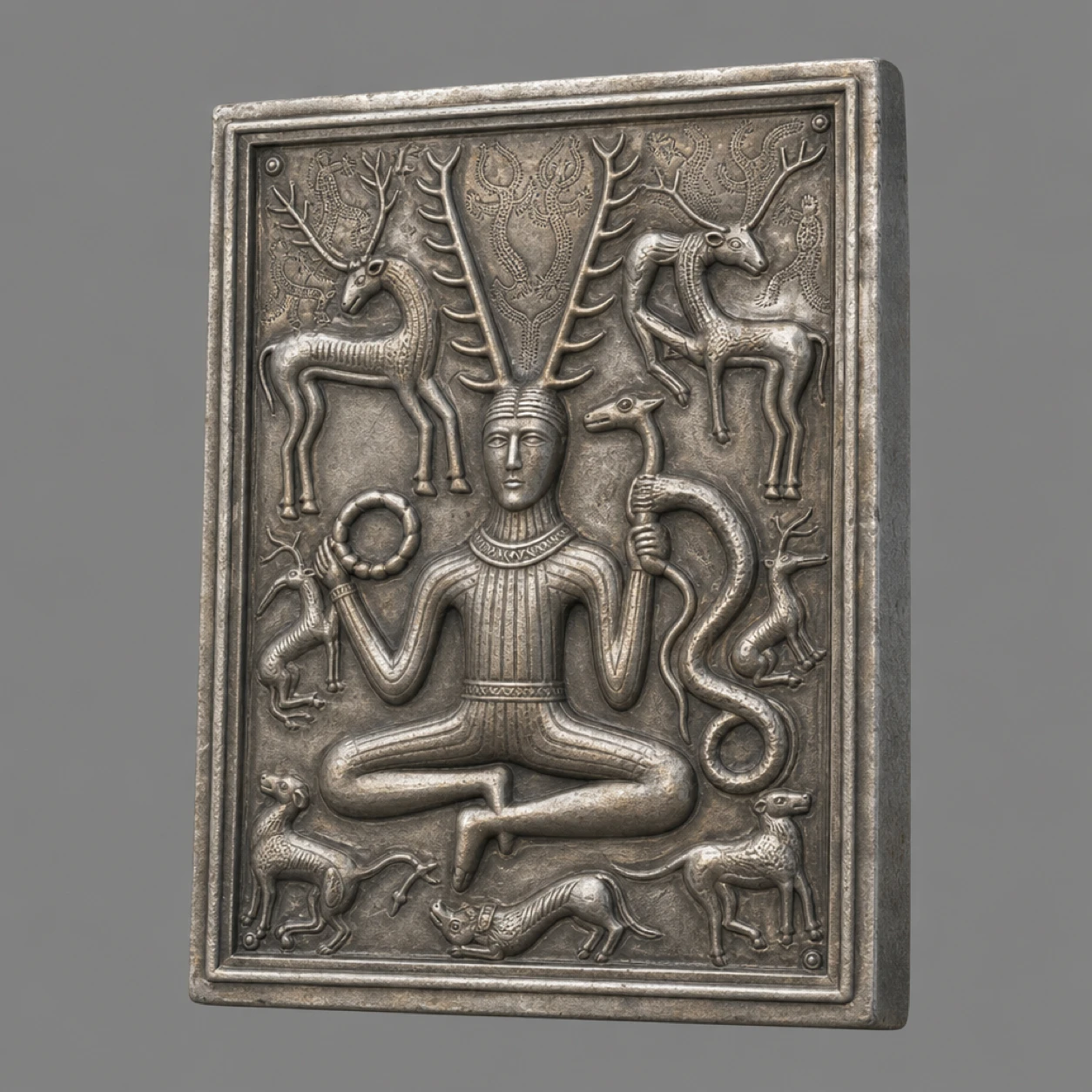
A Cernunnos plaque is not a separate archaeological type but a relief panel from the Gundestrup Cauldron showing a seated, antlered figure who is widely, though not certainly, identified as the Celtic god Cernunnos. Wildform's prop isolates that inner plate: a cross-legged god wearing a torc, holding another torc in one hand and a long snake with a ram's head in the other, with a stag and other animals ranged around him. The original is hammered silver, part of the richest Iron Age metal vessel known from northern Europe, and it now anchors debates about Celtic religion, Balkan manufacture, and how a Danish bog came to hold Thracian-style art.
Antlers, torcs, and the ram-headed serpent
The figure sits with legs folded, eyes level with the viewer, antlers rising like a crown. A heavy torc circles his neck, and his right hand grips a second torc as if offering or displaying it. In the other hand he holds an elongated serpent whose head is rendered with curled ram horns, a motif that appears on other Gundestrup panels and on Celtic metalwork where snakes signal power, water, or the underworld. To his left stands a stag whose antlers mirror the god's own in size and curve closely enough that museum writers have called the match deliberate.
Around the seated figure crowd dogs, felines, bovines, and stranger beasts, including a small rider on what may be a dolphin. An ivy-like plant rises between the antlers; some catalogues treat it as background filler, others as a tree or vine tied to forest sovereignty. Nothing on the silver names the god. The link to Cernunnos rests on other images: a 1st century CE pillar from Paris names an antlered deity Cernunnos with torcs hanging from his horns, and scattered Gallo-Roman reliefs repeat the horned, seated, or bust-length form. World History Encyclopedia cautions that our knowledge is thin enough that the Gundestrup figure might be a priest in antlers rather than a god at all.
From Paris inscriptions to a Danish bog find
Cernunnos as a name survives on only one ancient inscription, the Gallo-Roman Nautae Parisiaci monument dedicated under Tiberius, where the god appears bearded, horned, and torc-bearing above a broken lower register that may once have shown him seated as on Gundestrup. Literary sources are almost as sparse. Julius Caesar's Gallic War compares Celtic gods to Roman ones without preserving many Gaulish names, and insular Irish and Welsh texts that mention horned figures come centuries later.
The Gundestrup panel therefore matters because it is early, detailed, and three-dimensional. The cauldron was found dismantled in a peat bog at Gundestrup, Himmerland, in 1891, then reassembled in Copenhagen. National Museum of Denmark dates manufacture to roughly 150 BCE to the turn of the era and argues for production in the lower Danube region, perhaps southwest Romania or northwest Bulgaria, where Thracian silversmithing met Celtic helmet types and carnyx war horns in the same workshops. How the finished cauldron reached Jutland is unknown: gift, trade, and war booty all appear in modern summaries.
Lord of animals, wealth, or the crossing between worlds
In reconstruction, Cernunnos is often read as a god of nature, animals, and fertility, with torcs marking status and abundance in Celtic art. The Gundestrup stag beside the antlered figure fits a "lord of animals" reading common in Celtic studies, where wearing or carrying an animal lends its strength to the wearer. The ram-headed snake complicates a simple fertility label. Some scholars pair creatures on the god's right with positive symbols and those on his left with chthonic ones, echoing wider Indo-European patterns of ordered opposites.
Ritual context is indirect. The cauldron itself was deposited in a bog after being taken apart, which National Museum of Denmark treats as a costly sacrifice to powers above. Cauldrons in Celtic myth, notably the Dagda's inexhaustible vessel in Irish tradition, link feasting vessels to regeneration and plenty. Whether the antlered panel illustrated a myth recited at such feasts, or a deity honoured before deposition, cannot be proved from the metal alone.
How the horned god moved from temple relief to isolated plaque
For most of history the Cernunnos figure was one scene among thirteen on a single vessel, visible only when the cauldron was open or displayed inner-side out. Modern casts, photographs, and museum shop pendants have lifted the panel out of that context until it reads as an icon on its own. Neopagan and fantasy art since the late 20th century reinforced the antlered seated pose, sometimes merging Gundestrup, the Paris pillar, and medieval literary echoes into one visual type.
Academic opinion has shifted more slowly. Early interpreters sometimes treated every horned figure in Celtic art as the same god; later work stresses regional cults and warns against collapsing diverse images into a single named deity. The Gundestrup figure's cross-legged posture once invited comparisons to eastern seated sages, but most historians now see it as a Celtic feast posture or a compositional choice without Buddhist connection. What persists is the panel's role as a test case: if Cernunnos is real as a pan-Celtic god, Gundestrup is the strongest image; if not, the plaque is still a masterwork of Iron Age narrative metalwork.
The antlered inner plate in Copenhagen today
Visitors meet the full Gundestrup Cauldron in Room 17 of the National Museum of Denmark, where the inner plates are displayed so the antlered scene can be studied at eye level. The museum describes the inner set as more complex than the outer deity busts: warriors in procession, a bull sacrifice, and this horned figure surrounded by lions, deer, and griffins, perhaps a ruler over wild nature. The vessel weighs nearly 9 kg of silver, partially gilded, with glass inlays once set in the eyes of outer figures.
Standing before the panel, the depth of repoussé work is clearer than in photographs. The stag and god share a single visual rhythm; the snake's length draws the eye across the whole field of animals. Conservators reassembled the cauldron from stacked pieces found inside the base, so the plaque's exact original orientation within a working feasting bowl is partly conjectural. That uncertainty is worth keeping: the figure was never a freestanding temple plaque in antiquity, even though reproductions now treat him as one.
Silver, Balkan workshops, and what the name does not prove
The panel's style mixes Thracian embossing with Celtic costume details, which is why World History Encyclopedia calls the cauldron "not Celtic, or, at least, not just Celtic." Elephant and griffin motifs on other plates point to eastern Mediterranean iconography travelling into Danube workshops. None of that requires the antlered figure to be Thracian rather than Celtic in belief; it only shows that images crossed cultural lines in the 1st century BCE trade sphere.
What remains unsettled includes the god's name, his exact function, and whether multiple horned gods once shared the visual type now filed under Cernunnos. The Paris inscription helps, but it is a bust, not a seated scene with snake and stag. Until another labelled piece appears, Gundestrup's panel is argument by analogy. That is enough for cautious museum labels and for modern devotional art, but it is not the same as a priesthood's own words.
In your scene
Hang a Cernunnos plaque on an inner sanctuary wall or lean it against a ritual post where torchlight can catch raised antlers and torcs, not on a busy market street. Pair it with the full Gundestrup cauldron prop or a great torc to signal feasting and offering rather than battlefield loot. Our Celtic Ritual Relics pack includes a Cernunnos plaque model for druid groves and hill-fort shrines.