Carved Chest: Viking Storage and Gripping Beasts
A carved wooden chest in a Viking longhouse is both furniture and message. Plain pine trunks held tools, cloth, and food for ordinary households. Elite burials and great halls could afford something louder: panels cut with interlacing beasts, iron straps with tinned nails, and hasps shaped like animal heads. The surviving examples cluster around two carving traditions that artists still borrow: the swirling Oseberg style of the early 9th century and the bolder Mammen style of the late 10th.
Pine planks, iron bands, and animal scrollwork
Norse words for chests appear in saga texts and runic inscriptions, though archaeologists usually classify finds by shape rather than by a single Old Norse label. A typical Viking Age chest is a six-plank box: trapezoidal front and back boards narrowed toward the lid, a grooved base, and simple iron hinges. Pine and oak are the usual timbers in Norwegian graves.
Carving was not standard on every chest. Most households needed lockable storage, not parade sculpture. When ornament appears, it follows the same zoomorphic vocabulary as ships, carts, and bedposts: ribbon-bodied animals with small profile heads, bulging eyes, and paws that grip borders or their own limbs. World History Encyclopedia calls this the gripping-beast motif, the hallmark of Style E, also known as the Oseberg or Broa style.
From Oseberg curves to Mammen lions
Style E flourished from the late 8th to the late 9th century across Scandinavia. Its finest wooden showcase is the Oseberg ship burial near Tønsberg, Norway, sealed around 834 CE. Britannica lists chests among the grave goods beside carved carts, sleighs, and animal-head posts.
A century later, the Mammen style (c. 950 to 1000 CE) brought fuller beasts with spiral hips, plant tendrils, and asymmetrical layouts influenced by Anglo-Saxon and continental art. World History Encyclopedia notes that although few Mammen objects survive, the style spread from Scandinavia through the British Isles to Spain. Later elite portable chests overlaid thin ivory or antler panels with pellet-filled animals, a courtly step beyond the iron-banded wooden boxes in ship graves.
Your carved chest prop can quote either phase: early 9th-century gripping beasts for an Oseberg longhouse, or late 10th-century Mammen scrollwork for a Danish high-seat hall.
In the longhouse and the burial chamber
Chests did practical work. Tool kits, tablets, spare ship fittings, and domestic goods needed dry boxes that could move when a household relocated. Saga scenes describe valuables stored in locked chests, and ship burials repeat the pattern at a grand scale.
When a chest entered a grave, it was part of a portable household packed for the dead. The Oseberg women were buried with clothes, combs, kitchen tools, carts, sleighs, several chests, and animal-head posts, according to Britannica. That list reads less like luggage than like a staged home carried into the mound. Scholars debate whether every wooden object was new for burial or included worn pieces, but the ensemble clearly marked very high status.
When iron straps replaced plain boards
Surviving chests show a ladder of expense. The simplest are nail-joined planks with a hasp and hinge. Richer examples add horizontal and vertical iron mounts, sometimes with rows of tinned nail heads that catch firelight in a hall. Complex locks with multiple hasps appear on tool chests from elite graves, signaling that contents were worth guarding.
Wood carving on chests lagged behind carving on procession gear. The Oseberg cart and sleighs carry dense relief panels, while chests from the same burial are often plainer, relying on metal for display. That contrast matters for reconstructions: a carved chest in a feast hall is plausible as high-status furniture, but not every Viking trunk bore serpent scrollwork. Museums preserve both plain boxes and heavily mounted ones from the same period.
The Oseberg chests you can still see
Oslo's Museum of the Viking Age (successor to the Viking Ship Museum on Bygdøy) displays the Oseberg ship and many related wooden objects. Britannica describes the vessel as about 71 feet long, built around 820 CE, with a burial chamber dated to 834 CE holding two women and hundreds of grave goods, including several chests.
Unlike the five unique animal-head posts, the Oseberg chests are functional furniture that happened to enter a royal burial. At least one was disturbed when the mound was robbed in antiquity, which may explain why precious metals are largely absent from the assemblage. Standing near the ship hull, the chests show how Viking woodworkers joined planks, set iron hinges, and sometimes clad surfaces in metal rather than relief carving. They are humbler than the cart, but they prove chests belonged at the center of elite material culture, not only in workshops.
Wood that rots, ivory that travels
Organic furniture rarely survives a thousand years in Scandinavian soil. World History Encyclopedia stresses that metal and stone dominate museum collections, which biases our image toward brooches and runestones. Ship burials in watertight clay are the exception that lets us see wooden carts, beds, and chests at full scale.
Later Mammen-style caskets in walrus ivory or antler survive because bone and metal travel better than pine. Their house-shaped lids and gilt-bronze seams show how Scandinavian workshops exported carved chests as gifts to Christian churches abroad. Those pieces are not direct copies of Oseberg sea chests, but they extend the same habit of turning storage into status display.
Exact counts of Viking chests remain uncertain outside major graves. Your scene should feel grounded in the handful of well-published finds rather than implying a chest in every farmstead corner.
In your scene
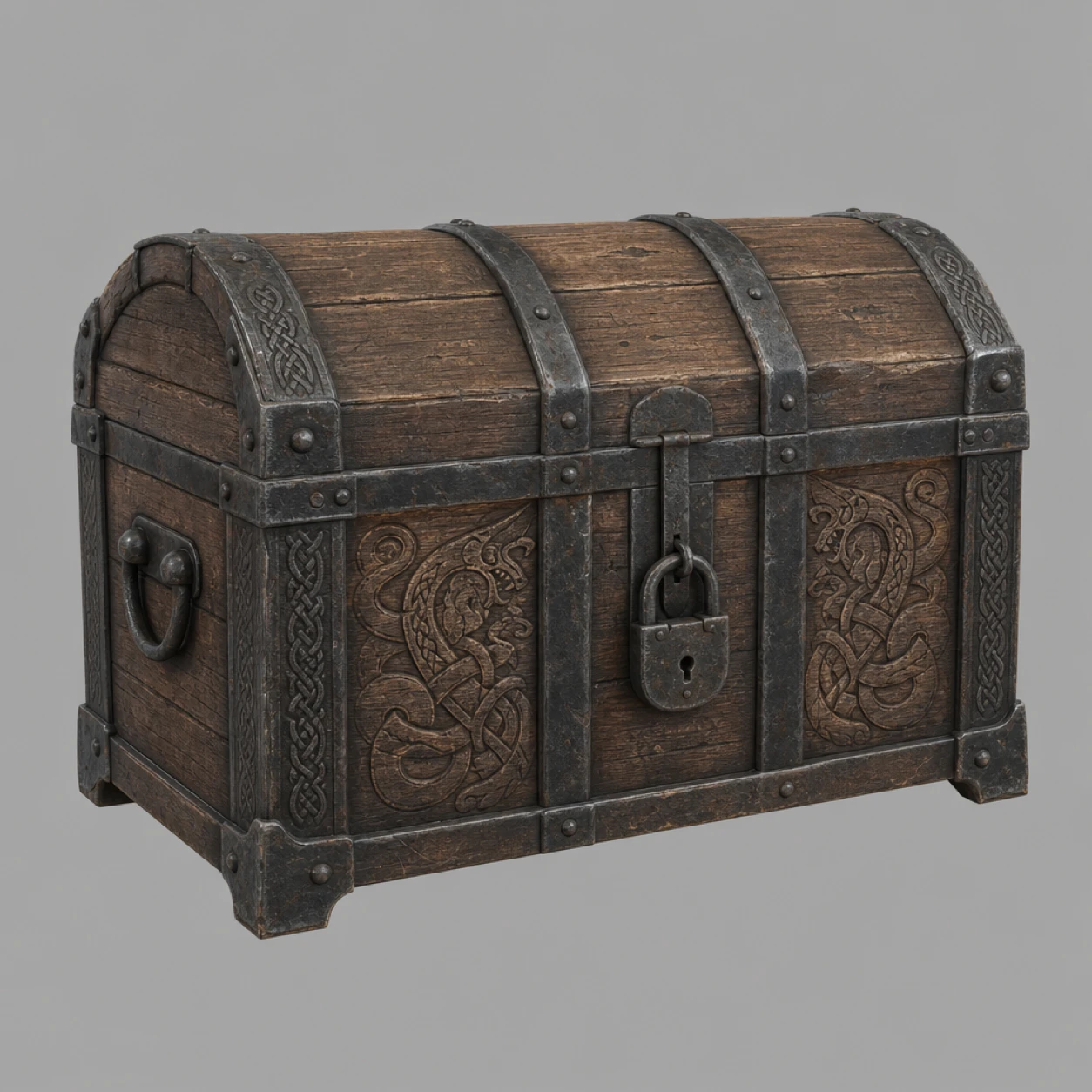
Set a carved chest against a longhouse wall near a drinking horn rack or beneath tapestries where lamplight picks out gripping beasts along the lid. Pair it with plainer storage if you want a believable farm interior, not only a chieftain's hall. Our Viking Hall Relics Vol. 2 pack includes a carved chest sized for feast halls, workshops, and Norse fantasy interiors.