The Broighter Boat: A Gold Ship from Lough Foyle
The Broighter boat is a miniature gold model of an Iron Age vessel from the Broighter Hoard, discovered in 1896 near Limavady, County Londonderry, on what was then marshy ground beside Lough Foyle. At roughly 19 to 20 cm long, it is small enough to rest in an open hand, yet it carries benches, oars, rowlocks, a steering oar, a mast, and tiny rigging details hammered from sheet gold. The hoard around it included torcs, a collar, chains, and a bowl, mostly in La Tène style with hints of Mediterranean contact. Together they rank among the finest Irish Iron Age metalwork and fuel a long argument over whether the deposit was a votive gift to a sea deity or a buried cache of wealth.
Hull, thwarts, oars, and a mast in beaten gold
Unlike abstract Celtic ornament on torcs and shields, the boat aims at realism. The hull is formed from thin gold sheet with internal thwarts that suggest rowing seats; twisted wire oars pass through holes in the gunwale, and a stern steering oar is modelled separately. A slender mast, yard, and related spars indicate a rigged craft, not only a rowed one. Small tools, including barge-poles and a grappling iron or anchor, appear in excavation accounts, though some fittings are lighter in weight than the hull and may be restored interpretations of bent metal.
The model is usually read as a wooden ocean-going boat rather than a skin curragh, which matters for how Iron Age Irish trade with Britain and the Atlantic coast is imagined. If the proportions are trustworthy, a full-size counterpart would be a serious coastal or short open-sea trader. Damage from the plough that uncovered the hoard bent parts of the hull and complicates exact counts of benches and oars; one ninth thwart was reportedly sold separately soon after discovery and is now lost, so museum displays work from the remaining pieces.
La Tène Ireland, marsh edge, and the 1st century BCE
The hoard is dated to the later Iron Age, commonly about 100 BCE, from typology of the gold collar and torcs rather than from direct scientific dating on the boat alone. Britannica places La Tène metalwork in northern Ireland from perhaps 300 BCE onward, with links to northern England and hill-fort building in the same broad period. Broighter sits in that northern landscape, on the shore of a lough that opens to the sea.
Find circumstances shaped later law and interpretation. Two farm workers struck the gold while ploughing; the objects passed through collectors and briefly to the British Museum before a 1903 court ruled the hoard treasure trove and assigned it to the National Museum of Ireland in Dublin. Debate turned partly on whether the tight packing implied burial rather than ritual casting into water, and partly on whether invoking a sea god counted as "religious" deposition under the law of the day. The boat's realism made it the public face of the hoard: stamps, coins, and textbook covers have repeated its silhouette for over a century.
Votive offering, trade ex-voto, or chieftain's stored wealth
Celtic religion across Europe includes depositing valuables in water. World History Encyclopedia notes La Tène practice of making votive offerings in lakes and rivers, while World History Encyclopedia describes precious goods thrown into Lake Neuchâtel at the Swiss type site. Bog and shoreline finds in Denmark, including the dismantled Gundestrup Cauldron, follow a similar logic of giving up usable wealth to powers beyond the farm.
Many archaeologists therefore read Broighter as an offering tied to the sea, sometimes linked by name to Manannán mac Lir, the Irish god of the otherworld waters in medieval literature. That identification is attractive because the hoard lay near tidal marsh and because the boat is the clearest "message" in the set, but medieval tales about Manannán are centuries later than the hoard, and no inscription names him on the gold. Others stress eclectic imports in the hoard, including chain types that recall eastern Mediterranean work, and argue for a wealthy patron assembling prestige goods through trade, then burying them for safekeeping or inheritance.
From open-water trade to miniature and back to icon
If the model reflects real shipping, it sits in a period when Irish communities were tied into Atlantic and British exchange networks: wine, metal, and ideas moved by boat long before Roman administration reached the island. Miniature boats elsewhere in European prehistory often appear in sanctuaries as votives; the Broighter example is unusual for its material and detail in an Irish context, where most surviving goldwork is torcs, collars, and dress fasteners rather than ship models.
After discovery the boat became a national symbol, copied on Irish currency and used in museum education as proof of early maritime skill. That fame can obscure how fragile the object is: sheet gold dents easily, and conservation stabilized plough damage rather than returning every oar to a sailing pose. Modern replicas for display differ in minor fittings, which is worth remembering when a game asset simplifies rigging for readability.
The Broighter Boat in Dublin's Treasury
Today the boat is displayed with the rest of the hoard in the Treasury exhibition at the National Museum of Ireland, alongside later masterpieces such as the Ardagh Chalice and the Tara brooch. Museum catalogue number RIA1903:232.1 identifies the piece among Irish Antiquities; published lengths centre on about 19.6 cm. Standing at the case, the craft reads as jewellery-scale engineering: wire oars thinner than a fingernail, thwarts riveted into a hull that still holds shape after two millennia in wet ground.
The accompanying collar is often called the finest Irish La Tène gold collar known, which helps date the whole group even when the boat itself carries little ornament. Viewed together, the hoard mixes local zoomorphic style on the collar with imported flavour in the chains, supporting an image of northern Irish elites participating in wider Iron Age luxury networks. The boat is the outlier object, the one piece that is not wearable body adornment but a model of the infrastructure that may have brought the gold to Ireland in the first place.
Gold sheet, lost pieces, and unresolved ritual law
All Broighter objects share a metallurgical character, yet styles vary enough that some parts may have been imported or remade before burial. The lost ninth bench reminds us that the hoard's history did not end at deposition: modern ploughing, sale, and court disputes reshaped what survives. Scholars still disagree on whether marsh edge counted as "water" for ritual purposes or whether packed soil implies a chest burial never retrieved.
Without written testimony from the people who deposited the gold, the boat remains evidence by context: marsh, completeness of the set, craftsmanship, and parallel water offerings elsewhere in Celtic Europe. It is stronger as a document of Iron Age metal skill and maritime imagination than as proof of a specific named god. Museum labels usually present the votive reading as plausible, not certain, which is the honest range the object supports.
In your scene
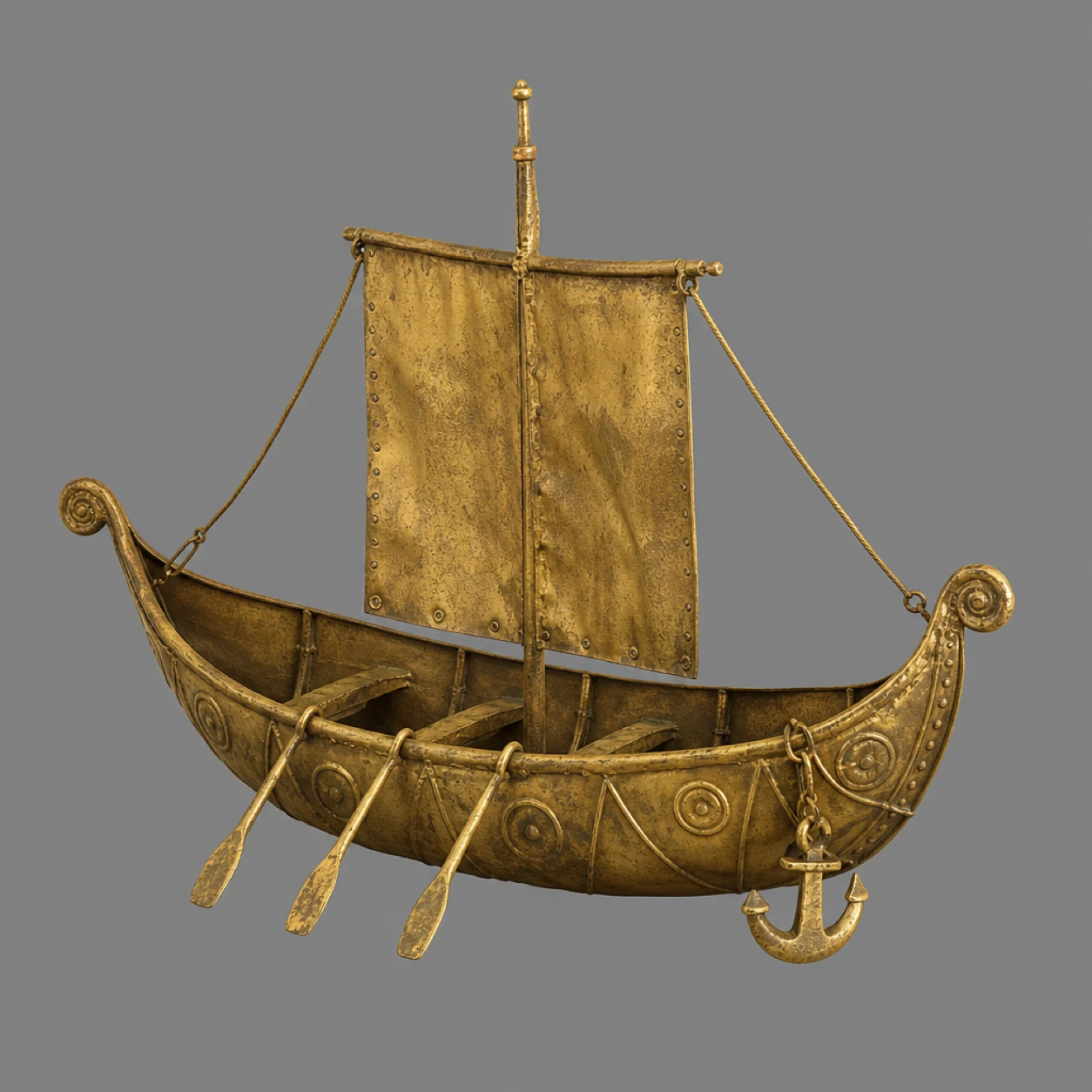
Place the Broighter boat on a marsh altar, shoreline rock, or inner shrine basin where a miniature ex-voto reads as an offering to the sea, not as a toy in a child's room. Pair it with a great torc from the same hoard story or a distant Gundestrup cauldron if you want parallel bog-and-water ritual deposits across the Celtic world. Our Celtic Ritual Relics pack includes a Broighter-style gold boat model for Iron Age Irish ritual shores and hill-fort treasure rooms.