Brass Leopard at the Met: Benin's King of the Bush
A Benin leopard sculpture is a court image of the big cat that Edo kings treated as their counterpart in the wild. In the Kingdom of Benin, in present-day southern Nigeria, the oba ruled the palace and the settled world; the leopard was praised as king of the bush. Guild artists cast freestanding cats in brass, carved others in ivory, and worked the same animal into plaques, aquamaniles, and hip ornaments. For a prop that reads as a palace animal rather than a plaque relief, the closest historical match is the solid brass leopard cast by the royal brass-casting guild: spotted hide in raised rings, compact body, and often a beaded or banded collar at the neck.
Spots, collar, and brass that is not bronze
A typical freestanding court leopard stands on four legs with a thick neck, rounded ears, and a long tail that can curve up over the back. Spots are usually circles or rings chased or cast across the body, legs, and tail. Many examples wear a layered collar or coral-like necklace, a visual link to the beads that mark royal bodies in Benin art. Museums label the metal as brass or copper alloy with iron details. The popular nickname "Benin Bronzes" covers a mixed corpus that catalogues still describe as mostly brass, plus ivory and other media.
Ivory leopards also survive, including famous pairs taken from the palace in 1897, but ivory and brass were not interchangeable props. Ivory pointed to the oba's monopoly over elephants and white, durable luxury. Brass held a different permanence: red metal associated with court power and with guild casting under royal control. The Wildform pack leopard follows the brass freestanding type, not an ivory carving and not a flat plaque cat.
Guild cats from the sixteenth century onward
Brass leopard figures sit inside the wider court art sequence that runs from roughly the fifteenth century into the nineteenth. The Metropolitan Museum of Art dates its freestanding brass leopard to 1550–1680 and credits the Ìgùn Ẹ́rọ̀nwwọ̀n (Igun Eronmwen) brass-casting guild of Benin City. Leopard aquamaniles in the same collection are given broader 16th–19th century brackets. Art Institute of Chicago wall text for a brass pair in Nigeria's National Commission for Museums and Monuments places that pair in the 16th/18th century. Those ranges are stylistic working dates, not stamped birth years. When two catalogues disagree by a century, the careful reading is that casters kept making royal cats across a long court history rather than in one short fashion wave.
Portuguese trade from the late fifteenth century brought more copper alloy into Benin. That influx helped guilds expand altar furniture, plaques, and animal casts. Leopard imagery appears in the round and in relief: plaques show spotted cats as royal emblems, while solid figures and vessels carried the same message into three dimensions.
King of the bush beside the king of the home
World History Encyclopedia summarizes the core idea: the leopard was "King of the Bush," and only the oba was permitted to kill one, typically in an annual royal rite. The king also claimed monopoly rights over leopard skins and other high-value goods. Art Institute commentary adds that when an oba dies, people may say "the leopard has returned to his lair." Before the twentieth century, rulers kept semi-domesticated leopards at the palace to show mastery over a dangerous realm that mirrored their own.
That symbolism is why leopard images sit near thrones, ancestral altars, and ceremonial dress. A hip ornament shaped as a leopard head could hang at the waist in festival costume. Brass aquamaniles in leopard form poured water for ritual handwashing after the oba dressed for rites that honor his paternal ancestors, including Ugie Erha Oba. Freestanding brass cats could flank a throne or stand on an ancestral altar; pairing two animals, as in the Nigerian museum pair discussed by the Art Institute, also evokes spiritual balance. The leopard is not a random wildlife trophy. It is a portable diagram of kingship: beauty, intelligence, predatory skill, and controlled force.
From palace floors to museum cases
For centuries these works stayed inside royal space. In February 1897 a British punitive expedition stormed Benin City, burned parts of the palace, and seized thousands of court objects. Brass heads, plaques, ivories, and animal figures entered European and American collections under the Benin Bronzes label. Museum and encyclopedia surveys frame that corpus as guild-made court art from roughly the fifteenth through nineteenth centuries, taken in the 1897 campaign and scattered afterward. Guild casting continued in Benin City after the conquest, and later obas rebuilt artistic patronage, but the diaspora of palace animals is why so many leopards now sit under museum glass instead of beside living court ritual.
Forms also split by job. Some leopards are hollow vessels with hinged lids or detachable heads so water can be poured through nostrils or teeth. Others are solid sculpture. Plaques flatten the cat into narrative palace walls. Ivory pairs can be assembled from several tusk sections with copper studs for spots. Knowing which type you are looking at matters more than treating every spotted cat as the same object.
The Met's brass leopard you can still see
One clear freestanding example is the Metropolitan Museum of Art's Leopard, object 1978.412.321, on view in Gallery 342. The Met attributes it to Ìgùn Ẹ́rọ̀nwwọ̀n brass-casting guild artists, dates it 1550–1680, and lists the medium as brass and iron. It measures 39.4 cm high, 12.7 cm wide, and 39.4 cm deep. The cast presents a compact standing cat of court scale, not a life-size animal and not a pouring vessel. Compared with smaller aquamaniles in the same museum (one leopard aquamanile is only about 17.2 cm high), this sculpture reads as an emblem meant to occupy floor or altar space rather than a hand-held water pot.
The Met record sits beside other Benin leopard types in the same wing: hip ornaments and aquamaniles that explain how the animal moved through costume and ritual. Use the freestanding leopard when you need the palace emblem in the round; use the aquamanile labels when you need the handwashing story; use plaque records when the cat is part of a wall narrative. For the commemorative brass heads that shared ancestral altars with other guild work, see What Is a Benin Head.
What brass, ivory, and labels still leave open
Scholars agree on the leopard's royal job more firmly than on every object's exact date or original spot in the palace. Some freestanding pairs may have guarded a throne; some may have stood on an ancestral altar; museum labels often keep both options open. Counts of surviving leopards are hard to state as one number because museum inventories keep growing, objects move between collections, and the 1897 dispersal mixed solid figures, vessels, plaques, and ivory carvings under one popular name.
Metal recipes vary, and "bronze" remains a convenient English label for works that are usually brass. Ivory leopards and brass leopards shared symbolism but not the same guild workflow or material meaning. Where catalogues print different century brackets for similar cats, treat those brackets as informed ranges. The secure core is simpler: in Edo court thought the leopard was the wild counterpart of the oba, and brass guild casts kept that idea visible in the palace until colonial seizure moved many of them abroad.
In your scene
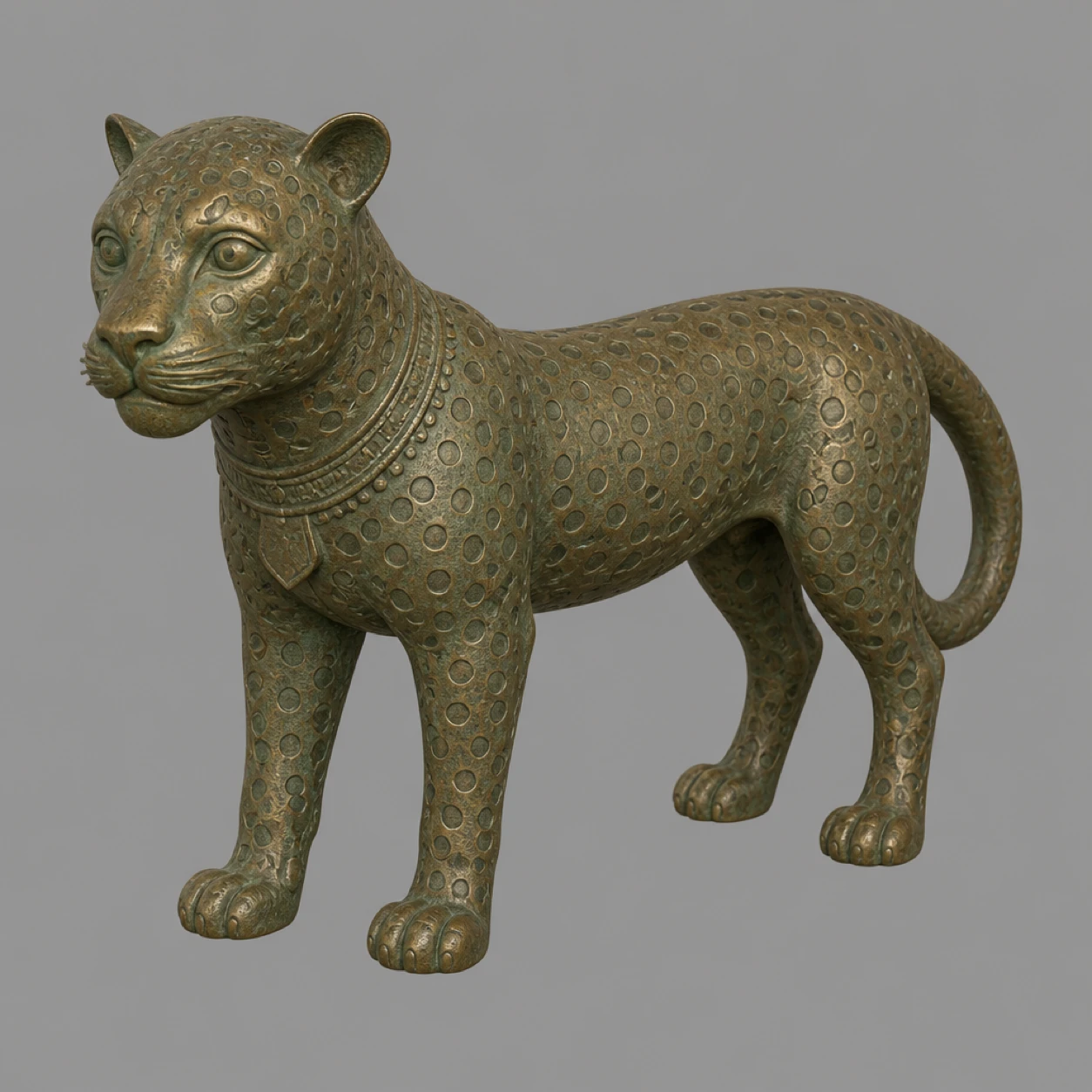
A Benin leopard reads as royal court furniture, not a safari prop. Place a brass standing cat near a throne dais or ancestral altar platform, keep the ringed spots and collar readable at game-camera distance, and let it share space with other palace brass rather than random wildlife trophies. For a full court set, see the African Kingdom Relics pack.