Owl Stele: Athena's Bird on Athenian Stone
An owl stele is an upright stone slab carved or painted with the little owl that Athenians linked to Athena, their patron goddess of wisdom and civic order. In classical Athens the bird was not a generic decoration. It stood for the goddess herself and for the city that minted silver coins bearing the same profile owl on the reverse. Stelai, the Greek word for such stone markers, served graves, sanctuaries, and public dedications. Combining owl and stele makes a plausible votive or civic monument at an Athena shrine, even though complete carved examples are rarer in museums than the famous coins.
Upright slab, carved face, and the owl emblem
A stele is a stone shaft set upright, usually with a carved or inscribed face. Greeks used the form for grave markers, boundary stones, and votive dedications. The owl that appears on Athenian coinage is the little owl (Athene noctua), Athena's habitual companion in literary and artistic tradition. World History Encyclopedia on Athena lists the owl among the goddess's standard attributes, alongside the olive tree and the spear, and connects both bird and tree to Athens's foundation myths.
On stone, the owl could mark devotion to Athena without showing the full goddess. Civic mints did the same in miniature: a helmeted Athena on one face, her bird on the other. A stele bearing only the owl would still read as Athenian to anyone who had handled the city's silver or walked the Acropolis slopes where Athena's cults dominated public life.
Grave naiskoi, votives, and sanctuary markers
Classical Attica produced thousands of sculpted stelai, especially in the Kerameikos cemetery. Many take the form of a naiskos, a small temple facade framing one or two figures in relief. The Grave Stele of Hegeso, dated to about 410–400 BCE and now in the National Archaeological Museum in Athens (NM 3624), shows the type at its most refined: a seated woman examines jewelry offered by an attendant, their names inscribed on the architrave.
Votive and sanctuary stelai could be simpler: a carved emblem, a short inscription, or a scene of the god. The Temple of Athena Nike on the Athenian Acropolis, completed about 420 BCE, was ringed by a marble parapet carved with reliefs of Athena and Nike in ritual and civic roles. Those slabs show how stone on the sacred hill could carry the goddess's emblem without a full cult statue. An owl stele sits in that same family: less narrative than Hegeso's monument, more emblematic, like a coin blown up to human height.
Little owl, wisdom, and polis identity
Athenians treated the owl as a good omen. When the city began minting its own silver in the sixth century BCE, the bird became a trademark on the reverse of the tetradrachm, paired with the ethnic abbreviation ΑΘΕ, "of the Athenians." Plutarch's Life of Themistocles preserves a story, widely repeated in modern guides, that an owl sighting encouraged Athenian sailors before the battle of Salamis in 480 BCE. The tale may be anecdotal, but it reflects how deeply the bird was tied to civic confidence.
The owl also traveled. Athenian "owls," as traders called the thick tetradrachms, turn up in hoards far from Attica because Laurion silver and a trusted design made them international currency. That reach means an owl carved on stone in Athens or a colony would signal the same polis identity as the coins in a merchant's pouch, linking sanctuary, tomb, and marketplace under one emblem.
From coin dies to stone relief
Coins preserve the owl in the crispest detail. Stone carving could match that silhouette on a stele face, above an inscription, or beside a dedicatory verse. Painted pottery already paired Athena, her owl, and olive sprays on Panathenaic prize vessels and everyday ware. A stone version extended the same iconography into permanent architecture: the entrance to a shrine, the border of sacred land, or the grave of a priestess of Athena's cults.
Not every Athena monument needed an owl. Many stelai name the goddess in full or show her in armor. The owl stele type is therefore a shorthand, best suited to contexts where viewers already knew the cult and city. That shorthand is exactly what makes it useful for game and museum displays: one glance, and the stone reads as Athenian sacred art.
The British Museum's Athenian owl tetradrachm (1948,0506.14)
Because few intact owl stelai survive in major collections, the best-documented owl of classical Athens is a coin. British Museum object 1948,0506.14 is a silver tetradrachm minted in Athens between about 450 and 406 BCE, weighing 17.21 grams. The obverse shows Athena's head in profile wearing an earring and a crested helmet decorated with olive leaves. The reverse carries the owl standing right within an incised square, with an olive spray and crescent to the left and the inscription ΑΘΕ to the right.
The die axis is set at nine o'clock; the piece comes from a hoard found at Tell el-Maskhuta in Egypt, a reminder of how far Athenian owls circulated. For historians reconstructing a stone stele, this coin is the reference image: compact body, large eyes, and the ethnic label that ties bird to polis. Carving that design in relief on marble or limestone would produce exactly the kind of emblematic marker Wildform's prop suggests.
Fragmentary evidence and what scholars debate
Complete owl stelai are not as common in excavation reports as grave naiskoi or coin dies. Specialists therefore work from combinations of evidence: coins, vase painting, Athena reliefs on parapets and shields, and inscriptions that name the goddess or her priesthoods. World History Encyclopedia's account of the Temple of Athena Nike notes that the shrine was blessed by women of Athena's cult under a high priestess, one of the few public offices open to Athenian women, which shows how stone and ritual together honored service to the goddess even when the surviving carving does not picture an owl.
Modern reconstructions, including stylized props and museum labels that call a slab an "owl stele," depend on that chain of inference. The emblem is secure; the exact format of stone monuments bearing only the owl is less firmly catalogued than Hegeso's naiskos or the Acropolis Athena reliefs. Saying so plainly matches how archaeologists treat shorthand civic symbols: real, meaningful, and sometimes better known from metal than from marble.
In your scene
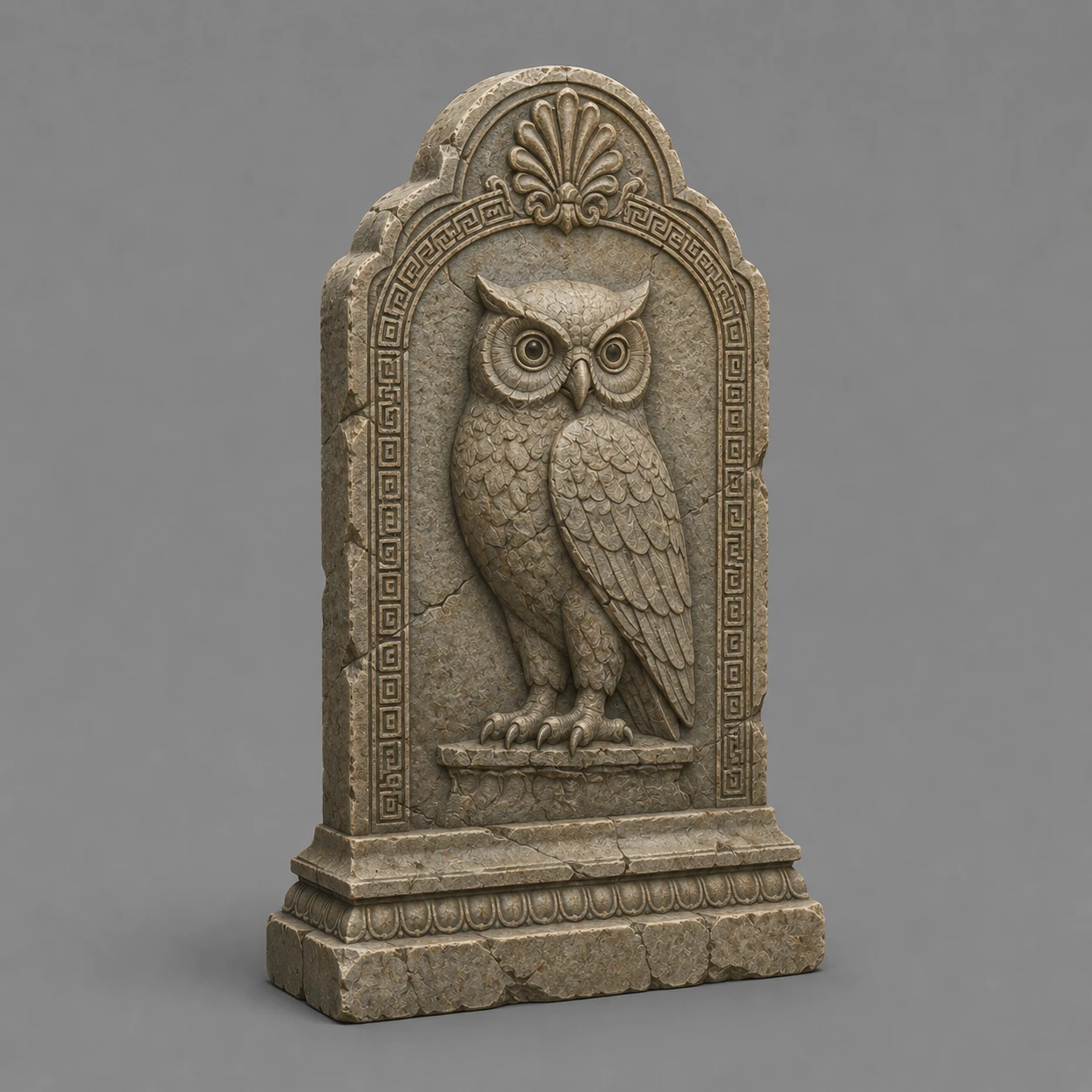
Stand an owl stele beside a temple threshold, in the Kerameikos-style row of grave markers, or against the wall of a treasury where Athena receives dedications. Pair it with olive branches, helmeted statues, or the Nike cult imagery that shared the Acropolis. Our Greek Temple Relics pack includes an owl stele model suited to Athenian sanctuaries, civic plazas, and burial avenues where stone and emblem marked piety and polis pride.