The Winged Victory of Samothrace: Nike on a Ship's Prow
A Nike statue shows Nike, the Greek goddess of victory, usually winged and in motion. In temples and sanctuaries she marked a military or athletic win, often hovering above an altar, a column, or the prow of a ship. The most famous surviving example is the headless Winged Victory of Samothrace in the Louvre, a Hellenistic marble from about 200 to 175 BCE that still reads as triumph even without her head or arms.
Nike, wings, and what the figure represents
Nike (Greek for "victory") appears in Greek religion as a minor goddess who brings success in war and in peaceful contests. Artists gave her large wings so she could descend quickly to crown a winner or announce a battle won. She might carry a wreath, a palm branch, or the staff of Hermes as messenger of victory.
A Nike statue is not a portrait of a mortal. It is an offering or monument that says victory happened here, and that the gods approved. Scale varies from small bronzes in household shrines to colossal figures set on temple roofs or in open sanctuaries. The winged, forward-leaning body became the standard visual shorthand for triumph across the Greek and later Roman world.
Hellenistic marble from c. 200–175 BCE
The great marble Nikai most people picture belong to the Hellenistic period, after the conquests of Alexander the Great spread Greek art and patronage across the eastern Mediterranean. Dates for individual works are often approximate. For the Samothrace masterpiece, Britannica places the sculpture at about 200 to 175 BCE, a span that fits its dramatic style and the naval symbolism of its base.
Sculptors of this era pushed beyond the calm, ideal proportions of Classical Athens. They twisted torsos, opened wings wide, and carved drapery that clung and flew at once. Marble from Paros, prized for its fine grain, was a common choice for these large figures because it could hold thin stone folds without crumbling.
Victory offerings at sanctuaries and naval battles
Nike statues served both religion and public memory. In a sanctuary they could be dedicated after a battle or a successful voyage, set where pilgrims would see them on approach. Naval victories were especially suited to the type: a goddess alighting on a ship's prow turned an abstract win into a single, readable image.
On Samothrace, the Sanctuary of the Great Gods drew visitors from across the Greek world to a mystery cult whose rites remain poorly documented. Scholars think the Winged Victory was both a religious gift to the gods of the island and a commemoration of a sea battle. The gray marble of the ship base comes from Rhodes, which has led some historians to connect the monument to Rhodian fleets, though the exact battle and whether Rhodes won or lost are still debated.
Wet drapery and the shift from Classical balance
The defining surface treatment on many Hellenistic Nikai is wet drapery: thin fabric pressed against the body by wind or water, with heavier folds breaking free at the edges. On the Samothrace figure the chiton clings to the torso and legs while the mantle billows behind, as if a sea breeze caught the cloth the moment Nike landed.
This technique heightens the sense of movement that earlier Classical statues often held in check. Where a fifth-century Athena might stand in quiet contrapposto, a Hellenistic Nike leans into the wind, wings spread, weight driving forward onto the prow. The effect is theatrical but grounded in observation of how real cloth behaves in strong air.
The Winged Victory of Samothrace in the Louvre
The anchor piece for any discussion of Nike sculpture is the Winged Victory of Samothrace in the Louvre, Paris. The figure stands about 3.28 meters (10.76 feet) tall without its base and is carved from white Parian marble. She mounts a base of gray Lartos marble shaped as the bow of a warship, so the whole group reads as Nike just touching down on a trireme after a fight at sea.
The statue entered the museum in the late nineteenth century and now crowns the Daru staircase, one of the most photographed views in any museum. Traces of pigment found on the stone suggest the marble was once painted, as was normal for ancient sculpture, even though modern audiences know it in bare white. The missing head and arms have not reduced the work's impact; the twist of the body and the rush of drapery carry the narrative without them.
Discovery on Samothrace and what is still missing
French diplomat and amateur archaeologist Charles Champoiseau found the statue in fragments in 1863 on the island of Samothrace in the northern Aegean, inside the Sanctuary of the Great Gods. The pieces went to Paris and were reassembled into the silhouette known today. Further digs in 1879 recovered the plinth and prow; parts of the right hand turned up in the 1870s and 1950 and are displayed near the main figure in the Louvre.
The wings were only partly preserved and were restored with plaster fills. The artist's name is unknown. That gap is typical for large Hellenistic bronzes and marbles: workshops, not signed masters, often produced civic monuments. What survives is enough to show patronage, technique, and intent, but not the individual hand that carved the folds.
In your scene
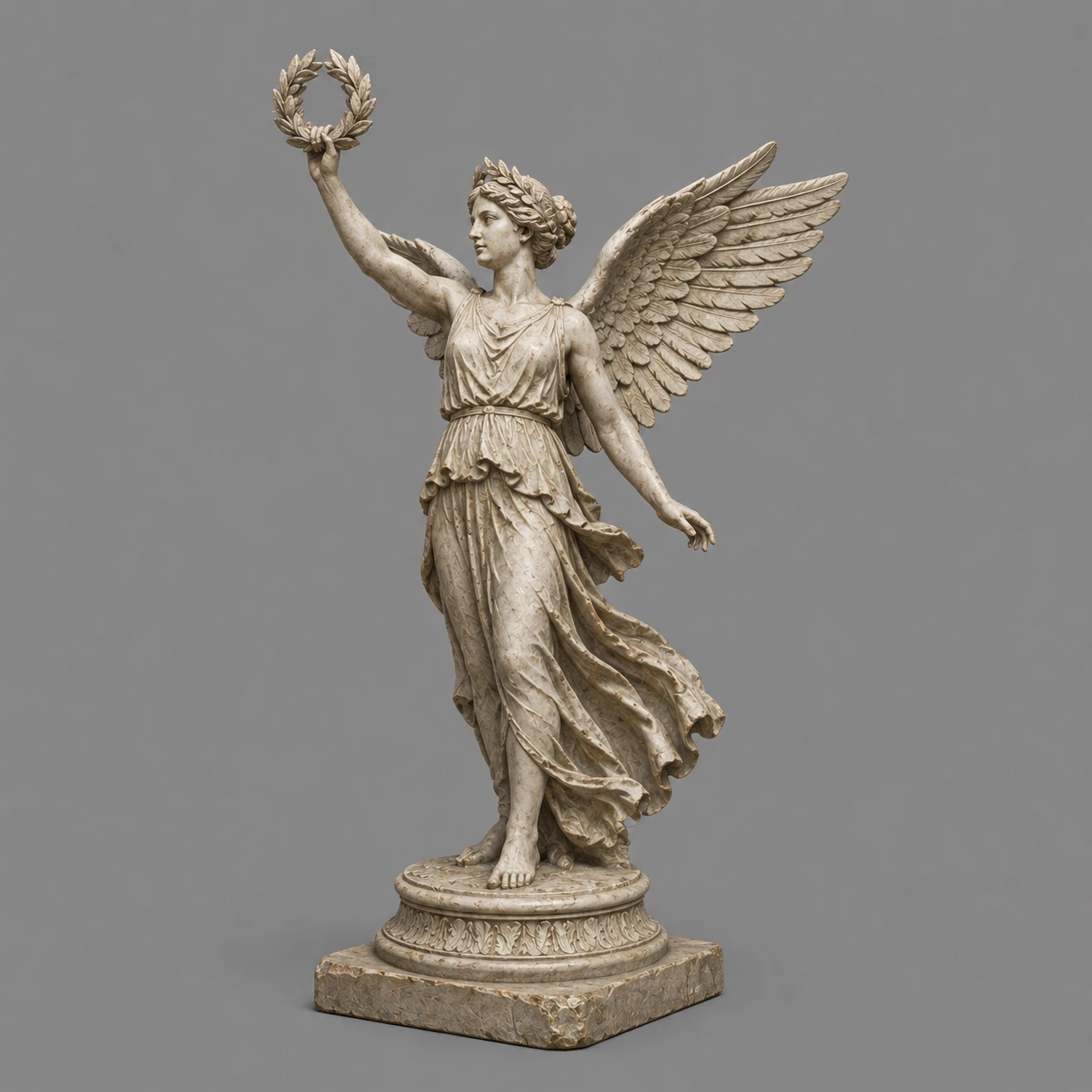
A winged Nike on a high plinth or stair landing gives a Greek temple interior instant focal weight, especially if light catches the drapery from below or the side. Place her where a player looks up, as pilgrims would have at a sanctuary entrance. Our Greek Temple Relics pack includes a stylised Nike statue for sanctuary corners and treasury alcoves.