Tlaloc Mask: Goggled Eyes for Rain and Storm
A Tlaloc mask is a carved or mosaic face that shows the Aztec rain and storm god with his most recognizable traits: wide, goggle-like eyes, a curling upper lip, and long fangs. The name Tlaloc (Nahuatl Tlāloc) derives from the Nahuatl words tlali ("earth") and oc ("something on the surface"), though scholars still debate the exact reading, and the same goggled face appears on stone masks, wooden faces inlaid with turquoise, and large ceramic jars shaped like the deity's head. In Tenochtitlan the god shared the summit of the Templo Mayor with Huitzilopochtli, so a Tlaloc mask in a temple scene marks the northern, rain side of Mexica ritual life rather than generic jungle decoration.
Goggled eyes, fangs, and the rain-god face
Mesoamerican artists did not need a caption once viewers learned the pattern. Britannica notes that images of a rain god in a peculiar mask, with large round eyes and long fangs, appear at least as early as Teotihuacán in the highlands (3rd to 8th century CE). The same goggled look links Tlaloc to earlier highland rain deities and to the Maya rain god Chac of the same broad period.
On masks and sculptures the eyes read as circular goggles or rings, the mouth often curls into a volute or opens to show predator teeth. World History Encyclopedia describes Tlaloc with goggled eyes and large fangs like a jaguar, and notes that he is commonly depicted with snakes. Blue paint, heron feathers, and marine offerings such as shells and coral reinforced his tie to water when Mexica priests dressed his temple. Not every goggled face in a museum case is Tlaloc himself: scholars also identify similar features on his consort Chalchiuhtlicue and on the Tlaloque, the mountain rain spirits who shared his cult.
From Teotihuacán reliefs to Mexica Tenochtitlan
The mask type long outlived any single empire. Stone Tlaloc images alternate with Quetzalcoatl on tiers of the Pyramid of the Feathered Serpent at Teotihuacán, a pairing that World History Encyclopedia dates to the 2nd and 3rd century CE. Centuries later, after the Mexica raised Tenochtitlan and rebuilt the Templo Mayor through successive phases, the rain god still wore the same face on offerings and architecture.
Britannica places Tlaloc among the main deities of central Mexico's agricultural peoples until northern, war-focused tribes elevated solar cults. Aztec syncretism then set Huitzilopochtli and Tlaloc at the head of the pantheon without erasing the older rain imagery. The visual formula was conservative even as politics shifted: goggled eyes on a mask still meant water, lightning, and the fertility of maize.
North shrine, blue steps, and the festival calendar
At the Templo Mayor the god received a shrine equal in size to Huitzilopochtli's. World History Encyclopedia states that Tlaloc's temple stood on the pyramid's north side, marked the summer solstice and wet season, and was reached by steps painted blue and white to evoke water. Britannica adds that Huitzilopochtli's sanctuary was painted white and red while Tlaloc's was white and blue, and that a high priest of Tlaloc held rank equal to the sun god's chief priest.
Five months of the eighteen-month ritual year belonged to Tlaloc and the Tlaloque, who were thought to dwell on mountaintops. Britannica records child sacrifices in the first month, Atlcahualo, and the third, Tozoztontli, and rain ceremonies in Etzalqualiztli when priests bathed in the lake and used rattles to call storms. Masks and effigy vessels mattered in these rites because performers and vessels could stand in for the god's body. World History Encyclopedia also notes offerings linked to the sea inside the pyramid, matching Tlaloc's control over every form of water, from mist to flood.
Stone masks, cedar mosaics, and ceramic Tlaloc faces
Not all Tlaloc "masks" were worn on the face. Mexica artists cast the deity's features in stone for deposits, carved them on urns that symbolized rain storage, and built portable faces from cedar wood set with thousands of turquoise tesserae. Britannica explains that Aztec lapidaries favored turquoise above other stones and fixed mosaic onto wood, pottery, shell, and gold with vegetal pitch or cement, a technique used widely for ritual gear before the Spanish conquest.
Ceramic effigy urns with Tlaloc's mask face and blue slip are among the most common large images excavated at the Templo Mayor. Stone masks could be heirloom pieces: some Teotihuacan-style faces were recut and reinlaid generations later when the Mexica placed them in temple offerings. Whether in stone, wood, or clay, the goggled eyes carried the same message about rain jars, mountain spirits, and agricultural survival.
The British Museum turquoise serpent mask
The most famous surviving mosaic face tied to Tlaloc may be the serpent mask in the British Museum, accession Am1987,Q.3. The museum dates it to about 1400 to 1521 CE and lists cedar wood, turquoise, conch shell, gold, beeswax, and pine resin among its materials. Two mosaic serpents in contrasting blue and green turquoise twist across the surface; their bodies form the prominent goggled eyes and twisted nose associated with Tlaloc, while feather-like turquoise plumes hang beside the eye rings.
Scholars still debate whether the mask represents Tlaloc, Quetzalcoatl, or a deliberate fusion of rain and feathered-serpent symbolism. That uncertainty is typical: elite Mexica masks were rare, precious, and seldom labeled in our sense. The piece is not a humble stone cult mask from a provincial shrine but a court-level object built from imported shell and cut stone, the sort of thing that could travel as tribute or diplomatic gift. For readers shaping a temple interior, its silhouette is the high end of the tradition: serpent coils, goggle eyes, and a mouth lined with conch-shell teeth.
What survives in museums and what scholars debate
Excavations at the Templo Mayor since 1978 have recovered thousands of objects, including mask-faced urns and modified stone faces, now displayed at the site's museum in Mexico City. World History Encyclopedia mentions a famous 15th century CE vase with goggled eyes and jaguar fangs in the National Museum of Anthropology, while Britannica stresses that the rain cult spread widely across Mexico before 1521.
Identification is not always straightforward. Goggled eyes can mark Tlaloc, a Tlaloc priest, or a related water deity; blue paint survives only in fragments on many ceramics; wooden mosaic masks are rarer than stone and clay because organic materials decay. Dates for specific mask types also range by region: Teotihuacán examples sit centuries earlier than Mexica temple deposits. When sources disagree on a mask's god, the honest response is to describe the shared iconography and note the debate, as museums do with the British Museum serpent face.
In your scene
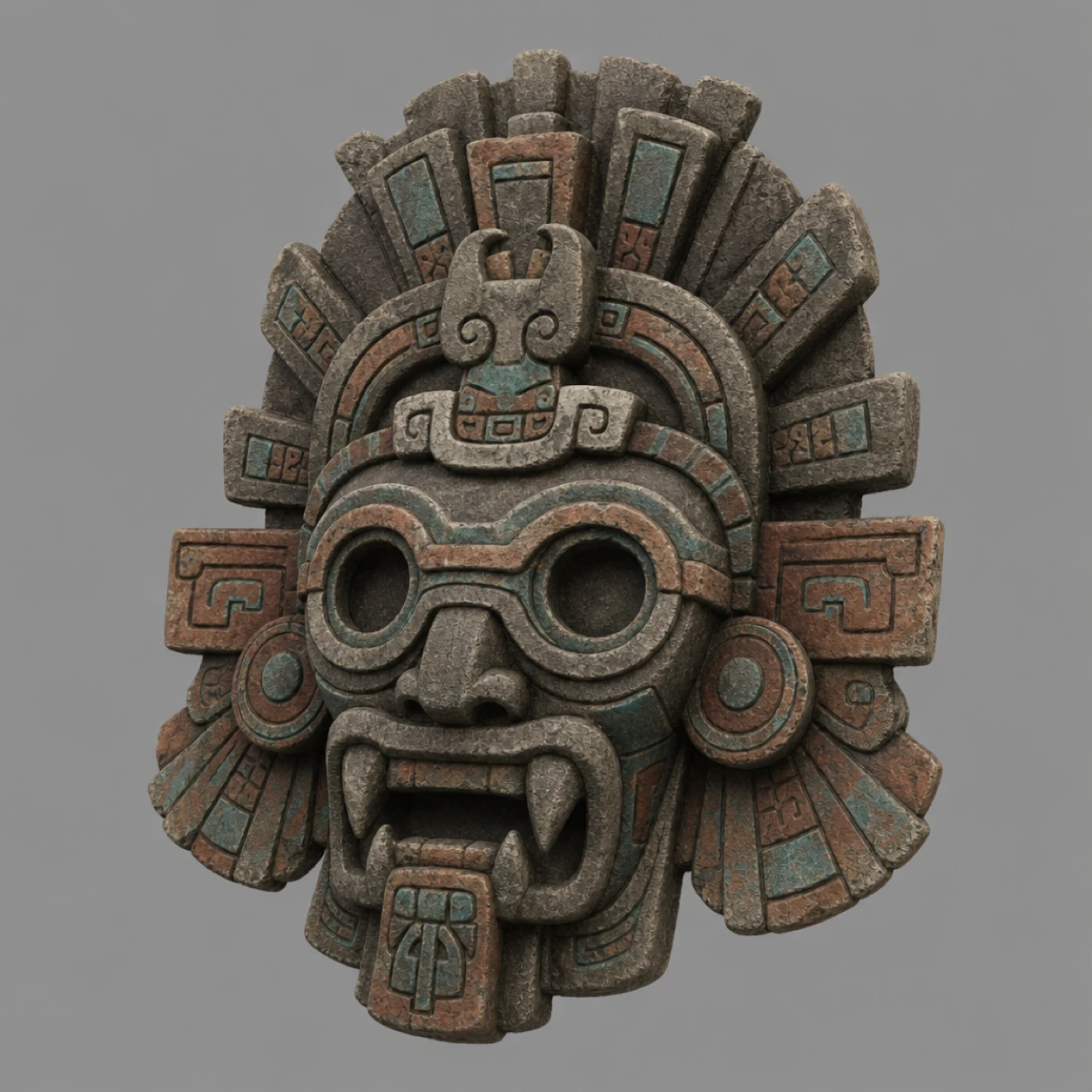
Place a Tlaloc mask on the north side of a pyramid platform or above a basin where priests would leave offerings, echoing the rain shrine on the Templo Mayor. Pair it with storm light, blue-painted steps, or a ceramic effigy jar if your scene needs ritual context rather than a lone trophy on a shelf. Our Aztec Temple Relics pack includes a stylised Tlaloc mask sized for temple antechambers and courtyard niches.