Stone Stelae: Egypt's Carved Records of Memory
A stone stela is an upright slab carved with text and images in ancient Egypt. Most survivors are limestone or sandstone, though harder stones such as granite appear on royal monuments. Stelae stood in tombs, temple courtyards, quarry roads, and cliff faces at city edges. They could commemorate a person, record a king's victory, mark a field boundary, or hold a priest's prayer to a god. For modern scholars they are primary evidence: epigraphy, the study of their inscriptions, reconstructs names, titles, dates, and ritual language when papyrus has vanished.
Wedj, ahau, and the standing slab
Egyptians had several words for the form. Wedj originally meant "command" and appears in compounds such as wedj-her-tash (boundary stela) and wedj-en-nekhtu (victory stela). Ahau, from aha ("to stand"), also described the upright monument. Britannica defines the stela broadly as a standing stone slab used for graves, dedication, commemoration, and demarcation, a shape found across the ancient Mediterranean and Near East.
Egyptian examples are usually rectangular with a rounded top, though false-door stelae from tomb chapels can be squared. Size ranges from handheld votive plaques a few centimetres high to cliff inscriptions many metres tall. Stone was preferred for permanence; painted wood stelae existed but survive rarely compared with limestone in dry tombs.
From First Dynasty markers at Abydos
Royal and private stelae appear by the First Dynasty in the necropolis at Abydos. Early forms include round-topped pillars inscribed with the king's name and slabs listing officials' titles. That combination of image, royal name, and ranked text set a pattern for three millennia.
Over time the upper curve of round-topped stelae gained a named design zone. The lunette, the semicircle above the main scene, often holds protective symbols such as the wedjat eye, winged sun disk, or shen ring. Under Pepi I in the Old Kingdom artists began to separate the lunette from the register below. By Senwosret III in the Middle Kingdom many lunettes split into symmetrical halves framing a central sign. Those layout rules help epigraphers date fragments when the inscription is worn.
Tombs, temples, cliffs, and quarry faces
Function followed placement. Funerary stelae inside or before tombs named the dead, showed them at an offering table, and asked visitors to speak an offering formula so bread and beer reached the tomb owner in the afterlife. False-door stelae, beginning in the Old Kingdom, acted as a symbolic doorway through which the deceased could receive goods left in the chapel.
Temple stelae could be votive gifts from pilgrims who recorded a god's help, or royal monuments celebrating a campaign. Victory stelae stood along military routes with the king smiting enemies. Quarry and mining expeditions left stelae describing miracles or listing witnesses, as at Wadi Hammamat. Boundary stelae defined estates, cities, and imperial edges. Akhenaten carved his new capital's limits into the cliffs at Amarna; Middle Kingdom forts in Nubia set policy texts into mudbrick walls at Semna.
Not every Egyptian could read the long hieroglyphic lines, but the carved figure facing Osiris or Ra was public theology in stone. A stela made permanence visible.
Offering formulas, ears, and the false door
Private stelae often show the owner seated before a table heaped with bread, meat, vegetables, and jars. A relative or servant stands opposite, arms raised in praise. Below, columns repeat an offering formula invoking Osiris or another god. The text asks any passerby to grant "a thousand of bread, beer, oxen, and fowl." Speaking the formula was thought to transfer merit even when no physical food was present.
From the Ramesside period some votive stelae add carved ears so the god would "hear" the petition. False-door stelae combine a painted door niche with the owner's name and titles, merging architecture and inscription. Workshops producing private stelae are well attested from the Middle Kingdom onward, which explains how similar layouts spread across cemeteries at Thebes, Saqqara, and Abydos.
Mentuwoser's stela for Senwosret I
The Metropolitan Museum holds one of the finest Middle Kingdom examples (object 12.184), carved for the steward Mentuwoser in year 17 of Senwosret I, about 1944 BCE. The limestone slab stands about 103 cm high and 50 cm wide, thick enough to stand firmly when set in a chapel floor. It was probably erected at Abydos, the cult centre linked to Osiris's burial, though the exact find circumstances are not fully documented.
The scene is crowded with detail. Senwosret I appears in the lunette as a living king presenting symbols to the god Wepwawet. Mentuwoser sits before a table piled with offerings while relatives and attendants bring more goods. Hieroglyphs name titles and repeat the offering prayer. Curator Diana Patch notes that Abydos drew pilgrims who wanted to be "present" at Osiris's tomb even when their own burial lay elsewhere. A stela like Mentuwoser's was both memorial and proxy attendance at the most sacred site in Egypt.
Smaller stelae could be equally informative. The Met's round-topped stela of Merneptah (04.2.533), about 29 cm high, shows a seated man with a water lily, a laden table, and wedjat eyes above, with an Osiris offering formula below. Scale did not diminish the religious job of the stone.
Limestone, paint, and what survives above ground
Most museum stelae are limestone or sandstone with traces of red, yellow, blue, and black paint that once covered every carved line. Desert cemeteries preserved colour better than temple courtyards exposed to rain and reuse. Many stelae were cut from living rock at quarry sites; others were freestanding slabs set in mudbrick chapels. Granite royal stelae endure when limestone crumbles, but even hard stone suffered when temples became quarries for later builders.
Epigraphers today copy inscriptions with photography, RTI, and digital drawing because rubbing damages soft stone. Lost stelae survive only in nineteenth-century copies made by travellers before sites were looted. When a stela lacks provenance, style and palaeography date it; when it comes from a labelled tomb, it anchors genealogy. The Rosetta Stone is itself a Ptolemaic stela, famous because Greek, demotic, and hieroglyphic versions of the same decree allowed Champollion to crack the script. Every chipped village stela contributed a line to that larger puzzle.
In your scene
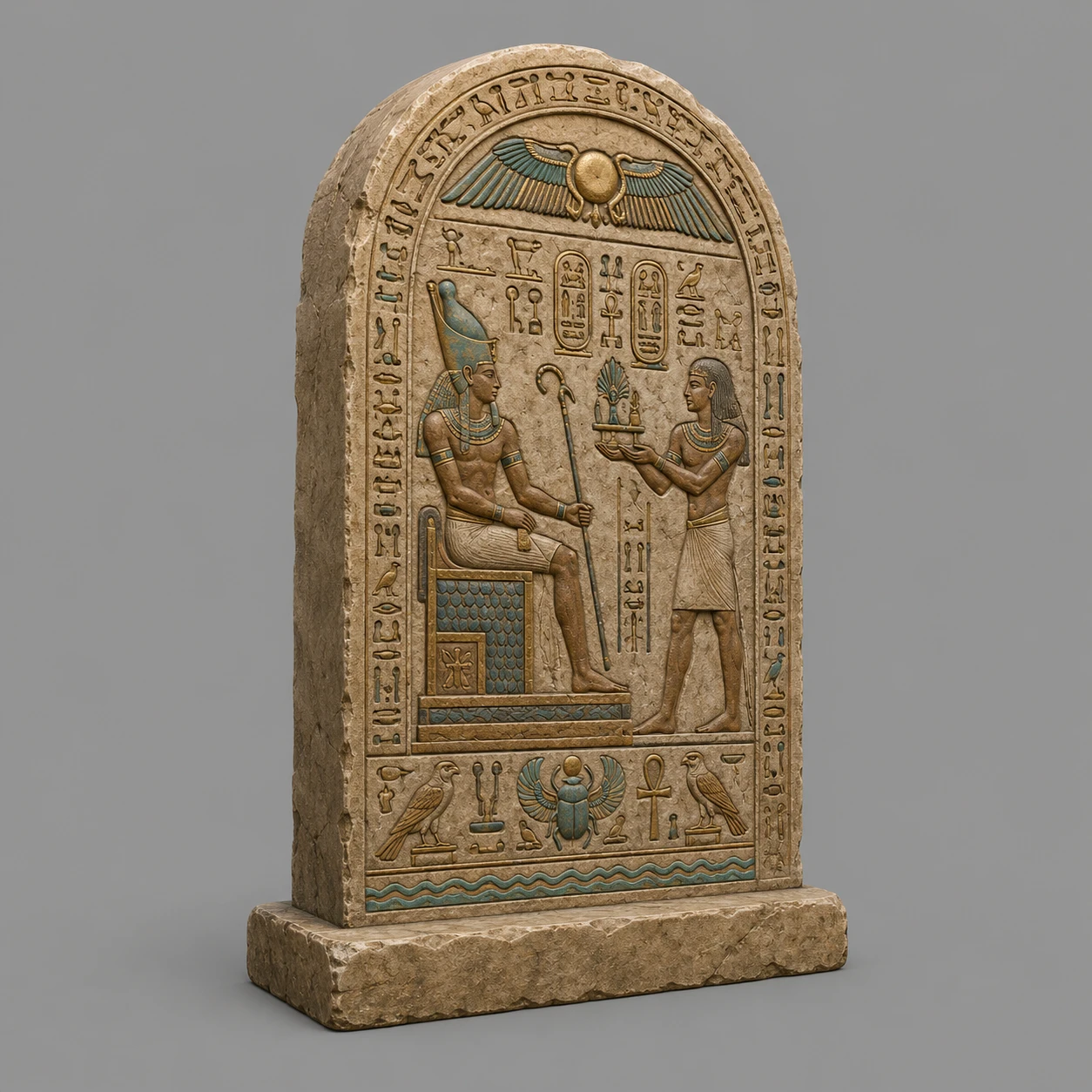
A single round-topped stela against a chapel wall gives instant readable context: offering scene, hieroglyphs, and a seated tomb owner. Angle a torch so relief shadow picks up carved lines. Our Egyptian Tomb Relics pack includes a stone stele for tomb passages and temple niches.