Serpent Head Sculpture: Snakes at the Aztec Temple Stair
A Mexica serpent head sculpture is a carved stone image of a snake's head, usually shown with an open fanged mouth, forked tongue, and scales worked in relief. At the Aztec capital Tenochtitlan these heads were not isolated curios. They marked sacred architecture: paired along temple stairways, set beside braziers, and repeated in the serpent imagery that wrapped the earth goddess Coatlicue and the mythic mountain where Huitzilopochtli was born.
Open mouth, forked tongue, carved scales
Mexica artists rendered serpent heads in basalt and other hard stones, often at a scale that dwarfed a human body. The Metropolitan Museum's catalogue for a Mexica coiled serpent notes that at the Main Temple in Tenochtitlan, monumental snake heads with open fanged mouths and forked tongues flanked braziers and stairways leading to the shrines. Many examples show the jaw dropped wide, the tongue split, and the eye set under a heavy brow ridge, a visual language that reads as warning even when the species is not named in the label.
The same carving tradition could shrink the motif onto jewellery or coil the body into a knot with only the head emerging. A temple prop usually evokes the large architectural type: a single head meant to sit at the foot of steps or against a platform, not a full snake body. Feathered variants belong to the Quetzalcoatl tradition and to earlier Teotihuacan art, but the stair-head type at the Templo Mayor is a simpler rattlesnake-like profile adapted to stone mass and public display.
Nahuatl gives several snake words that appear in place names and titles, including coatl (snake) and compounds such as coatepantli (serpent wall) and Coatepec (serpent mountain). Those names matter because Mexica builders named real architecture after mythic snakes rather than treating the heads as mere decoration.
From Coatepec myth to Tenochtitlan rebuilds
Serpent imagery at Tenochtitlan rests on a foundation story. World History Encyclopedia recounts how the priestess Coatlicue, sweeping on the sacred mountain Coatepec, became pregnant with Huitzilopochtli. Her other children attacked her; the war god sprang forth armed and defeated them, dismembering his sister Coyolxauhqui. The Templo Mayor was understood as a stone version of that mountain, and the great round relief of Coyolxauhqui at the pyramid base still records the myth in sculpture.
The temple itself grew through successive rebuilds from the fourteenth century until the Spanish conquest. World History Encyclopedia dates major expansion under rulers such as Motecuhzoma I and Ahuitzotl, when new facings, offerings, and sculpture were buried inside earlier shells. Each enlargement could add fresh serpent heads at the stairs while entombing older ones, which is why excavations at the Templo Mayor site keep producing snake sculpture in many sizes and states of preservation.
At the stair foot and the coatepantli wall
The Templo Mayor rose as a twin shrine: Tlaloc on the north, Huitzilopochtli on the south, on a shared pyramid platform. World History Encyclopedia describes the sacred precinct wall carved with snake reliefs, called the coatepantli or Serpent Wall, and the monumental steps painted blue and white on Tlaloc's side and red on Huitzilopochtli's. Both stair flights carried sculptures of snake heads. Those on Tlaloc's side wore blinkers; those on Huitzilopochtli's were adorned with feathers, a deliberate pairing that let the same animal motif speak for rain and warfare in one complex.
Britannica treats snakes in Aztec thought as fertility symbols tied to the earth goddess Coatlicue, whose skirt is formed of interwoven serpents. That religious layer sits behind the architectural heads. They marked the threshold where a climber left the city floor and entered the god's house, much as the coiled serpents flanking braziers framed fire and sacrifice on the platform above.
From painted cult image to buried rubble
Mexica temples were not bare grey stone in their prime. Lime plaster and bright paint covered pyramid facings and sculpture. World History Encyclopedia stresses that the Templo Mayor was designed as a literal mountain in homage to Coatepec, with snake sculpture lining the base and colour coding the two shrines. Red stood for blood and war on Huitzilopochtli's stair; blue and white evoked water on Tlaloc's.
After the conquest of 1521, the pyramid was dismantled and the precinct built over. Many cult images were buried deliberately rather than left for Spanish display. The colossal Coatlicue statue, unearthed in 1790, was reburied more than once because viewers found it unbearable, a reminder that serpent-linked sculpture could frighten as easily as it impressed. Smaller serpent heads from the same world often survived only as rubble in fill layers until modern excavation.
A Mexica serpent you can still see at the Met
One carved snake lets you walk the numbers in a museum catalogue even when the stair monsters remain in Mexico. The Metropolitan Museum holds object 00.5.32, titled Coiled serpent, catalogued as Mexica (Aztec) work from 1325 to 1521 CE. Carved from porous stone, the body forms a tight knot roughly 11 1/4 inches high, 10 3/4 inches wide, and 11 1/2 inches deep (about 28.6 by 27.3 by 29.2 cm). A flattened head emerges from the coil with a pointed closed mouth and sunken oval eyes; two rattles appear in shallow relief on the tail end.
The museum text links the piece to the same cult landscape as the giant stair heads: proliferation of serpent depictions at the Main Temple, open jaws at braziers and stairways, and the coatepantli wall of adjoining snake sculptures said to surround the pyramid at the time of the conquest. Curators note that the function of this smaller knot sculpture is uncertain, which is honest for a class of objects that ranged from architectural member to offering. Held beside a monumental fanged head prop, the Met serpent shows how Mexica carvers could move between colossal public fangs and tabletop stone knots using the same reptile vocabulary.
Monumental heads, fragile paint, and unknown names
Archaeology confirms the type without always naming the species or deity. Templo Mayor excavations have recovered multiple serpent heads, some still carrying traces of pigment where fill preserved colour. Scholars do not automatically equate every fanged head with Quetzalcoatl, the feathered serpent god, or with Coatlicue's skirt snakes; context on the stair, beside a brazier, or in a fill deposit matters more than a single template.
Scale varies widely. Architectural heads had to read from below against a painted pyramid; smaller stone versions could serve as offerings or furniture ornaments. World History Encyclopedia places the great Coatlicue monolith, 3.5 metres high with two snake heads replacing the goddess's own face and a skirt of writhing serpents, among the most terrifying achievements of late Aztec sculpture. That statue is not a stair balustrade piece, but it shares the same carved snake-head idiom, proof of how deeply the motif ran through Mexica sacred art.
Whether a given prop head should wear blinkers, feathers, or plain scales depends on which deity's precinct you are evoking. The historical record is strongest for the Tlaloc and Huitzilopochtli pairing on the Templo Mayor, not for a single universal template.
In your scene
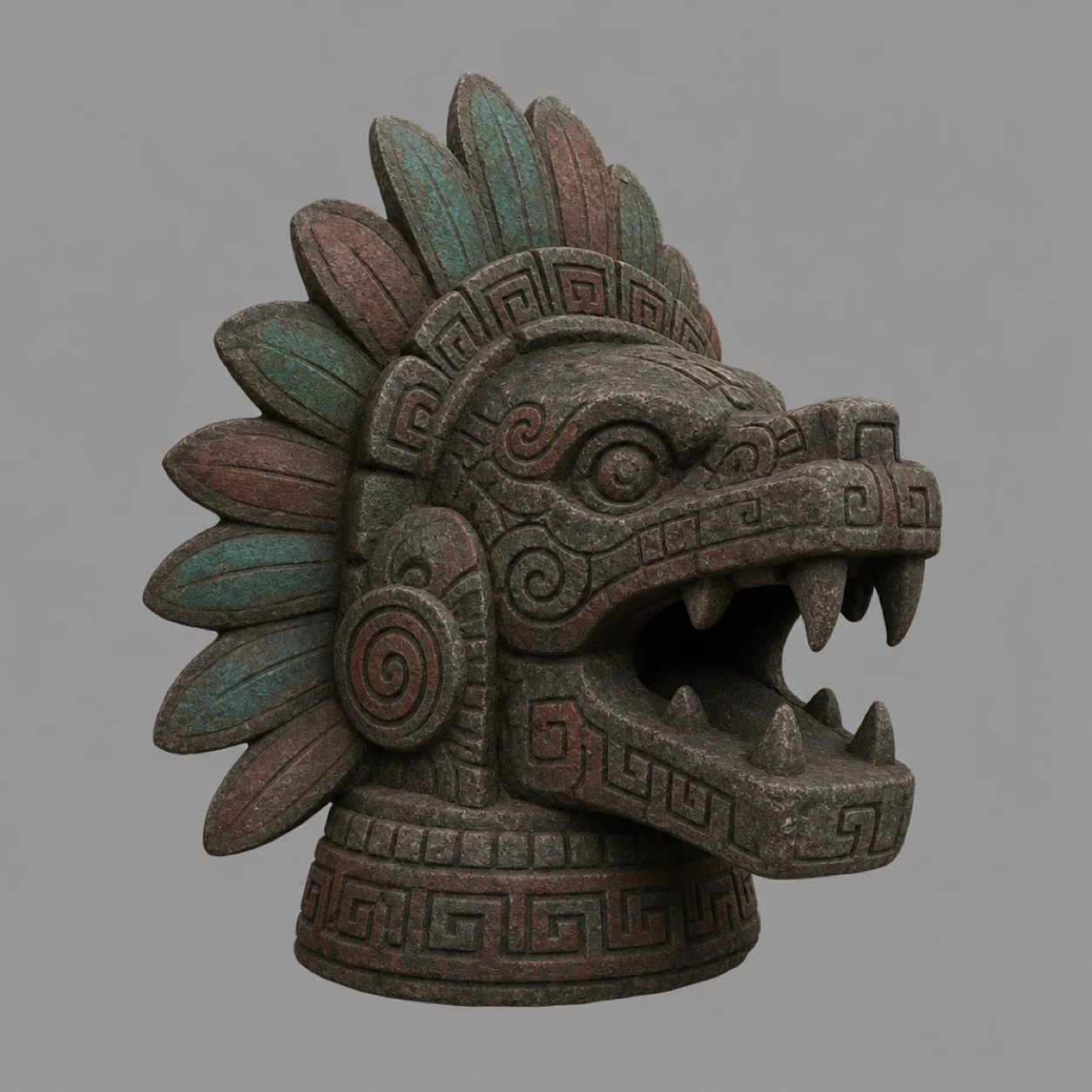
Place a serpent head sculpture at the foot of pyramid stairs, beside a brazier, or flanking a temple doorway, with the open jaw facing outward toward the courtyard. Scale it above human height if you want the Templo Mayor effect, and pair two heads with contrasting details if your scene splits Tlaloc and Huitzilopochtli precincts. Our Aztec Temple Relics pack includes a serpent head model sized for ritual architecture and jungle ruin sets.