Nkisi Nkondi: Kongo's Hunter Power Figure
A Central African power figure is a charged container, not a portrait statue. Among Kongo-speaking peoples of the lower Congo region (today spanning parts of the Democratic Republic of the Congo, the Republic of the Congo, and northern Angola), the broad class is called nkisi (plural minkisi). An nkisi can be a packet, a filled vessel, a shell, or a carved wooden body. What matters is the sacred matter inside and the spirit linked to it. The subtype most familiar in museum galleries is the nkisi nkondi: a figure packed with medicines and bristling with nails, blades, or pegs driven in during oaths, lawsuits, healing work, and the pursuit of wrongdoers. Nkondi means hunter. The figure was built to hunt problems that people could not settle by ordinary speech alone.
Wood, bilongo, and the mirror belly
A sculptor first carved an empty wooden body under the direction of an nganga, the ritual specialist who would later control the finished work. The nganga then filled selected cavities with bilongo (also called milongo or nlongo in related spellings): earths, ashes, herbs, leaves, mineral matter, and relics associated with the dead. Britannica's entry on nkisi treats the word as any object or substance invested with sacred energy for spiritual protection, and records one Kongo tradition that the god Funza gave the world the first nkisi. Museum labels translate the same idea as sacred medicine: force concentrated so a living community can call on it.
The most common storage place on figurative minkisi is the abdomen, often sealed with resin and a mirror, glass, or shell. The Art Institute of Chicago's Vili Nkisi Nkondi keeps bilongo in the head cap and in a mirror-sealed resin packet on the belly. Reflective seals are widely read as a window onto the other world, where the dead can look back at living enemies and clients. Packs may also sit on the head or hang in pouches at the neck. Materials on the outside (cloth, cowries, chains, miniature objects) are not decoration alone; they can mark a case, amplify a force, or show what kind of help the figure was asked to give.
From packets to nailed hunters
Nkisi as a category is older and wider than the nail-studded museum type. Cloth packets and vessels belong to the same family of charged containers. Figurative hunters that survive in Western collections are mostly dated to the nineteenth and early twentieth centuries. The Met dates its monumental Mangaaka figure to about 1880–1900 and a smaller male Nkisi Nkondi to the nineteenth or twentieth century. The Art Institute places its Vili example in the early to mid-nineteenth century. Those brackets overlap but do not match, so a single invention year is the wrong kind of claim.
What changed in the later nineteenth century was intensity of collecting and colonial pressure, not the sudden birth of Kongo medicine. Portuguese contact with the Kingdom of Kongo began in the late fifteenth century; missionaries burned images they called idols. Nailed figurative hunters are poorly attested in early European written sources and become abundant in collections only after mid-nineteenth-century coastal trade and colonial campaigns. Scholars still debate how much the dense iron hardware of surviving nkondi reflects older practice versus a later, archaeologically visible phase. The honest public summary is that charged minkisi are deep in Kongo religious history, while the nail-encrusted wooden hunters in glass cases are a late, well-documented chapter of that longer story.
Oaths, lawsuits, and the hunting spirit
An nkondi could heal, protect a town, witness a contract, or hunt a thief, witch, or oath-breaker. The Met's label for its smaller male figure lists healing illness, settling disputes, safeguarding peace, and punishing wrongdoers. The Art Institute states that nkondi names the figure's ability to hunt down and punish wrongdoers, and that a nail or blade was driven in at every consultation to prompt the inhabiting spirit. Clients and opposing parties could bind themselves under that witness when metal entered the wood. Different insertions carried different weight: a peg might mark a settled matter, while a deep nail could mark a graver offense. The nganga had to remember what each piece of metal meant. Over years of use the surface became a social ledger of petitions, treaties, and grievances.
Activation was physical and noisy. Driving metal woke or enraged the resident force. Some rituals used insults, gunpowder, or bells for the same purpose. Dog-form minkisi (kozo) underline the hunting metaphor: dogs move between village and forest, and so between the living and the buried dead. Human-form hunters often stand aggressive, hands on hips or raised with a weapon. They are instruments of community law as much as private magic. Hollywood "voodoo dolls" borrow the pin image and discard the judicial, medicinal, and ancestral context that made nkondi work inside Kongo towns.
Mission burning, museum collecting, and diaspora
In the late nineteenth century, missionaries and colonial administrators tried to suppress minkisi as sorcery. Many figures were burned. Others were stripped of their medicines and sold into European and American collections, which is why museum torsos often show empty or vestigial abdominal cavities. Britannica notes that knowledge of nkisi making traveled with Africans uprooted in the Atlantic slave trade, and that related practices appear in parts of the United States, the Caribbean, and South America. Museum collecting therefore freezes one late colonial moment: hardware-rich wooden bodies without the living nganga who once mixed their medicines and recalled each nail's case.
At the same time, the monumental Mangaaka class shows how ambitious the tradition could be on the eve of that disruption. These large judicial figures, linked to workshops along the Chiloango River coast of Congo and Cabinda, present Mangaaka as a force of jurisprudence: a lordly enforcer who seals vows and treaties for a whole community, not only a private client.
Mangaaka at the Met you can still see
A clear named example is the Metropolitan Museum of Art's Mangaaka Power Figure (Nkisi N'Kondi), object 2008.30. The Met attributes it to a Yombe-Kongo artist and nganga, dates it about 1880–1900, and places its making along the Chiloango River in the Republic of the Congo or Cabinda, Angola. It stands 118 cm high, 49.5 cm wide, and 39.4 cm deep, and weighs about 24 kg. The medium is wood, iron, resin, ceramic, plant fiber, textile, and pigment. The figure wears an mpu headdress of chiefs or priests, leans forward with hands akimbo on the hips, and once had a medicinal abdominal cavity whose force is now only vestigial. Nails along the chin mark a missing beard of seniority. The metals driven into the torso record vows sealed, treaties signed, and efforts to eradicate evil. In Met language, Mangaaka is the preeminent force of jurisprudence in this ambitious class of nkondi.
Compared with smaller personal or town figures, Mangaaka reads as public authority. Its scale and posture challenge the viewer the way a court officer challenges a defendant. What you see in the gallery is the carved and iron-studded shell after the medicines that once defined its power were removed or lost. That gap between living instrument and museum sculpture is part of the object's modern biography.
What nails and empty cavities leave open
Counts of surviving minkisi are hard to state as one number. Collections keep publishing; medicines were often removed before sale; colonial burning destroyed unknown quantities. Date labels disagree by decades for similar types, as the Met's ca. 1880–1900 Mangaaka and the Art Institute's early-to-mid-nineteenth-century Vili figure show. Not every nkisi was figurative, not every figurative nkisi was an nkondi, and not every nail-studded body was used in the same legal or healing register. Mirror seals, belly packs, and head packs vary by workshop and case.
Where sources conflict, treat brackets as working ranges. The secure core remains: Kongo power figures were collaborative products of carver and nganga, activated with bilongo, and used to heal, protect, witness, and hunt wrongs. The nail surface is a record of community use, not a single artist's signature style alone.
In your scene
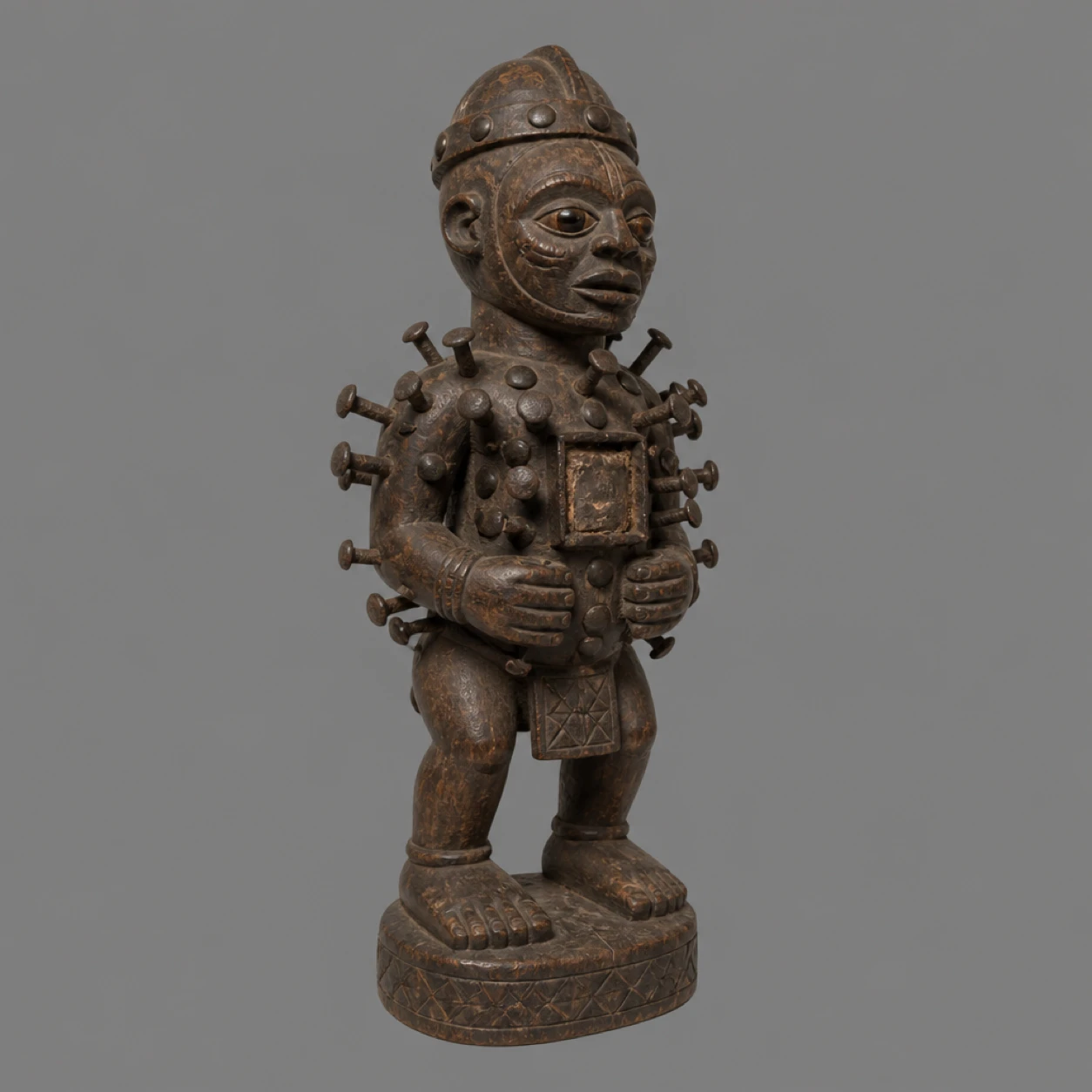
A power figure reads as a working shrine instrument, not a decorative idol. Keep the belly cavity and metal insertions readable, and leave space around it as if an nganga still tended the piece. For a full Central and West African court and ritual set, see the African Kingdom Relics pack.