Medusa Relief: Rome's Apotropaic Gorgoneion
A Medusa relief is a carved or molded image of Medusa's head, the motif art historians call a gorgoneion. Romans did not usually show the full snake-haired body from myth. They repeated the frontal face on marble panels, floor mosaics, armor fittings, and tomb monuments because the image was believed to turn harm aside. In Greek art the same emblem had started as a grotesque mask with beard and bared teeth; by the Roman period it more often looked like a beautiful woman with wild curls, sometimes winged, still staring straight at the viewer. A relief prop in a villa or barracks room echoes a real Roman habit: put Medusa's face where danger might enter, and let the monster's reputation do the guarding.
Gorgoneion, snaky locks, and the carved face
The word gorgoneion refers specifically to the head and face of Medusa, not the full figure Perseus beheaded in myth. The Metropolitan Museum of Art's essay on Medusa in Greek art describes it as a decorative motif that spread through architecture, vase painting, and metalwork. Medusa's name may relate to the Greek verb for guarding or protecting, which fits the way Romans used her face as a talisman rather than as a narrative scene.
On a relief, the carver concentrates on what reads at a distance: wide eyes, a frontal stare, and hair that could be read as snakes, curls, or both. Wings above the brow appear on some Hellenistic and Roman examples and mark the Gorgon as a supernatural being. The Met's Hellenistic terracotta roundel (object 98.8.30) shows how artists could render her as a beautiful female with thick wavy locks, a sharp change from the monstrous Archaic type, while still identifying her as Medusa through those small wings. Roman reliefs and mosaics often shrink the motif to a roundel or shield-shaped panel that could sit over a doorway, in a pavement emblema, or on a sarcophagus lid.
From Archaic terror to Roman beauty
Early Greek gorgoneia were deliberately frightening. The Met essay notes Archaic examples (roughly 700–480 BCE) with round faces, wide eyes, beards, protruding tongues, and gnashing teeth, including antefixes on temple roofs across Sicily, southern Italy, and mainland Greece. Monumental pairs also filled temple pediments, such as those on Temple C at Selinunte in Sicily around 540 BCE. The point was confrontation: a face that looked back at you before you crossed a sacred threshold.
Classical and Hellenistic sculptors softened the type. The beard and fangs dropped away; the face became recognizably female, with tousled hair and a direct gaze that still carried apotropaic force. Romans inherited both traditions. Mosaic floors and marble reliefs from the 1st–3rd centuries CE frequently show a humanized Medusa with wind-blown curls rather than explicit serpent locks, sometimes modeled on royal portrait conventions. Scholars still debate how much myth mattered to Roman viewers versus simple luck-chasing, but the visual shift is clear in museum collections from Italy to Egypt: the Roman Medusa relief is more portrait-like than the Archaic mask, even when it serves the same protective job.
Warding off evil on tombs, gates, and armor
Roman writers and artists treated the Gorgon head as an apotropaic symbol, an image of danger meant to repel danger, comparable in spirit to the evil eye charms still sold in Mediterranean markets. The Met's essay on Roman sarcophagi lists Gorgon faces among the decorative themes on stone coffins, explicitly calling them apotropaic images for protection against evil forces. On Asiatic sarcophagi produced in workshops such as Dokimeion in Phrygia, frontal Gorgon heads appear among garlands and architectural colonnades (for example Met object 70.1), where some scholars read the coffin as a house or hero's shrine for the deceased.
The same logic applied outside tombs. Athena wore Medusa's severed head on her shield, the aegis, in Greek myth, and Roman mosaicists borrowed the spinning, shield-shaped frame that surrounds many pavement heads. Military equipment and civic architecture picked up the motif for the same reason: a terrifying face at the gate, on the breastplate, or beside the door suggested that harm would meet a worse stare first. World History Encyclopedia's survey of Medusa notes that the Gorgoneion appears on shields and breastplates as well as pottery, and that the image was widely believed to ward off evil across Greek, Hellenistic, and Roman art. Whether a given homeowner cared about Perseus, Athena, or plain superstition is harder to recover from archaeology, but the placement pattern is consistent: thresholds, floors, and bodies that needed defending.
Mosaics, doorways, and empire-wide spread
If Greek architects favored terracotta antefixes on temple eaves, Roman patrons favored floor mosaics and wall reliefs in houses, baths, and public buildings. Black-and-white shield patterns with a central Medusa head appear in Italian villas of the 2nd century CE; polychrome versions spread through provincial cities. Domestic examples turn up from Britain to North Africa, showing that the motif was not limited to Rome itself.
Doorways and lintels were natural homes for a frontal face that "saw" visitors before they entered. In military contexts, relief bosses and sculpted roundels echoed the same emblem without requiring a full mythological program. Because marble sarcophagi, mosaics, and small personal amulets share the iconography, a single Medusa relief model can stand for villa luxury, tomb protection, or barracks superstition depending on how you stage it. The unifying thread is the gorgoneion as portable, repeatable protection, not a single canonical statue type.
The Met's third-century Medusa cameo ring
A compact Roman object makes the apotropaic habit tangible. The Metropolitan Museum ring 10.130.1428, dated to the 3rd century CE and said to be from Egypt, sets a cameo Medusa head in an oval gold box on a narrow shaft. The museum's label notes that gorgoneia remained ubiquitous until the end of Greco-Roman antiquity and that such images could serve as protective amulets while also invoking a deep mythological background. Here the carver used cameo technique, raising Medusa from the stone surface rather than sinking the image in intaglio, and chose banded onyx so face and ground could contrast in color.
The piece measures about 1.7 by 2.2 cm, small enough to wear daily yet detailed enough to read the Gorgon identity. It entered the collection as a gift from Helen Miller Gould in 1910 and sits in the Egyptian Art department because of its find context, even though the iconography is broadly Roman imperial. For historians, it bridges the gap between monumental relief and personal magic: the same face on a tomb sarcophagus could shrink onto a finger and travel. When you anchor a scene on a real object, this ring is a safer choice than an anonymous wall fragment because the accession number, date, and museum label spell out both date and intended use.
Marble, mosaic, and what survives today
Most Roman Medusa reliefs that survive are stone or glass tesserae rather than bronze. Marble panels could be worked in low relief for facades or sarcophagus fronts; mosaics could embed a central head in a geometric shield that seems to rotate when you walk around it. Paint once picked out hair, lips, and wings on terracotta and stone, though color is often lost. Fragmentation is common: mosaics survive as floor patches, and architectural reliefs turn up reused in medieval walls.
Attribution to a specific workshop is rare outside major urban centers, and many relief roundels in museums lack provenance beyond "Roman period." Dating within the empire relies on stylistic comparison: more humanized faces and elaborate coiffures tend toward the 1st–3rd centuries CE, while sharper, more mask-like types echo earlier Hellenistic models. If sources disagree on whether a given head belongs to the 2nd or 3rd century, the safer prose keeps a century-wide range. What is secure is function: Romans kept placing Medusa where they wanted an image to stare back at the world on their behalf.
In your scene
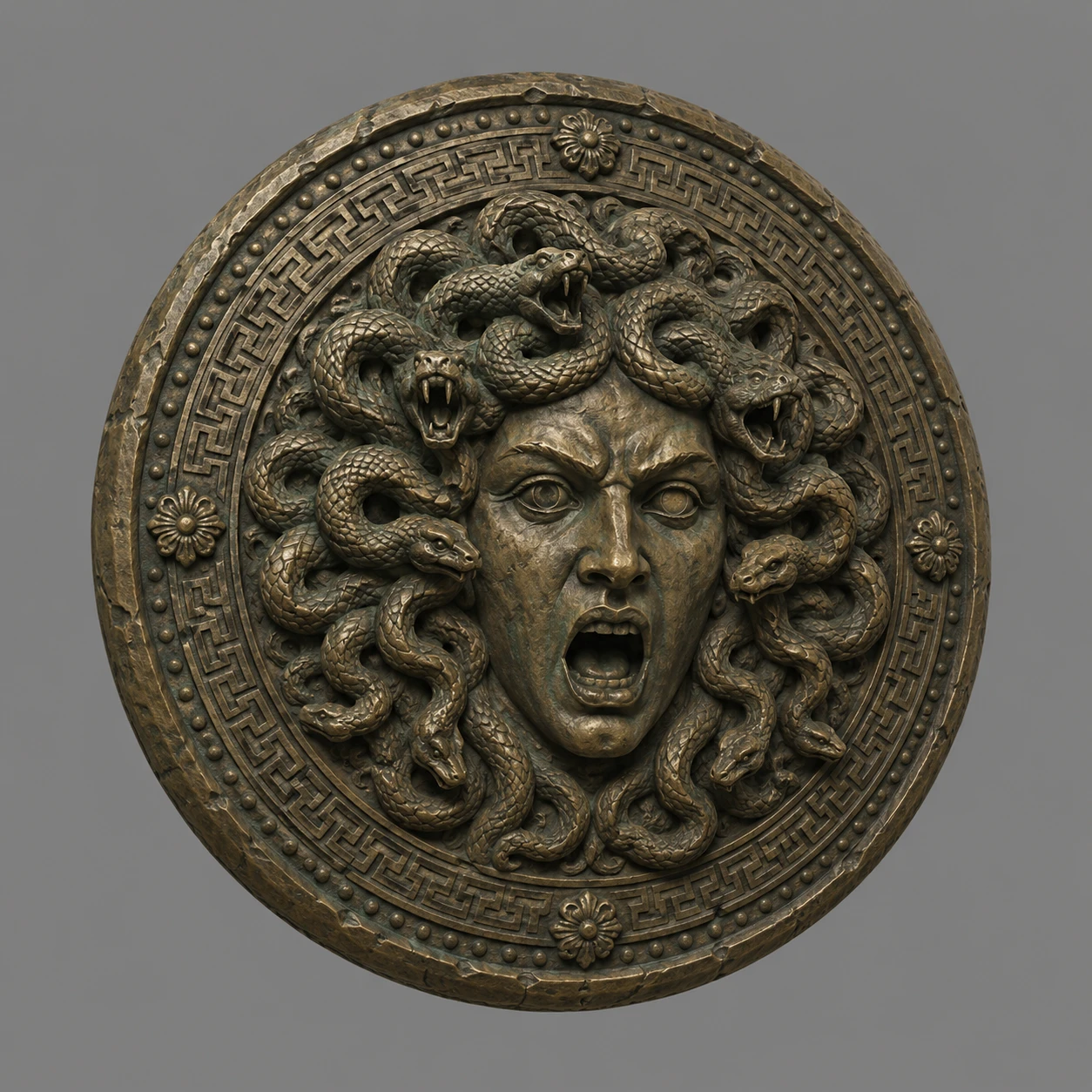
A Medusa relief reads instantly above a villa doorway, on a barracks wall, or set into a tomb niche where a sarcophagus would have carried the same apotropaic stare. Frontal placement matters: the face should meet the viewer at the threshold, not hide in profile. Our Roman Empire Relics pack includes a stylised Medusa relief suited to fort interiors, lararium corners, and temple antechambers.