Dragon Prow: Serpent Carvings at the Viking Stem
A Viking dragon prow is the carved animal head mounted at a ship's stem, the forward end that cut through waves. Modern English calls it a dragon prow because longships appear in art with snarling heads and because Old Norse texts speak of drekar, dragon ships. Archaeology more often finds serpents: tight spirals, gaping jaws, and long necks worked from oak. The prow was wood sculpture meant to be seen at sea, on a vessel whose owner could afford ornament below the waterline as well as above it.
Serpent, dragon, and the carved stem
Norse ship vocabulary mixes worm and dragon words. Medieval sources call large warships dreki or name them after serpents, as with the famous Ormen lange, the Long Serpent. World History Encyclopedia notes that later terminology attached the label serpent ship or drakkar when a carved head stood on the prow, even though not every Viking hull carried one. Popular images show a striped sail and a dragon head, but the same article stresses that many surviving boats lack the elaborate carving.
The carving itself was joinery and sculpture. On elite ships, animal ornament could run from the keel far below the waterline up the prow to the stem. Britannica describes the Oseberg bowhead as an elegant spiraling serpent's head, a phrase that matches the tight coils seen in photographs from the 1904 excavation. Prow pieces were wooden, painted or left bare, and sized to read clearly from the shore or from another deck.
From Oseberg ornament to longship prows
The best-preserved early example comes from the Oseberg ship, built around 820 CE in western Norway and buried as a funeral ship in 834 CE. Britannica gives the hull length at about 21.5 metres, with clinker-built oak strakes and a pine mast that once stood roughly 9 to 13 metres tall. World History Encyclopedia adds 15 pairs of oars and a beam near 5.1 metres, broader than the slender longships that dominate later Viking Age raids.
Decoration marked rank. Only certain members of the upper class received ships with carving along the hull and prow, a point both Britannica and World History Encyclopedia repeat when describing Oseberg. As the Viking Age progressed, specialised warships grew longer and narrower, built for speed and shallow draft. Dragon-headed prows remained a prestige marker on those warships rather than a standard fitting on every fishing boat or cargo knarr.
Fear at sea and status at the strand
A prow head did practical work in a world that moved by water. World History Encyclopedia ties the nightmare image of dragon heads descending on targets to the hit-and-run raids that longships enabled: oars for rivers, sails for open water, and a shallow draft that let crews land away from fortified harbours. A snarling animal at the bow turned the hull into a message before anyone shouted a threat.
Symbolism leaned on serpents from Norse myth, including the Midgard Serpent that encircled the human world. Ship names and prow shapes may have linked a vessel to that story world, though texts written centuries later cannot prove every captain's intent. What archaeology confirms is display: the Oseberg burial held wealth meant to be seen, from woven tapestries to carved wood, and the animal heads belonged to that same theatre of status.
Handles, ropes, and heads apart from the hull
Not every carved head sat permanently on the bow. Britannica lists five carved wooden animal heads among the Oseberg grave goods, each unique in design. Four lay in the burial chamber linked by a rope, and one was found on the forward deck. Each head has a handle at the base of the neck, which suggests it could be mounted on a wall, a throne, or a ship, but the exact ritual use is unknown.
Scholars therefore distinguish the fixed stem carving from detachable heads that might have been swapped for ceremony or storage. Sagas describe dragon-headed warships of kings, yet few prow carvings survive outside ship burials, so the rope-linked set at Oseberg remains a rare, tangible hint of how flexible the display could be. Your prop can read either way: a permanent bow spirit or a carved head waiting to be lifted into place.
Walking the Oseberg bow in Oslo
Visitors to the Museum of the Viking Age in Oslo meet the reassembled Oseberg hull with its carved prow rising above the gallery floor. Britannica still anchors basic measurements and the 834 CE burial date used in every catalogue entry. Standing at the bow shows how the serpent head grows out of the strakes, not simply bolted on as an afterthought.
Early excavation photos show workers brushing turf from coils that remained sharp after a millennium in blue clay. Conservators later debated how much of the forward carving could stay mounted on the fragile timbers, which is why discussions of the original serpent head often mention a replica on the displayed ship. Even so, the prow defines the silhouette: without that spiral snout, the vessel would look like cargo timber rather than a royal funeral monument.
Wood, rivets, and how few prows survive
Wood rots. World History Encyclopedia warns that most Viking Age hulls now lie decayed on the seabed or survive only as rivet clusters in graves. Oseberg, Gokstad, and Tune are exceptions because mound builders packed turf and clay around the timbers. Prow carvings are rarer still: iron fittings from Ladby and other burials hint at dragon heads that disintegrated, leaving spirals of metal where wood once coiled.
That patchy record keeps interpretation cautious. We know upper-class ships carried animal art because mounds like Oseberg preserved it. We cannot assume every raid ship in a saga had a gilded snout. When you place a dragon prow in a scene, treat it as elite equipment tied to a named vessel or hall, not as generic dock clutter.
In your scene
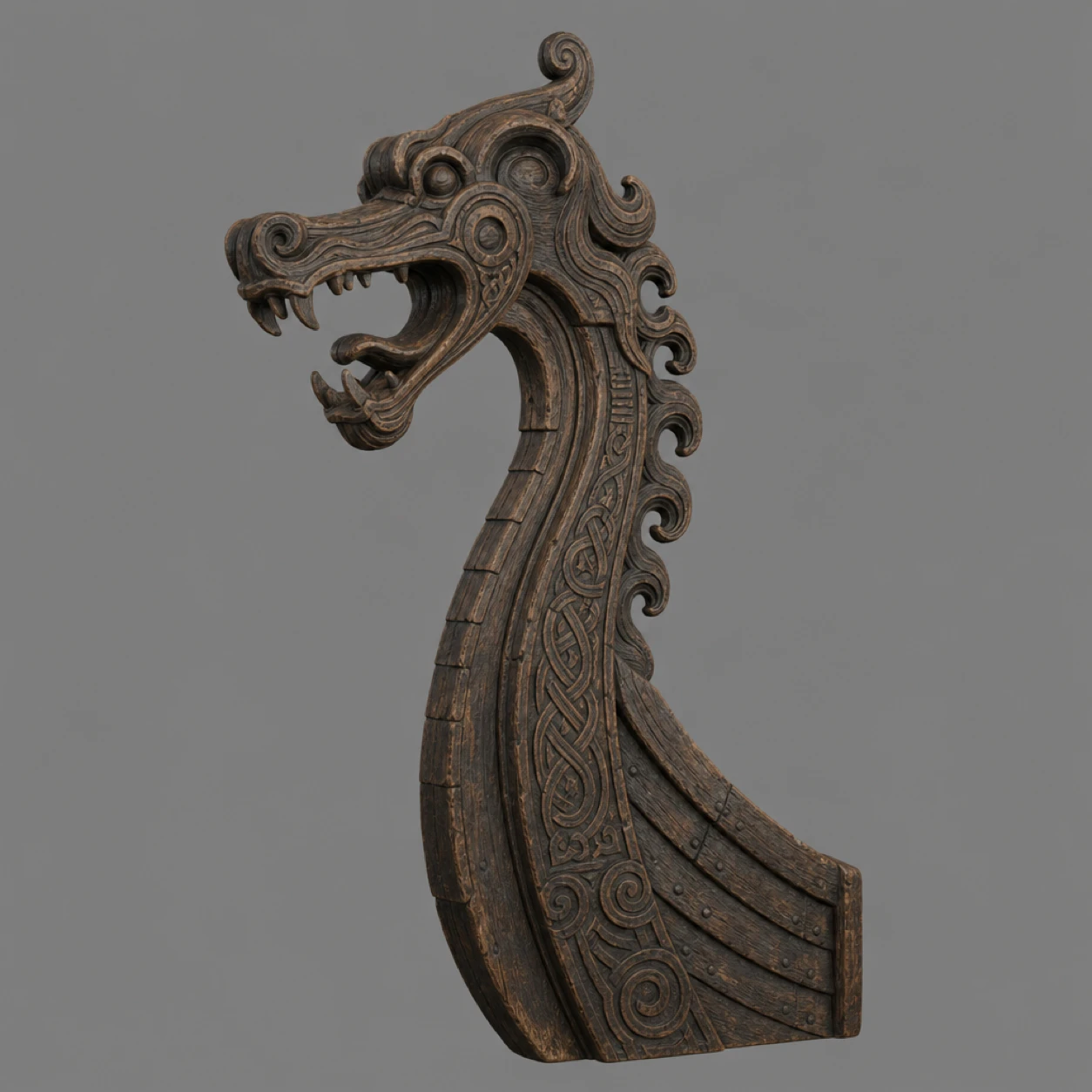
Mount a dragon prow at the bow of a beached longship, or lean a carved serpent head against the wall of a chieftain's hall as if it were stored between voyages. Pair it with the funeral ship article's mound setting if you want the full Oseberg send-off. Our Viking Hall Relics Vol. 2 pack includes a dragon prow model sized for stem mounts beside mead benches and woven hangings.