Obsidian Mirror: Tezcatlipoca's Smoking Mirror in Ritual
An Aztec obsidian mirror is a polished disc of volcanic glass, dark, glossy, and slightly convex, made to catch light rather than a clear reflection. In Mexica religion the mirror was not household furniture. It belonged to rulers, priests, and the god Tezcatlipoca, whose Nahuatl name means Smoking Mirror. The same objects later crossed the Atlantic as exotic treasures and, in one famous case, became an Elizabethan scrying stone.
Black glass, flat polish, and the word tezcatl
The stone is obsidian, called itztli in Nahuatl, a natural glass formed when silica-rich lava cools quickly. Britannica notes that peoples from Greece to the Americas shaped it into blades, tools, and mirrors because it fractures in smooth curved flakes that take a high polish.
Mexica mirrors were cut from obsidian and ground with abrasive sand before mounting. Finished pieces are usually circular or oval, a handspan or more across, with a drilled hole or projecting tab for a wooden frame. Perishable parts are almost never preserved: feather borders, painted rims, and carrying cases rotted away centuries ago. What survives in museums is the glass itself, often mistaken at first glance for jet or polished coal.
In Nahuatl the general word for mirror is tezcatl, used for the polished discs employed in divination. Scholars writing on Tezcatlipoca treat the mirror as both a physical object and a metaphor for royal sight, the power to read fate in a chaotic world.
From early Mesoamerica to Aztec workshops
Broken obsidian flakes served as simple mirrors across Mesoamerica long before the Aztec empire. By the Late Postclassic period, roughly the 12th to early 16th centuries, workshops in central Mexico produced larger, more deliberate discs for elite clients. Obsidian from the Pachuca source in Hidalgo, prized for its clarity, appears in several museum pieces analysed in recent decades.
The people we call Aztec named themselves Mexica. Their capital Tenochtitlan rose to dominance in the 14th to 16th centuries, when obsidian mirrors sat among the regalia of kings and the inventory of temples. World History Encyclopedia places Tezcatlipoca at the summit of the divine hierarchy by Aztec times, which helps explain why mirror imagery saturates codex paintings and sculpture from that period.
Divination, Tezcatlipoca, and the smoking mirror
Tezcatlipoca was god of the night sky, kingship, warriors, and sorcery. Britannica describes him with a stripe of black paint across his face and an obsidian mirror in place of one foot, or worn on his chest. In that mirror he was said to see everything: human deeds, hidden thoughts, the turns of fate.
Codex images show the smoking mirror as a round disc with curling wisps, the visual pun behind his name. Priests and rulers used polished obsidian in divination rites, gazing into the dark surface to summon visions or read omens. The practice tied earthly power to Tezcatlipoca's omniscience. A mirror in the ruler's hand claimed the same all-seeing authority as the god's.
Annual rituals could be extreme. During the month Toxcatl, a handsome captive warrior spent a year impersonating Tezcatlipoca before his heart was removed on the temple steps, an offering that linked human sacrifice to the god's cult. Mirrors were not props in that ceremony alone, but they belonged to the same ritual world of sight, fate, and violent renewal.
From Cortes's gifts to European cabinets
After the Spanish conquest of Mexico in 1521, polished obsidian mirrors entered European collections as wonders from the New World. Cortes and other conquistadors sent Mexica treasures to the Spanish court, and aristocrats traded them across the continent. Frames and feathers were often stripped or lost in transit, so collectors saw bare glass and invented new stories.
John Dee, mathematician and astrologer to Elizabeth I, owned at least one such mirror and used it as a shew-stone for angelic conversations with his medium Edward Kelley from the 1580s onward. Whether Dee understood the object's Mexica meaning is debated, but European occult tradition already valued black mirrors for scrying, which made an Aztec disc easy to repurpose. By the 18th century Horace Walpole kept Dee's mirror in a leather case and labelled it the black stone into which Dee called his spirits.
Dr Dee's mirror at the British Museum
The best-documented example is registration 1966,1001.1 in the British Museum, titled Dr Dee's Magical Mirror. The disc is obsidian, about 19 by 18.5 centimetres across, weighing about 882 grams. A 2021 geochemical study identified the stone as from Pachuca, Mexico. The museum dates production to the 15th to 16th centuries and notes the mirror reached Europe after the conquest.
A tooled leather case survives with handwritten labels in Walpole's hand, quoting Samuel Butler's satirical poem Hudibras and tracing the mirror through English aristocratic collections back toward Dee. The museum purchased it in 1966 from the Reverend Robert William Stannard. It has been displayed in the Enlightenment gallery and featured in exhibitions on Moctezuma, Shakespeare's world, and John Dee's library.
Held beside the glass, the case tells two histories at once: an Aztec ritual object polished for divine sight, and a Tudor magician's tool reframed for a Gothic antiquary's cabinet.
What survives, and what scholars still dispute
Dozens of pre-Hispanic obsidian mirrors are known from museums worldwide, but the total is modest compared with obsidian blades or pottery. Many lack provenance beyond "Mexico," and wooden frames rarely survive burial. Scholars continue to debate how mirrors were used in specific rites, whether all belonged to divination or some served as royal insignia only, and how faithfully codex smoke wisps record real practice versus theological shorthand.
Recent museum science, including the British Museum's sourcing study, has clarified where stones were mined. Interpretation of meaning still depends on colonial-era texts, painted books, and comparison with later ethnography. The mirrors remain eloquent objects even when the spells spoken over them are lost.
In your scene
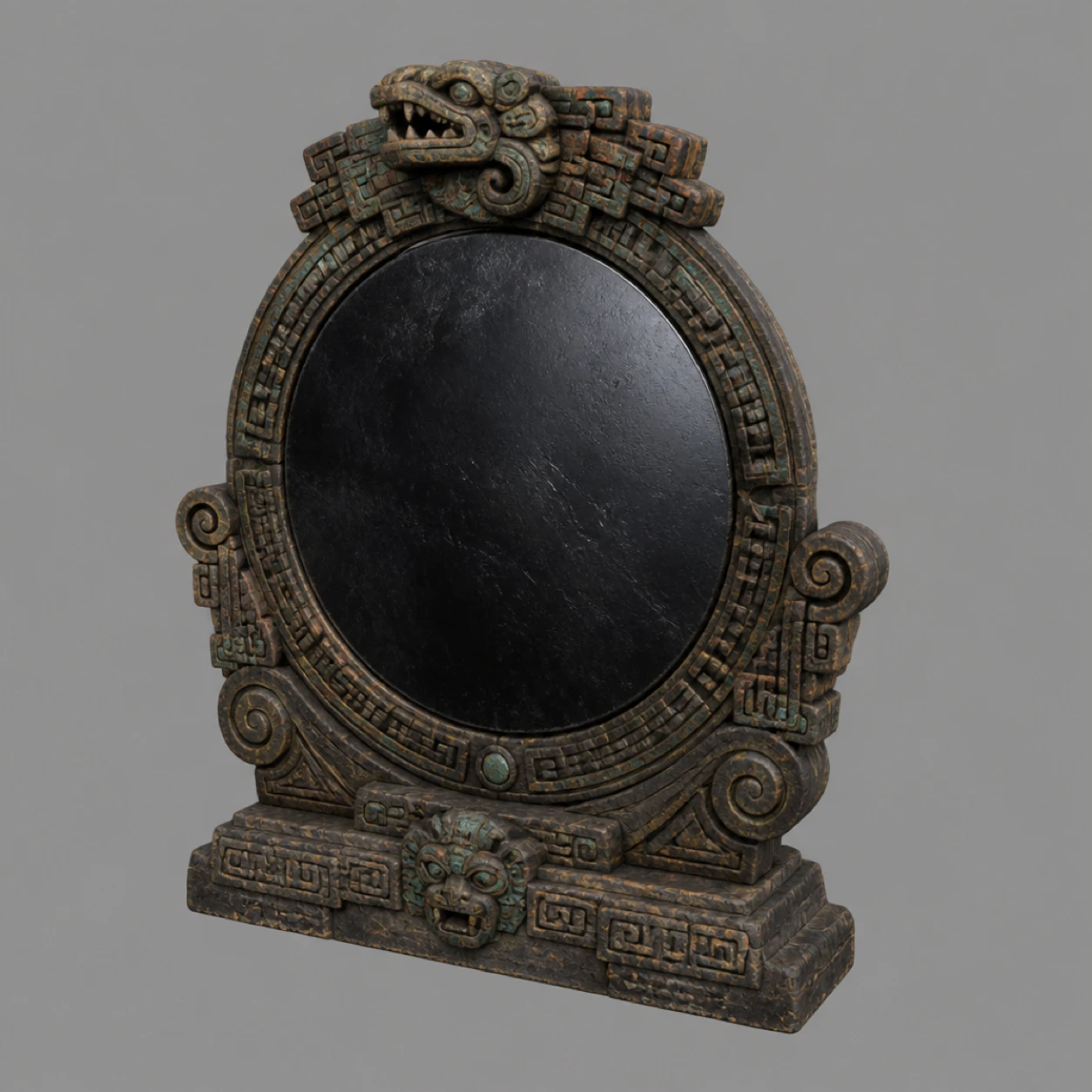
Place a convex obsidian disc on an altar cloth or in a priest's hands, lit by firelight so the surface gleams without offering a crisp reflection. A temple interior or royal chamber fits better than a marketplace stall. Our Aztec Temple Relics pack includes an obsidian mirror model sized for ritual scenes beside drums, braziers, and temple sculpture.