Soapstone Birds of Great Zimbabwe: Royal Emblems in Stone
A Zimbabwe bird is a carved soapstone sculpture of a stylized bird, usually shown perched on a tall stone column, recovered from the ruins of Great Zimbabwe in present-day southeastern Zimbabwe. Eight such birds are the famous set tied to the site. They mix bird and human traits: lips where a beak might be, five-toed feet instead of claws. They are not naturalistic portraits of a single living species. World History Encyclopedia notes that the form does not match any bird in nature, yet this creature became the national emblem on the modern Zimbabwe flag. Scholars read the sculptures as status and religious signs linked to royal authority at a capital that once commanded trade across the Zimbabwe Plateau toward the Indian Ocean.
Soapstone bodies on columns taller than a meter
Each bird sits atop a soapstone column more than a meter high. The bird figures themselves average about 40 centimeters tall in the Met's account of the finds (older Met Timeline text rounded the same average to about sixteen inches). The stone is soft enough to carve with iron tools yet durable enough to survive in ruined enclosures. Related soapstone work from the site includes bowls, pipes, pendants, molds, and other figurines, so the birds belong to a wider carving tradition, not a one-off novelty.
The hybrid anatomy matters. Human lips and five-toed feet pull the image out of pure zoology and into emblem. Viewers have proposed links to birds of prey familiar in the region, but the carvings refuse a clean field-guide match. That ambiguity is part of their power: they read as messengers or ancestral signs more than as taxidermy in stone.
Capital of stone houses on the Zimbabwe Plateau
Great Zimbabwe was a dry-stone city whose Bantu name-root zimbabwe refers to stone houses. The Met's current essay places occupation between the eleventh and seventeenth centuries, with economic peak often described between the twelfth and fifteenth; Britannica and World History Encyclopedia commonly stress an eleventh-to-fifteenth-century heartland before decline and political shifts. At its height the capital held on the order of 20,000 people, living from cattle, crops, metalwork, and gold and ivory trade toward the coast.
The site has three main built zones: the Hill Complex, the Great Enclosure, and the Valley Enclosures. Granite walls rise without mortar in carefully laid courses. The Great Enclosure's outer wall runs roughly 252 meters around and up to about 11 meters high in the Met's measurements, the largest precolonial built structure of its kind south of the Sahara. Against that architectural scale, the soapstone birds are small, portable sacred furniture rather than wall decoration.
Emblems of royal and ancestral authority
Six of the eight birds came from the Eastern Enclosure of the Hill Complex. One was found in the Western Enclosure of the same hill zone, and one inside the Central Valley ruins of the Valley Enclosures. Their exact original arrangement on the hill is lost; colonial-era excavation scrambled context. Even so, the clustering on the Hill Complex, long read as a ritual and elite focus, supports the view that the birds marked royal presence and communication with ancestors.
Precise meaning is still debated. Suggestions include royal ancestors, spirit messengers, or status markers of the ruling house. What is not serious archaeology today is the old colonial claim that foreigners from the Mediterranean or Near East built Great Zimbabwe and left the birds as proof. World History Encyclopedia recounts how colonial-era writers used such finds as false evidence for Phoenician or other foreign builders. Modern consensus attributes the city and its art to African builders, ancestors of Shona-speaking communities.
From ruined enclosures to national emblem
In the late nineteenth century, soapstone bird figurines found in the ruins entered colonial collecting and nationalist argument. Britannica records that the Zimbabwe Bird later became a national symbol, placed on the flag and in other places of high honour. After independence in 1980, the country took the name Zimbabwe from the stone-house tradition of the site. The bird that once stood in elite enclosures now appears on currency, coats of arms, and state ceremony.
Some sculptures were removed from the country during colonial rule and later became subjects of return and loan negotiations. Counts and current museum homes shift as inventories and restitutions proceed, so treat any single "all eight are in X" claim with care unless a current catalogue confirms it. What remains stable is the emblem's public life: the bird is how a medieval capital's ritual art entered modern state identity.
The eight birds the Met essay still walks through
There is no single Met accession for an original Great Zimbabwe bird in the museum's public essay the way a Benin head has an object number. The named set itself is the walkable object. The Metropolitan Museum of Art's Great Zimbabwe essay (Tawanda Mukwende, Heilbrunn Timeline) describes eight carved soapstone birds found within the site: columns more than a meter tall, birds averaging about 40 cm, hybrid human-avian features, and the findspot split of six / one / one across Eastern Enclosure, Western Enclosure, and Central Valley. Scholars cited there treat the birds as emblems of royal authority and religious status.
That essay also places the birds inside a longer soapstone craft history at the site, with utilitarian and nonutilitarian carving earlier than the eleventh century, and notes twentieth-century Shona sculptors who returned to soapstone under that deep local tradition. For a reader who cannot stand in the Eastern Enclosure, the Met's findspot map in prose is the clearest museum-grade tour of the set that still exists in publication.
What dates and meanings still disagree
Occupation brackets differ by a century or two at the edges depending on whether an author emphasizes peak trade centuries or the full radiocarbon and import span into the seventeenth century. Bird species identifications (bateleur eagle and other guesses) remain conjectural. Ritual function is inferred from findspots, hybrid form, and ethnographic analogy, not from an inscribed label on the stone. World Heritage listing in 1986 protects the ruins; it does not freeze interpretation.
When sources disagree, keep both hedges in view: the birds are securely from Great Zimbabwe's elite soapstone corpus, and their exact theology is still an open scholarly conversation.
In your scene
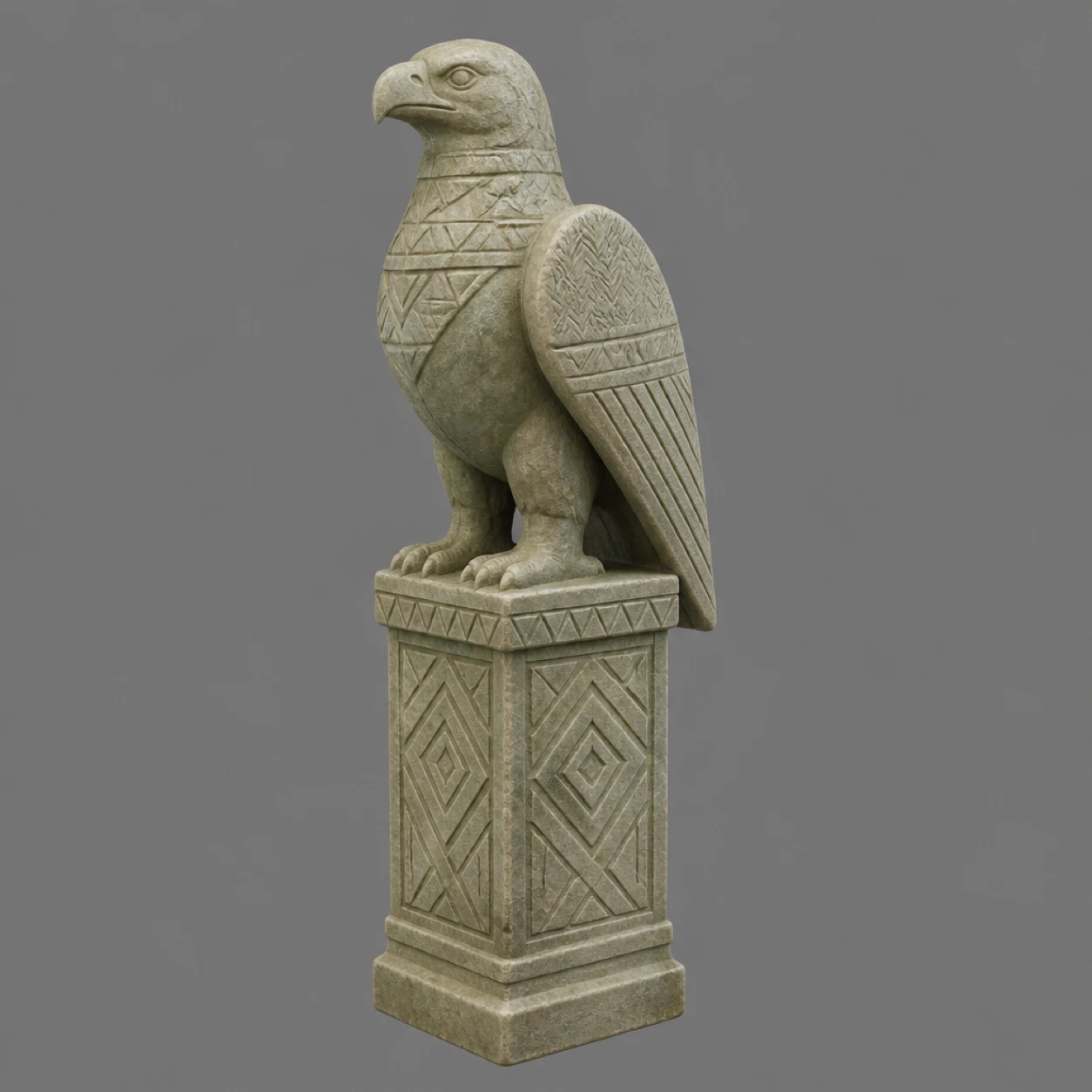
A Zimbabwe bird reads as a perched emblem on a tall shaft, not a free-flying animal statue. Place it in a hilltop enclosure or court shrine context, and keep the humanized beak and feet if you want the historical hybrid look. For a matching court set, see the African Kingdom Relics pack.