Weaving in the Longhouse: The Norse Warp-Weighted Loom
A warp-weighted loom is a vertical weaving frame: two upright posts support a horizontal beam at the top, and bundles of warp threads hang straight down from that beam. Clay, stone, or ceramic loom weights tied to the lower ends keep the warp taut while the weaver works standing in front of the frame, often with the loom leaning against a longhouse wall. In Viking Age Scandinavia this was the standard way to turn fleece into the woollen cloth that dressed households from Iceland to Denmark.
Upright frame, hanging warp, and loom weights
The essential parts are simple. A cloth beam at the top can be cylindrical so finished fabric rolls around it, allowing a piece taller than the room itself. Below the beam hang the warp threads, grouped and weighted. A shed rod and heddle rod (sometimes called a heddle bar) separate alternating threads so the weft can pass through in a shed, then a counter-shed on the next row. The weaver beats each weft row upward with a weaving sword or beater, working from the top of the loom toward the floor.
Britannica's survey of weaving describes the warp-weighted type as one of the primitive loom families alongside horizontal and vertical two-bar designs. Weights of clay, ceramic, or chalk tied to the free ends of the warp keep tension without fixing the lower warp to a second beam. That open lower edge is what lets the weaver add more warp from the weights when a long cloth runs out of hanging thread.
Archaeologists rarely find the wooden frame intact. What survives in the soil are the loom weights themselves, usually doughnut-shaped or pyramidal lumps of fired clay, sometimes marked with incised lines or runes.
A European loom older than the Vikings
Loom weights at sites dating to around 3000 BCE show how long this technology predates the Viking Age. The same upright principle remained in use across northern Europe for millennia. In Norway and Iceland it persisted into early modern centuries, long after horizontal treadle looms spread on the Continent.
By the 8th to 11th centuries CE, when Norse farmers, traders, and raiders were active from Greenland to Russia, the warp-weighted loom was still the household tool for producing vadmal and other woollens. Settlement layers at trading towns and magnate estates alike yield clusters of weights, proof that weaving was not a marginal craft but part of ordinary economic life.
Wool, clothing, and work at the farmhouse
Textile production in Viking Scandinavia was largely domestic work. World History Encyclopedia's overview of Viking Age women notes that rural women spent much of their time moving between byre, dairy, and living quarters, supplying food and clothing for the family. Turning raw wool into finished dress was a multi-step chain: washing, combing, spinning on a drop spindle with a whorl, dyeing when dyestuffs were available, then weaving on the upright loom, and finally cutting and sewing garments.
Female graves, especially in the countryside, often contain spindle whorls, wool combs, and weaving battens. Those objects map directly onto the tasks at the loom. Tortoise brooches and other dress fasteners in the same burials show why the cloth mattered: layered wool gowns and cloaks had to be pinned, belted, and maintained season after season.
The labour was slow. Experimental work is sobering about pace, but it confirms that a household needed steady weaving through the year to keep everyone clothed.
From homestead cloth to Hedeby's traded textiles
Not every loom stood in a small farm hall. At magnate centres, pit-houses served as workshops. The National Museum of Denmark's account of crafts at Tissø records loom weights and spindle whorls from several pit-houses at the magnate courtyard near Lake Tissø, alongside evidence of smithing, bead making, and bronze casting. Textile work sat beside other specialised crafts that supplied the hall and its guests.
At Hedeby, one of the great Viking Age trading towns on the border of Denmark and Germany, archaeologists have recovered textile fragments and tools that show local production as well as imported luxury cloth. The Fashioning the Viking Age project at the National Museum of Denmark and the University of Copenhagen reconstructed Viking Age weaving using copies of tools from Hedeby and other sites. Researchers wove samples matching archaeological fragments such as H14 (tabby) and H2 (2/2 twill), using reconstructed clay loom weights in several masses. One experiment aimed at a legal Icelandic cloth measure roughly 1 m by 3 m, a unit of vadmal, and recorded weaving speeds on the order of 10 to 15 cm per hour for that larger piece.
Winter camps in England, such as Torksey, have also produced evidence of textile manufacture among Viking armies. Weaving followed people wherever households or workshops settled.
The Faroes loom at the National Museum of Denmark
Because wooden looms rot, the most dramatic surviving frame in Scandinavia is a historical example rather than a Viking Age excavation find. The National Museum's online collections record describes an upright warp-weighted loom from the Faroe Islands as the oldest preserved weight loom in the Nordic countries. The catalog entry identifies it as Norse (Nordbo) in culture and notes that the warp threads are weighted by loom weights with incised runes. The museum photograph shows a re-setup for 2/2 twill dating to 1980, illustrating how living tradition bridged medieval Norse practice and modern documentation.
The object is not a sealed time capsule from the 10th century, but it makes the mechanics visible: leaning posts, top beam, hanging warps, and the weight bundles that archaeologists infer everywhere else from clay alone. For a reader who has only seen loom weights in a display case, this frame shows how the pieces assemble in a hall.
Clay weights survive, wooden frames do not
Excavated loom weights are common enough to map weaving zones inside settlements. Shapes and masses vary, and the Fashioning the Viking Age team produced replica weights at about 200 g, 400 g, and 600 g to test how mass affects beat and fabric density. Different weights changed how the weaver worked and how the cloth looked, which helps explain why sites produce such varied tool kits.
Interpreting a handful of weights beside a hearth still takes care. Not every clay lump is a loom weight, and not every pit-house with weights was exclusively a weaving shed. Yet the combined evidence from farms, halls, towns, and camps leaves little doubt that the warp-weighted loom was the workhorse behind Viking Age wool culture.
Norse poetry and later commentary also turned the upright loom into metaphor. World History Encyclopedia's article on the Norns explains how the fixed warp pattern on a vertical loom, invisible until the cloth nears completion, could stand for fate decided early yet revealed only late. Whether or not Viking listeners made that connection every day, it shows how deeply weaving sat in the cultural imagination.
In your scene
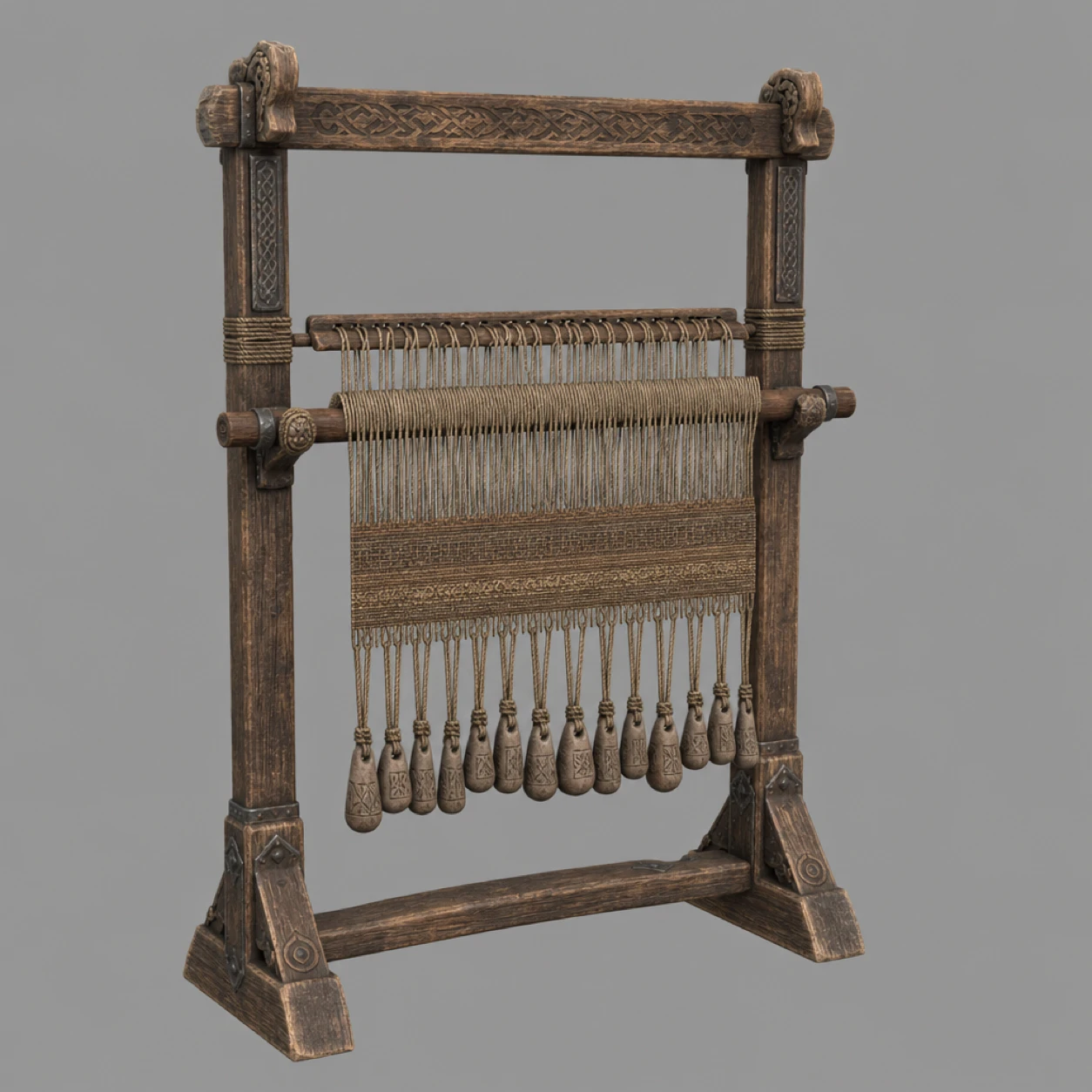
Place a warp-weighted loom against the longhouse wall, with clay weights hanging below the beam and a partially woven wool panel rolled at the top. Pair it with spindle whorls, a wool comb, or tortoise brooches on a nearby figure to signal textile work rather than an empty craft corner. Our Viking Hall Relics Vol. 2 pack includes a warp-weighted loom model sized for interior hall scenes.