Tortoise Brooches: Oval Pins for the Viking Apron Dress
A tortoise brooch is a large, domed oval pin that Viking Age women wore in matched pairs at the chest. Archaeologists also call them oval brooches or concave brooches; Danish museum texts describe the same objects as shell-shaped brooches. Each piece fastened a shoulder strap of the apron dress, the close-fitting wool garment worn over a linen smock. The brooches were practical dress hardware, but their size, relief decoration, and paired placement also turned them into one of the clearest signals of Scandinavian women's dress anywhere the Norse traveled.
Domed ovals, shell brooches, and the pinned strap
The silhouette is unmistakable: a convex bronze shell, often 9 to 13 centimetres long, with a pin hinge on the back and a catch plate below. The English nickname "tortoise" comes from that domed, carapace-like curve. Cast bronze was standard; silver and gilt examples appear in wealthy graves, but base metal dominates excavation reports.
Women wore two brooches, one at each strap, so the pair is part of the object's identity. Textile fragments preserved against the metal show how the pin passed through folded strap ends rather than through a cloak alone. World History Encyclopedia notes that these domed oval brooches are the most common brooch type from the Viking Age, usually worn in pairs with bold relief ornament, often in a gripping-beast style, and typically about 10 to 12 centimetres long.
From Vendel prototypes to workshop casts
Oval brooches grew out of earlier Scandinavian bowl brooches and swell in size and standardization through the Viking Age, broadly the 9th to 11th centuries. Workshops produced them in large numbers using lost-wax casting: a wax model, a clay mould, molten bronze poured in, then hinge plates and pins fitted after the cast cooled. Mould fragments from production sites show that many pieces were near copies, not one-off jeweller's work.
Typologists still sort the brooches into long series, Jan Petersen's 1928 classification being the backbone most catalogues cite. Forms shift by region and century: some early types bridge the Vendel and Viking periods; later Jellinge-style ornament appears on 10th-century examples. Scholars disagree on exact date brackets for individual types, so museum labels often quote century ranges rather than single years.
At the chest: apron dress, beads, and belt keys
The cultural job was to hold up the strap dress. The National Museum of Denmark describes a close-fitting wool dress held by a strap on each shoulder, fastened at the front with a shell-shaped brooch. Between the two brooches many women hung strings of beads in amber, glass, or silver. From one brooch, usually the right, straps could carry small tools: scissors, a needle case, tweezers, or an awl.
Under the dress went a smock, plain in Danish graves and sometimes pleated in Swedish ones, a small regional fashion difference preserved in textile scraps. Over everything went a cloak pinned with a smaller round or trilobite brooch. At the waist a belt carried keys, pouches, and a strike-a-light. The oval pair sat at the centre of that layered outfit, not as a lone jewel but as the anchor for chains, beads, and everyday kit.
Styles that shift east, west, and south
Distribution follows Norse movement. Concave brooches turn up across Scandinavia and in settler regions: England, Ireland, Iceland, and the eastern river routes into Russia, which is why archaeologists treat them as evidence that Viking women, not only men, traveled on expedition and migration routes. Ibn Fadlan's 10th-century account of travelers on the Volga describes women wearing chest cases that may match the hollow brooches known from graves.
Fashion did not stand still. In Denmark the paired apron-dress look fades earlier than in Norway and Sweden; some scholars place the decline in the 10th century as Christian court dress and new brooch types spread among elites. Eastern Scandinavia keeps the tortoise-brooched costume longer, while Gotland develops its own paired animal-head brooches that may have served a similar fastening role. The brooch type therefore marks both Scandinavian identity and local taste, depending on where a woman lived or was buried.
The Gerlev-Dråby pair in Copenhagen
A plain but instructive pair sits in the National Museum of Denmark's collections. Museum asset DO-1987 photographs two bronze oval bowl-shaped brooches, inventory numbers C28534 and C28535, from Gerlev-Dråby in Frederiksborg County on Zealand. They were found in an uncremated inhumation grave of the Viking Age, the sort of burial that can preserve textile traces against the metal.
The pair is not a gilded showpiece. It represents the everyday matched set a woman would have pinned each morning: two shells of cast bronze, domed enough to earn the tortoise name, without the filigree seen on elite hoard brooches. Displayed together, they make the pairing rule visible in a way a single stray find cannot. The museum's online catalogue labels them skålformet fibler, bowl-shaped brooches, the Danish term curators still use beside English "oval" and "tortoise."
Bronze in graves, cloth on the pins
Thousands of oval brooches survive, which suggests they were widespread rather than a rare luxury for a few aristocrats. Exact totals depend on the catalogue you consult and grow as new detector finds are recorded, so published counts should be read as minimums. Plain bronze dominates; excavated pairs with bead strings between them show how the hardware framed colour and sound when a woman moved.
Corrosion and cremation destroy context. Many women's graves were burned, and iron pins rust away, so museum cases skew toward bronze that survived in soil. Archaeologists still debate how high on the torso the brooches sat in life; grave positions on the chest are the main evidence, and some researchers argue for slightly higher placement while others follow the burial evidence literally. When sources disagree on dates for a given Petersen type, the honest answer is a century bracket, not a false precision.
In your scene
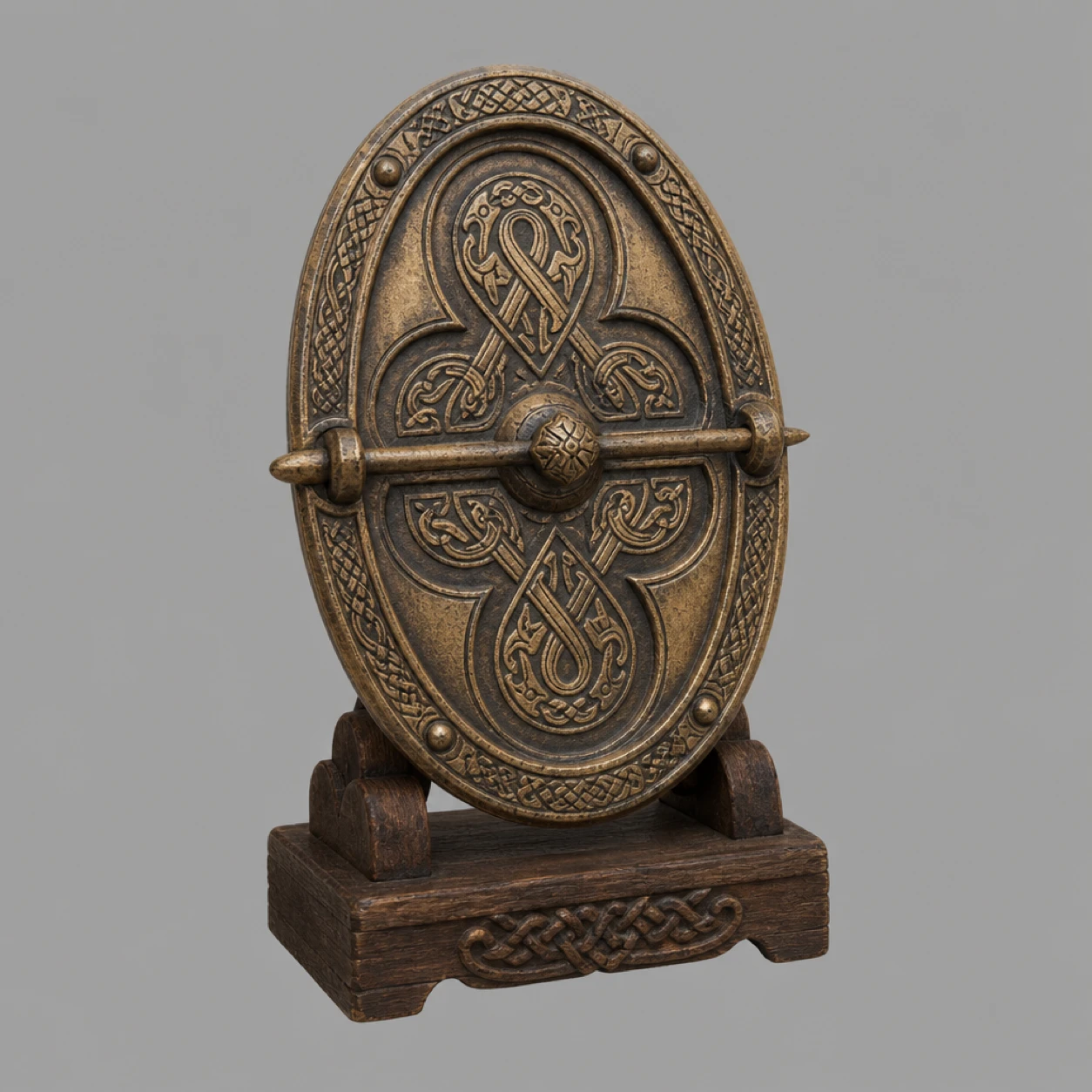
A paired tortoise brooch belongs on a hall display stand, a weaving room shelf, or a woman's dressing corner, not on a warrior's belt. Show two matched ovals, or one brooch on a stand with bead strands implied nearby. Our Viking Hall Relics Vol. 2 pack includes a tortoise brooch on stand sized for longhouse interiors and feast-hall dressing areas.