Kuduo: Asante Brass Vessel for Gold Dust and Kra
A kuduo is a cast brass ritual container made for kings and courtiers among the Akan peoples of Ghana, above all the Asante. Owners kept gold dust, nuggets, and other high-value personal goods inside it. Museum labels also treat the vessel as a receptacle for the owner's kra, the vital force often translated as soul or life force. Ceremonies that honored and protected that person put the kuduo in view; at death it could be filled with gold and other offerings and left with the burial assemblage. The word names a courtly brass type, not a household cooking pot.
Brass lids, latches, and the look of a kuduo
Most museum kuduo are lidded copper-alloy vessels with a raised foot, a rounded body, and surface bands of incised geometry. Many have an exterior latch or hasp. That hardware is practical (the contents were valuable) and symbolic: the Met's labels link the closed latch to the idea of keeping the owner's kra secure. Some examples carry pigment traces. Heights commonly fall in the teens of centimeters for compact court pieces, though larger casts also survive.
Casters worked in brass rather than gold for the container itself. Gold dust was the treasure inside; brass was the durable shell that could take sharp engraving and, on later lids, full figurative scenes. The look sits between a locked casket and a ritual flask. Compared with terracotta abusua kuruwa ("family pots") used in Akan commemorative rites, a kuduo is a metal prestige object tied to wealth storage and personal spiritual care, not a clay funerary serving vessel.
From Saharan trade prototypes to Asante court brass
The Met's Heilbrunn essay on gold in Asante courtly arts states that kuduo were based on metal vessel prototypes imported from North Africa during early Akan involvement in the trans-Saharan gold trade. Object labels for early geometric kuduo point the same way: flaring feet, banded bodies, and handles that may echo Medieval Egyptian or wider Islamic metalwares that reached the forest kingdoms in exchange for gold, textiles, and enslaved people. Goods from Europe and North Africa included vessels that may have partly inspired kuduo design for court taste.
Chronology is stylistic rather than inscribed. Met labels place early North African-inspired forms in the seventeenth and eighteenth centuries, while many ornate figurative kuduo are dated nineteenth to twentieth century. The Asante empire that Britannica surveys as an eighteenth- and nineteenth-century West African state in southern Ghana, centered on Kumasi, was a major consumer of such court brass, but the kuduo tradition among Akan speakers is older than the empire's political peak. Gold trade and brass casting in the region antedate the consolidation under Osei Tutu; the vessels belong to that longer economic and ritual history.
Gold dust, kra, and rites for the living owner
A kuduo was not only a strongbox. Met collection texts describe these vessels as possessions of kings and courtiers that held gold dust and other personally significant items, and as containers for the owner's kra. They featured in ceremonies meant to honor and protect that individual while alive. The latch motif underlines the double job: keep the metal safe, keep the soul contained.
At death, a person's kuduo could be filled with gold and offerings and included among items left at the burial site. If the owner was a paramount chief, Met labels note another path: the vessel might accompany his ceremonially blackened stool in a room devoted to his spirit and memory. That link between brass container and stool room is important for reading kuduo as court memorial furniture, not only as portable treasure boxes. Gold itself, in Asante belief as summarized by the Met essay, was tied to vital force and royal vigor; storing dust in a kra-guarding vessel made economic and spiritual sense at once.
From geometric caskets to proverb animals on the lid
Early kuduo emphasize continuous geometric bands and casket-like silhouettes close to imported metalware. Later examples often add openwork bases and crowded figurative lids. One Met Asante piece (1978.412.384a, b), dated nineteenth to twentieth century and 17 cm high, shows a leopard preparing to eat a pig and chicken. The museum reads that scene as a possible reference to the owner's dominant social position, the kind of animal proverb language familiar from Akan gold-weights and court arts.
The shift is not a single dated reform. Museum texts treat North African-leaning geometry as earlier and proverbial lid sculpture as later court fashion. Both types store valuables and both are discussed as kra vessels. What changes is how openly the lid announces rank and proverb meaning. A geometric kuduo can look almost like a traded Islamic metal form adapted for Akan use; a leopard lid announces local verbal-visual culture on top of the same ritual job.
The Met's Kuduo vessel 1981.431.14 you can still see
A clear geometric example is the Metropolitan Museum of Art's Kuduo vessel, object 1981.431.14, by an Asante-Akan artist, on view in Gallery 341 at The Met Fifth Avenue. The museum dates it eighteenth to nineteenth century, Ghana, Akan peoples, Asante. Medium is brass with pigment. Dimensions are height 6 7/8 in. (17.5 cm) by diameter 5 1/2 in. (14 cm). Credit line: Gift of Dr. and Mrs. Jeffrey S. Hammer, in memory of Dr. Milton Gross, 1981. The Met's Heilbrunn essay highlights this same object as an eighteenth-century example with especially fine incised geometric patterns.
The label stresses ornate cast brass ownership by kings and courtiers, storage of gold dust and nuggets, and the vessel's role as a kra receptacle in protective ceremonies. At death it could be filled with gold and left at the burial site. Surface bands of geometry, a flaring foot, body, and handle may reflect Medieval Egyptian metalware influences arriving through trade. An exterior latch marks both valuable contents and the symbolic job of securing the owner's life force. The museum notes that this kuduo is a pair with 1979.206.178a-c.
This piece is not a named king's personal inventory tag. It is a well-documented court type with published measurements, a public gallery location, and curatorial language that matches the wider kuduo corpus. Compared with the Met's figurative leopard lid, 1981.431.14 shows the earlier, trade-linked geometric register rather than proverb animals crowning the cover.
What style dates and burial stories still leave open
Almost no kuduo carry maker names or year marks. Museum date ranges such as "18th–19th century" versus "19th–20th century" are working stylistic brackets. The Heilbrunn essay calls 1981.431.14 eighteenth-century while the object record prints the wider eighteenth-to-nineteenth span; both can be true as degrees of confidence, and the disagreement is worth stating rather than smoothing away. Claims that early forms "suggest" North African inspiration are labeled as suggestions in Met prose, not as excavated workshop proofs for each cast.
Burial practice is also summarized at a high level in museum texts: kuduo left at burial sites, or, for a paramount chief, placed with a blackened stool. Field archaeology has not handed every collection piece a sealed context. Survival in Western museums reflects collecting histories of the nineteenth and twentieth centuries as much as court inventory lists. Counts of "how many kuduo exist" are not a single census figure across Ghanaian shrines, private treasuries, and global museums. What remains secure across Met object pages and the Heilbrunn essay is the core type: cast brass prestige containers for gold and personal valuables, bound to kra care in life and to memorial placement after death among Akan, especially Asante, elites.
In your scene
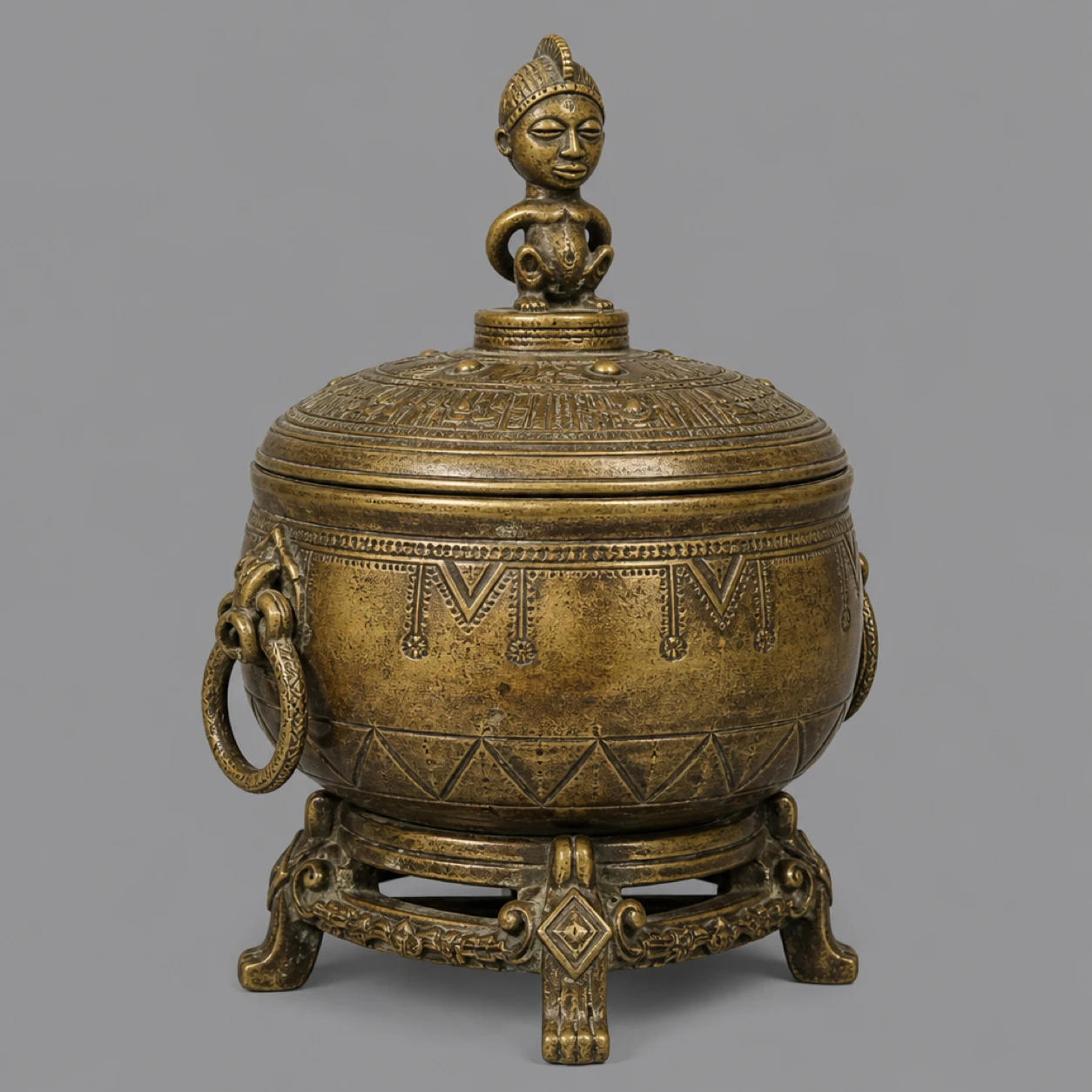
A kuduo reads as locked court wealth and personal soul-care, not as kitchen ware. Give it a lidded brass silhouette, visible latch logic, and either tight geometric bands or a proverbial animal lid depending on period. For a full Akan and wider African court set, see the African Kingdom Relics pack.