Huehuetl: The Aztec Vertical Drum at War and Festival
A huehuetl is a single-headed vertical drum from central Mexico. The player strikes a skin head stretched over a hollow wooden cylinder while the drum stands upright, usually with bare hands rather than sticks. In Aztec ritual music it sat beside the teponaztli, a horizontal slit drum struck with a mallet. Spanish chroniclers and colonial codices show both instruments at festivals, warrior dances, and temple ceremonies where sound marked sacred time.
Huēhuētl, membranophone, and the teponaztli pair
The Nahuatl word huēhuētl names this family of upright drums across Mesoamerica. Scholars class it as a membranophone because the sound comes from a stretched animal skin. The body is a hollow wooden cylinder with a skin head on top. Britannica describes it as a single-headed cylindrical upright drum played with bare hands.
The teponaztli is the usual partner. Where the huehuetl is vertical and hand-played, the teponaztli lies horizontal and is struck with a mallet on two raised tongues that yield two distinct pitches. Britannica treats both as sacred Aztec instruments whose archaeological remains often carry carved glyphs and figurative scenes.
From pre-Columbian courts to Tenochtitlan festivals
Drums of this type were already old when the Mexica built their empire. Britannica notes that Mesoamerican cultures from at least the 8th century to the early 16th century used similar drums, and that court ritual music is the best-documented setting: large ensembles combined drums, flutes, rattles, and trumpets for state ceremonies.
By the Post-Classic period, when Tenochtitlan dominated the Basin of Mexico (from roughly 1428 until the Spanish conquest in 1521), music and dance were part of Aztec education as well as public festival life. A scene in the Florentine Codex, reproduced by World History Encyclopedia, shows Aztec musicians with upright and horizontal drums among other instruments. The image is sixteenth-century testimony to a performance tradition that predated European notation.
Sacred sound at temple rites and warrior gatherings
Aztec writers did not leave musical scores. What survives instead are chronicles, codex pictures, and carved drums that spell out ritual meaning in glyphs. Britannica states that the teponaztli and huehuetl occupied a special position in Aztec rituals and were considered sacred instruments. Their sound accompanied processions, feast days tied to the agricultural calendar, and gatherings of warriors where dance and music framed obligation to the gods.
The pairing matters for how you read a scene. A huehuetl alone suggests festival rhythm or a temple courtyard. Add a teponaztli and you signal the full Mesoamerican percussion battery that Spanish observers described again and again at Mexica celebrations.
Carved shells and what survives
Not every huehuetl looked the same. World History Encyclopedia groups wooden teponaztlis and huehuetls among the richly carved instruments Aztec artists made alongside flutes and rattles. Surfaces could carry warriors, animals, calendar signs, and speech scrolls that tie the object to warfare, sacrifice, or cosmic movement.
Wood and skin decay quickly in the tropics, so complete pre-conquest examples are rare in museum collections. After 1521, colonial chronicles and codex pictures still show indigenous drumming alongside new European instruments. Modern groups still build hand-played upright drums from traditional patterns even when carved Aztec originals are gone.
The Malinalco drum and its jaguar-eagle carvings
One of the most discussed survivors is the Malinalco drum, described in detail by World History Encyclopedia as among the finest carved examples. Its body is covered with dancing jaguars and eagles who represent sacrificial victims, marked by banners and speech scrolls linked to warfare and fire symbols. The iconography turns the drum from a simple noisemaker into a readable argument about battle, captives, and the sun's violent nourishment.
The carving is explicit: predators and prey circle the shell in a choreography that matches how colonial artists drew military orders in the codices. Which exact feast days the drum served, and whether it sounded only for warriors or for wider temple crowds, is less clear from the surviving object alone.
What survives in museums and codices
Complete pre-conquest huehuetls are rare in public collections because temples used them until they wore out. Evidence therefore comes from several channels at once. Archaeological drums with relief carving confirm the sacred status Britannica describes. Codex scenes such as the Florentine musicians fill in performance context. Named masterpieces like the Malinalco drum anchor the typology when a whole wooden body still exists.
Mesoamerican musicians did not write pitch notation, so we cannot reconstruct exact melodies. We know ensemble layout, instrument pairs, and the social settings where drums were required. Any claim about precise tuning or standard rhythms should stay cautious unless tied to a specific excavated example or early colonial text.
In your scene
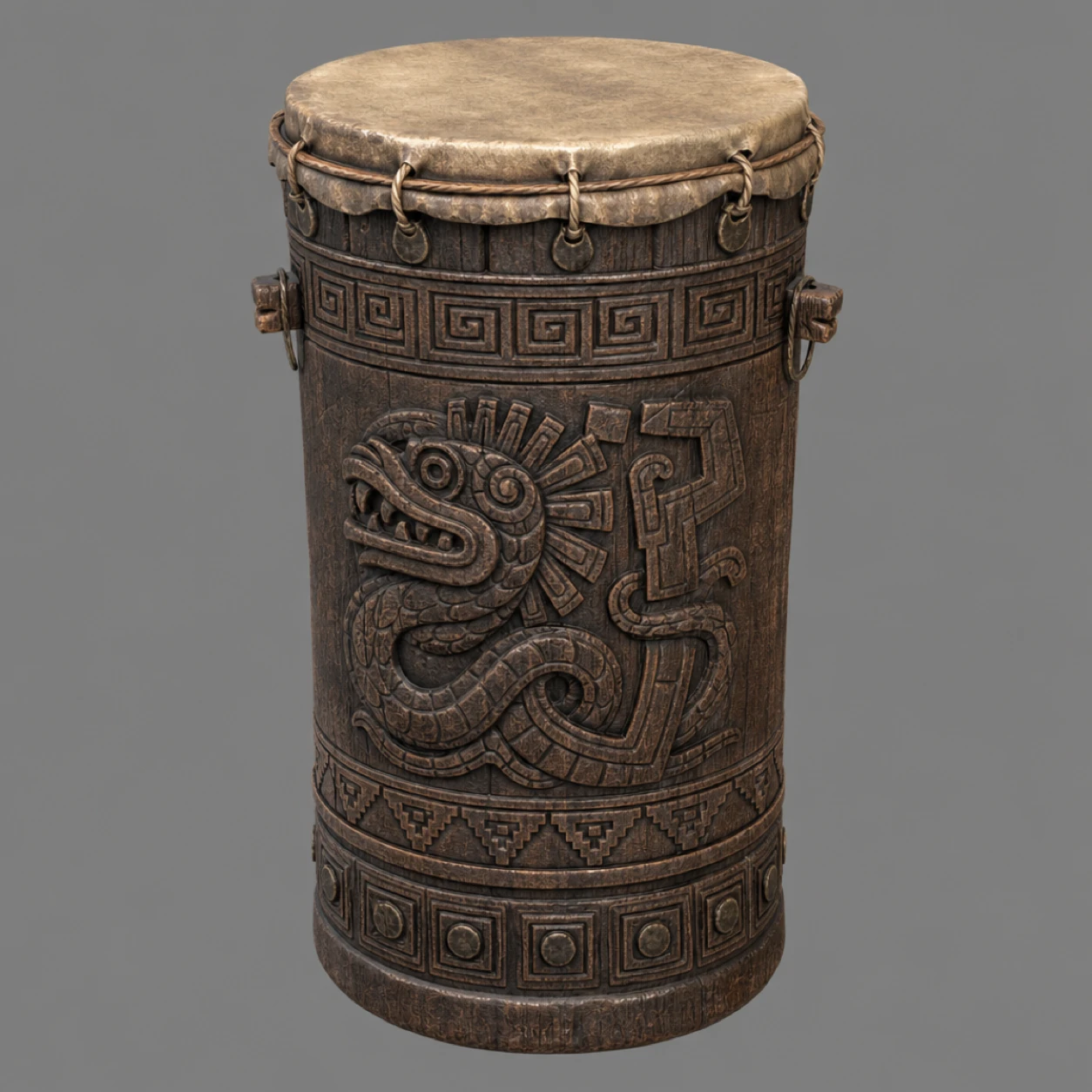
Place a huehuetl where festival sound should feel grounded and ancient: a pyramid courtyard, a warrior lodge, or a torch-lit night rite. Pair it with a teponaztli and conch trumpet from our Aztec Temple Relics pack so the percussion reads as Mesoamerican rather than generic fantasy. Angle the open base toward the camera and let players or NPCs strike the head in cutscenes.