Fibula Brooch: Rome's Pin Before the Button
A fibula is an ancient garment fastener: a pin, a bow or plate, and a catch that grips the cloth. It does the same job as a modern safety pin or brooch, holding a cloak at the shoulder or closing a tunic at the chest. The Latin word fibula also names the leg bone, because its shape reminded Romans of the pin's shaft. Across Italy, Gaul, Britain, and the frontier provinces, fibulae were everyday metalwork from the Iron Age through late antiquity, and their changing shapes now help archaeologists date soil layers when coins are scarce.
Bow, pin, spring, and the catch plate
Most fibulae share one mechanical idea. A pointed pin passes through folded fabric and locks into a foot or catch plate at the far end. Earlier types rely on a coiled bronze spring at the head to tension the pin. Roman workshops later introduced hinges and solid cast bows that could be mass-produced and stamped with maker names. Materials run from plain iron to bronze, silver, and gold; decoration might be incised lines, enamel cells, granulation, or cast figures.
The silhouette varies widely. Simple bow fibulae look like bent wire. Plate fibulae spread a wide decorative surface across the chest. Crossbow and knee fibulae turn up in late Roman graves. Scholars group these forms into typologies (often named after findspots or makers) because the hardware changed faster than written fashion manuals.
From Greek pins to an empire of workshops
Fibulae predate Rome. Etruscan and Greek craftsmen cast and hammered elaborate examples long before the legions marched beyond Italy. As Rome absorbed Mediterranean trade networks in the last centuries BCE, provincial workshops copied and simplified designs for soldiers, settlers, and townspeople who needed reliable dress pins.
World History Encyclopedia's Roman Army overview traces how recruitment widened from Italian citizen militia to provincial legions and auxiliaries stationed from Britain to the Danube. That same expansion moved goods and habits with the troops. Fibula styles that first appear in Gaul or the Rhineland spread along supply roads and turn up in forts, civilian settlements, and cremation graves far from their workshops. The object is small, but its distribution maps Roman presence as clearly as pottery or coins.
Cloaks, belts, and who wore the pin
On campaign a legionary might fasten a wool sagum with a bronze fibula at the shoulder, leaving both hands free for shield and pilum. Officers and civilians wore pins too: matching pairs appear in women's graves, and gilt examples advertised rank at the belt or neck. Unlike buttons sewn to cloth, a fibula could move between garments and be repaired when the spring weakened.
Military kit lists and grave goods rarely spell out "fibula" in every inventory, but excavation reports from frontier sites routinely publish them by typology. A plain hinged bow brooch in a barracks ditch suggests a lost cloak pin; a matched pair in a cremation urn marks dress at burial. The pin was practical first and symbolic second, though fine metalwork still showed status.
Hinges, stamped names, and provincial floods
Roman-period fibulae grow more standardized than many Iron Age ancestors. The Aucissa type in the Metropolitan Museum, dated late first century BCE to mid first century CE, shows the pattern: a flat semicircular bow, a hinge at the head instead of a long spring, and a bronze body about five or six centimetres long. Many field finds carry the stamp AVCISSA above the hinge, probably a workshop signature rather than a single inventor. They are among the commonest Roman brooches on northern European sites.
At the luxury end, the British Museum's Braganza fibula (2001,0501.1) is a Hellenistic gold piece of about 250 to 200 BCE, possibly from Iberia, cast with a warrior, hound, and coiled bow wires. It weighs 111 grams and is far from a legionary's plain pin, but it shows the same long-footed mechanics elite patrons expected.
Other families include trumpet brooches in Britain, knee fibulae on the Rhine, and plate types that echo older Celtic metalwork. Enamel and gilding appear on dress pieces; camp finds are often plain cast bronze. Because forms overlapped and local copies varied, typologists date by stratigraphy and associated pottery, not by stamp alone.
A Boeotian plate fibula in the British Museum
The British Museum holds a spectacular early example that shows how ambitious a fibula could be before Rome's hinge factories. Museum number 1898,1118.1 is a large bronze fibula attributed to the Boeotian Orientalising period, dated circa 680 BCE and said to be from Thebes in Greece. It survives about 20.3 centimetres long, though the plate is broken into fragments and most of the pin is missing.
Both faces carry incised decoration on a wide crescent plate. One side shows a small figure fighting a serpentine creature, identified as Herakles and the Hydra, with fish and birds in the field. On the right, the hind legs of a horse on wheels evoke the Wooden Horse of Troy, with a detached fragment preserving a foreleg. The reverse mixes warriors with round shields, a lion facing a human figure, and a woman holding a cup beside a horse. The piece was cast, hammered, and engraved, not a rough camp pin but a display object for elite dress.
It is not Roman, yet it explains what later Roman plate fibulae inherited: a public surface for myth, status, and metalworking skill. Room 12 displays it among early Greek bronzes, a reminder that the legionary's humble clasp belonged to a long Mediterranean tradition of pinned wool.
What survives in the ground, and how typology dates sites
Fibulae are durable when bronze or iron is not too corroded, so they survive in graves, forts, and town dumps in huge numbers. Archaeologists use type series to bracket dates: an Aucissa hinge brooch in a layer with Augustan pottery narrows that context; a later crossbow form suggests third or fourth century CE use in some regions. Stamps like AVCISSA help trace workshop output but do not replace context, because unsigned copies are common.
Corrosion hides detail, and ploughing breaks springs. A pinless plate in a museum case, like the Boeotian example, may have lost its working hardware long ago. Detectorists and old excavations without full recording still leave gaps. When sources disagree on a type's date range, reports quote broad brackets and note regional lag. That uncertainty belongs in the story: fibulae are dating tools, not calendar labels.
In your scene
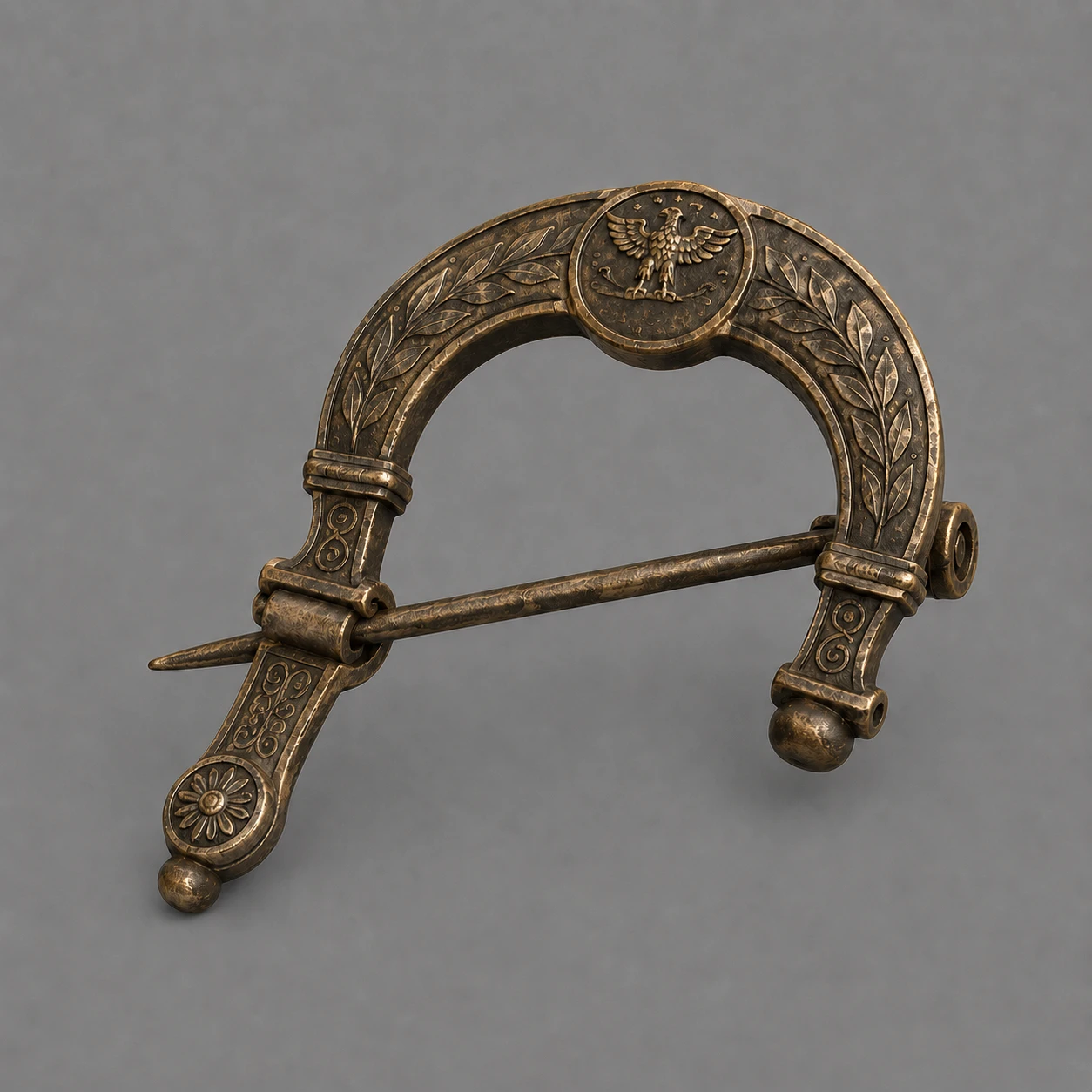
A single fibula on a cloak fold or beside a lorica on a shelf reads as Roman daily life without cluttering a barracks floor. Hinged bow types suit legionary kit; larger plate shapes echo officer or civilian dress. Our Roman Empire Relics pack includes a fibula brooch sized for fort interiors and lararium corners.